Chapter 10
Minerals and Energy Resources
Preview Minerals and Energy Resources for Social Science in JAC 10.
A quick look
Study material preview
Notes
Minerals and Energy Resources – Complete Notes
Class 10 Geography | Contemporary India – II | JAC Board
1. Introduction
Minerals and energy resources are essential for agriculture, industries, transport, construction and daily life.
Many objects we use, such as machines, vehicles, electric wires and household appliances, are made from minerals.
Energy resources provide power for homes, industries, farming and transportation.
2. What Is a Mineral?
A mineral is a naturally occurring, homogeneous substance with a definite chemical composition and an ordered internal structure.
Minerals occur in different forms in the Earth's crust.
Examples: Iron ore, copper, mica, limestone and bauxite.
Important: Minerals are generally formed through geological processes over very long periods, so many mineral resources are non-renewable on a human timescale.
3. Importance of Minerals
- Iron ore is used to produce iron and steel.
- Copper is used in electrical equipment and wires.
- Bauxite is used to produce aluminium.
- Limestone is important for cement production.
- Mica is used in electrical and electronic applications.
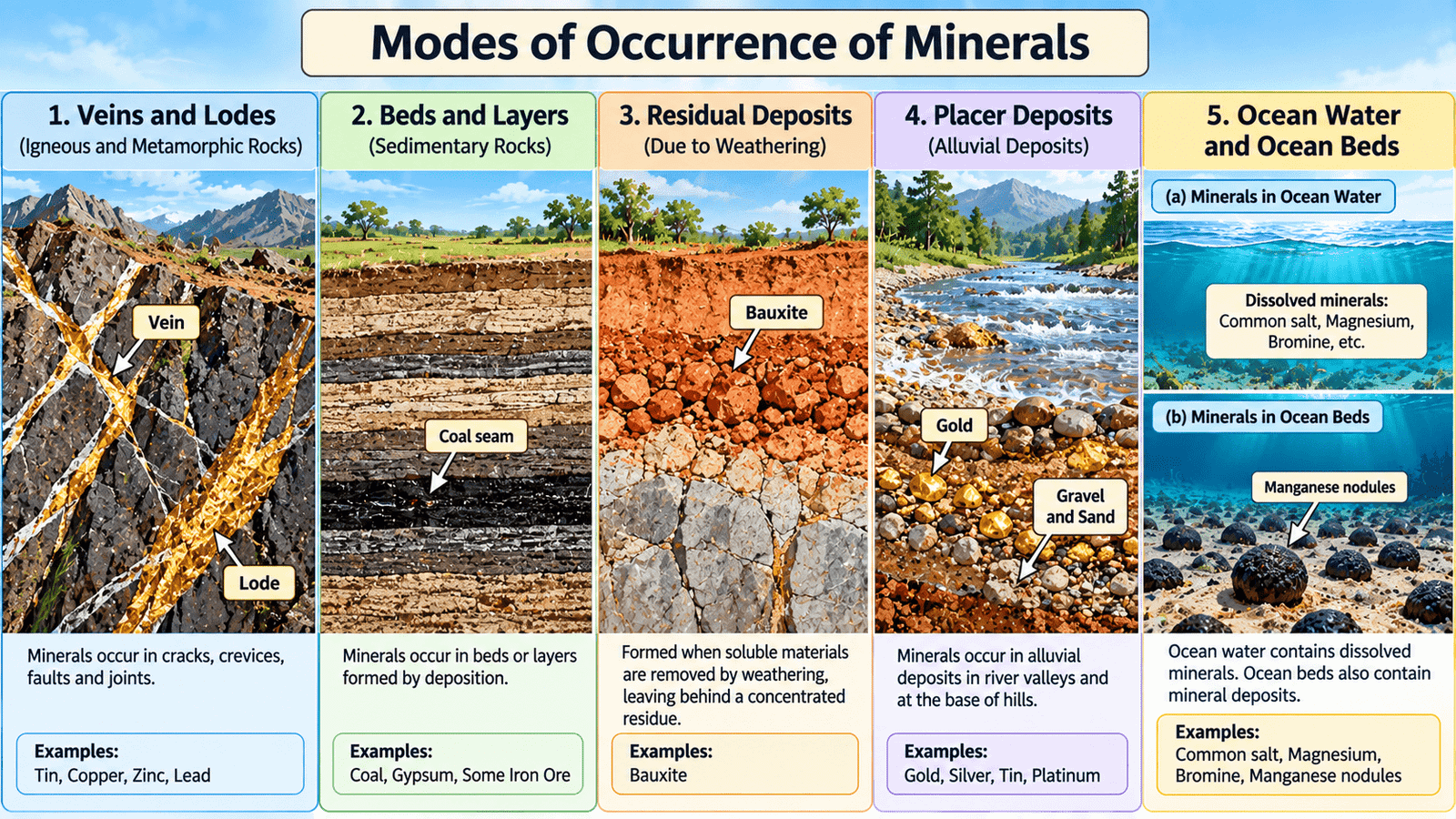
4. Mode of Occurrence of Minerals
Minerals occur in different geological formations.
4.1 Veins and Lodes
In igneous and metamorphic rocks, minerals may occur in cracks, crevices, faults and joints.
Smaller mineral deposits are called veins, while larger deposits are called lodes.
Examples: Tin, copper, zinc and lead.
4.2 Beds and Layers
In sedimentary rocks, minerals may occur in beds or layers formed through deposition and accumulation.
Examples: Coal, some forms of iron ore and gypsum.
4.3 Residual Deposits
Some minerals form when soluble materials are removed from rocks by weathering, leaving behind a concentrated residue.
Example: Bauxite.
4.4 Placer Deposits
Some minerals occur in alluvial deposits in river valleys and at the base of hills.
These deposits are called placer deposits.
Examples: Gold, silver, tin and platinum.
4.5 Ocean Water and Ocean Beds
Ocean water contains dissolved minerals such as common salt, magnesium and bromine.
Ocean beds also contain mineral deposits such as manganese nodules.
5. Classification of Minerals
Minerals are broadly classified into metallic and non-metallic minerals.
5.1 Metallic Minerals
Metallic minerals contain metals and are used in industrial production.
- Ferrous Minerals: Contain iron, such as iron ore and manganese.
- Non-ferrous Minerals: Do not contain iron as the main metal, such as copper and bauxite.
Keep preparing
Available in the app
- Complete NotesConfirmed for this chapter
- Important QuestionsConfirmed for this chapter
- Previous Year QuestionsConfirmed for this chapter
- Revision NotesConfirmed for this chapter