Chapter 9
Light – Reflection and Refraction
Preview Light – Reflection and Refraction for Science in JAC 10.
A quick look
Study material preview
Notes
Chapter 9: Light – Reflection and Refraction
1. Introduction to Light
Imagine entering a dark room. Even if a book is placed in front of you, you cannot see it clearly. When you switch on the light, the book becomes visible.
This happens because light reflected by the book reaches your eyes.
Light: Light is a form of electromagnetic radiation that produces the sensation of vision when it enters our eyes.
The branch of physics that studies light and its behaviour is called optics.
Important Properties of Light
- Light is a form of electromagnetic radiation.
- It can travel through a vacuum.
- In a uniform transparent medium, light travels approximately in straight lines.
- Light can undergo reflection and refraction.
- The speed of light in vacuum is approximately 3 × 10^8 m/s.
- Light carries energy.
2. Types of Light
Light is commonly discussed in two categories:
- Visible light: Electromagnetic radiation that can be detected by the human eye, approximately 380–750 nm in wavelength.
- Invisible electromagnetic radiation: Radiation outside the visible range, such as ultraviolet and infrared radiation.
The visible spectrum is commonly represented as violet, indigo, blue, green, yellow, orange and red (VIBGYOR).
Different visible colours correspond to different ranges of wavelength.
3. Reflection of Light
Have you ever seen your face in a mirror? This happens because light from your face strikes the mirror and returns towards your eyes.
Reflection: The bouncing back of light into the same medium after striking a surface is called reflection of light.
Important Terms
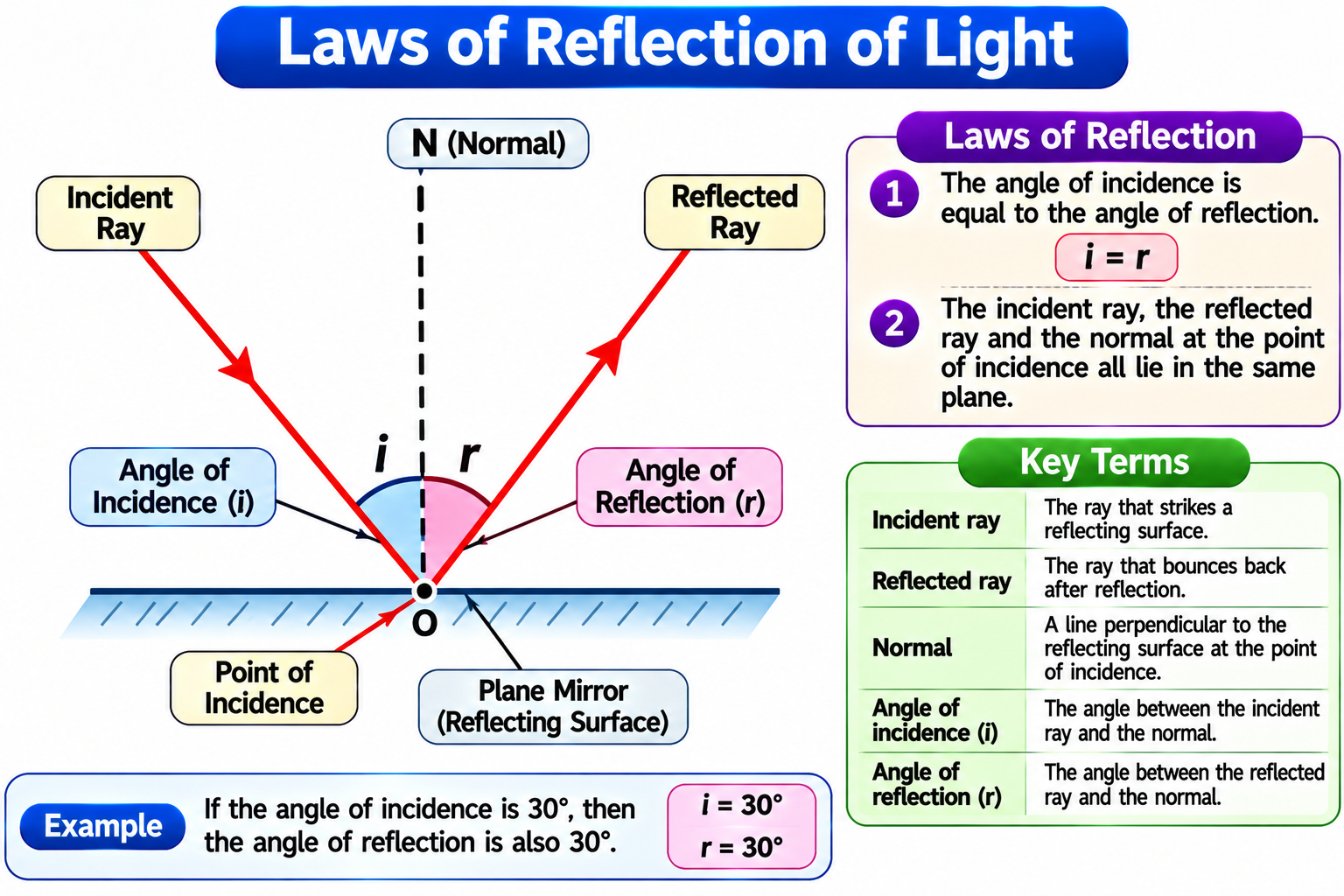
- Incident ray: The ray that strikes a surface.
- Reflected ray: The ray that returns after reflection.
- Point of incidence: The point where the incident ray meets the surface.
- Normal: A line perpendicular to the reflecting surface at the point of incidence.
- Angle of incidence (i): The angle between the incident ray and the normal.
- Angle of reflection (r): The angle between the reflected ray and the normal.
3.1 Laws of Reflection
Reflection of light follows two laws:
- The angle of incidence is equal to the angle of reflection.
- The incident ray, reflected ray and normal at the point of incidence all lie in the same plane.
Keep preparing
Available in the app
- Complete NotesConfirmed for this chapter
- Important QuestionsConfirmed for this chapter
- Previous Year QuestionsConfirmed for this chapter
- Revision NotesConfirmed for this chapter