Chapter 12
Magnetic Effects of Electric Current
Preview Magnetic Effects of Electric Current for Science in JAC 10.
A quick look
Study material preview
Notes
Chapter 12: Magnetic Effects of Electric Current
1. Introduction
Have you ever noticed that a compass needle moves when it is brought near a wire carrying electric current? This simple observation tells us something important: electricity and magnetism are connected.
When electric current passes through a conductor, a magnetic field develops around it. This phenomenon is known as the magnetic effect of electric current.
In this chapter, we will learn how magnetic fields are represented, how current produces magnetism, how magnetic fields exert forces, and how electrical circuits are used safely in our homes.
2. Magnets and Magnetic Poles
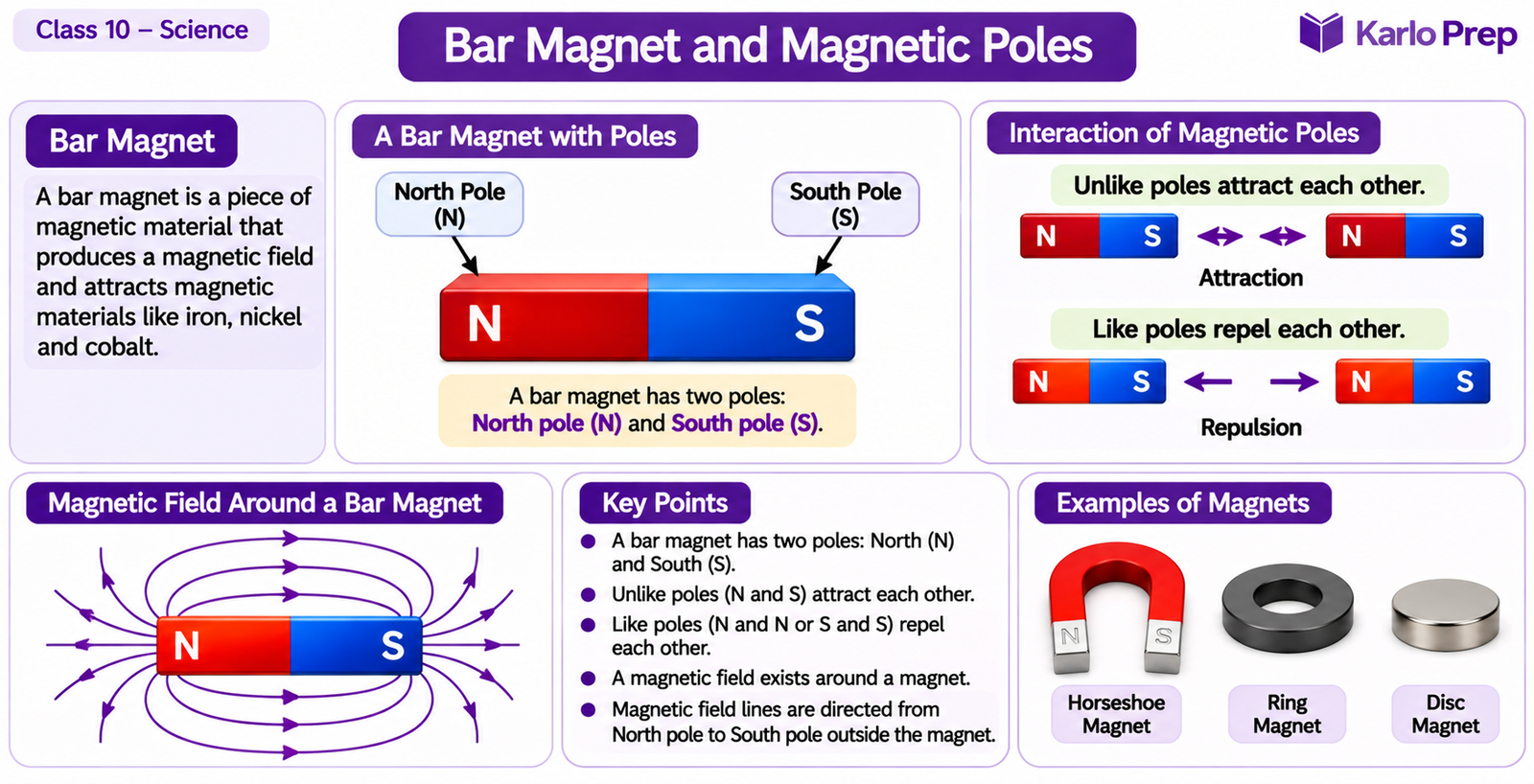
A magnet is a material or object that produces a magnetic field and attracts certain magnetic materials, such as iron, nickel and cobalt.
A bar magnet has two poles:
- North pole (N)
- South pole (S)
Like poles repel each other, whereas unlike poles attract each other.
For example, bringing two north poles close together produces repulsion, but bringing a north pole near a south pole produces attraction.
3. Magnetic Field
A magnetic field is the region around a magnet or current-carrying conductor in which magnetic effects or forces can be experienced.
It is represented by the symbol B.
The SI unit of magnetic field is tesla (T).
A magnetic field has both magnitude and direction. Therefore, it is a vector quantity.
How Can We Detect a Magnetic Field?
A magnetic compass can be used to detect the direction of the local magnetic field. The compass needle turns and aligns itself with the magnetic field.
The north-seeking end of the compass needle indicates the direction of the magnetic field at that point.
4. Magnetic Field Lines
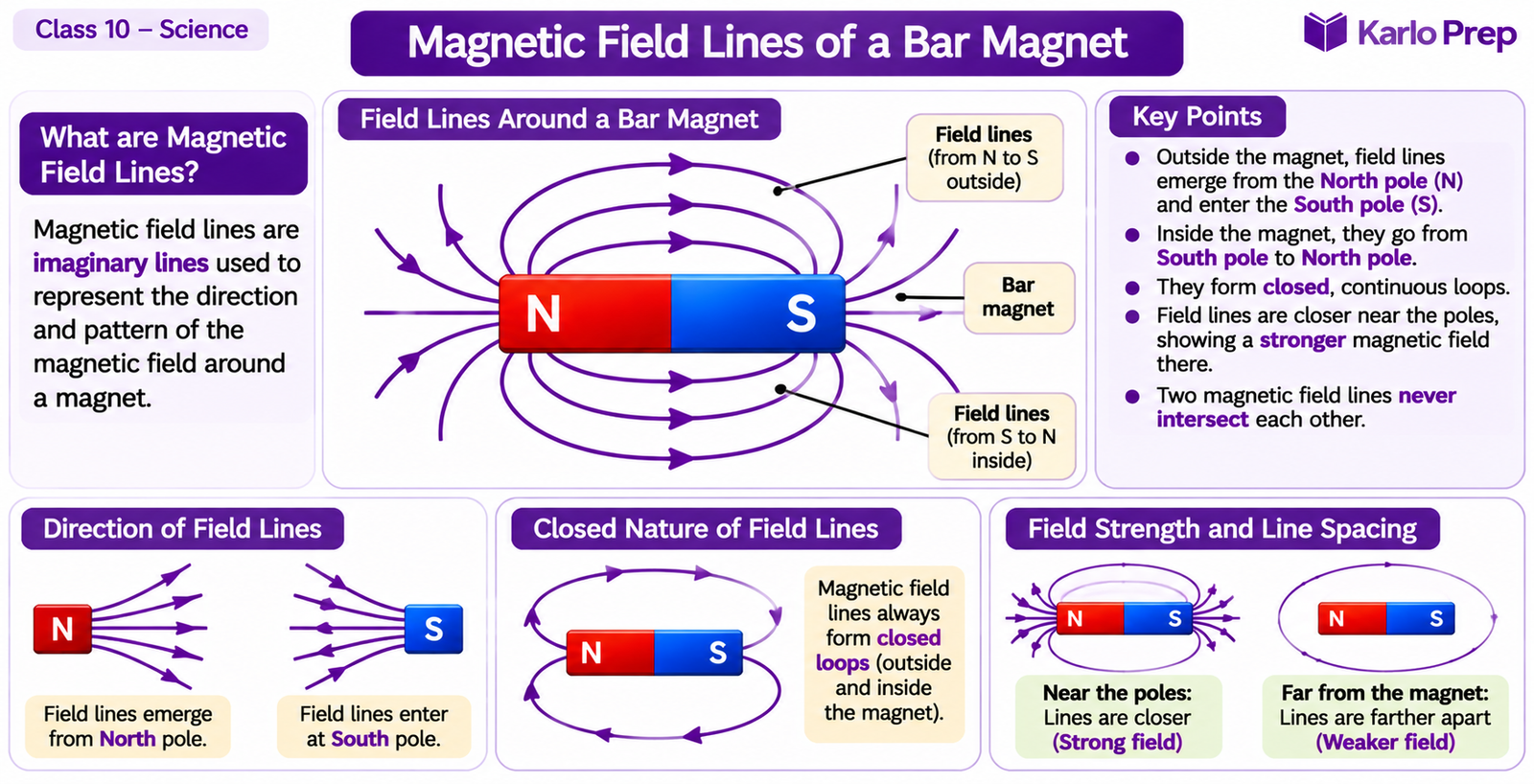
Magnetic field lines are imaginary lines used to represent the direction and pattern of a magnetic field.
The direction of the magnetic field at a point is given by the direction of the tangent to a field line at that point.
Properties of Magnetic Field Lines
- Outside a bar magnet, magnetic field lines emerge from the north pole and enter the south pole.
- Inside the magnet, they continue from the south pole towards the north pole, forming closed loops.
- The direction of a magnetic field line at a point gives the direction of the magnetic field there.
- Field lines are closer together where the magnetic field is stronger.
- Two magnetic field lines never intersect each other.
Keep preparing
Available in the app
- Complete NotesConfirmed for this chapter
- Important QuestionsConfirmed for this chapter
- Previous Year QuestionsConfirmed for this chapter
- Revision NotesConfirmed for this chapter