Chapter 4
The d- and f-Block Elements
Preview The d- and f-Block Elements for Chemistry in JAC 12th (SCI.).
A quick look
Study material preview
Notes
The d- and f-Block Elements
The d- and f-block elements form an important part of inorganic chemistry. The d-block elements are generally known as transition elements, while the f-block elements are known as inner transition elements.
1. d-Block Elements
The elements in which the last electron enters the (n−1)d orbital are called d-block elements.
General electronic configuration:
(n−1)d1–10 ns0–2
The d-block elements are placed between the s-block and p-block elements in the periodic table.
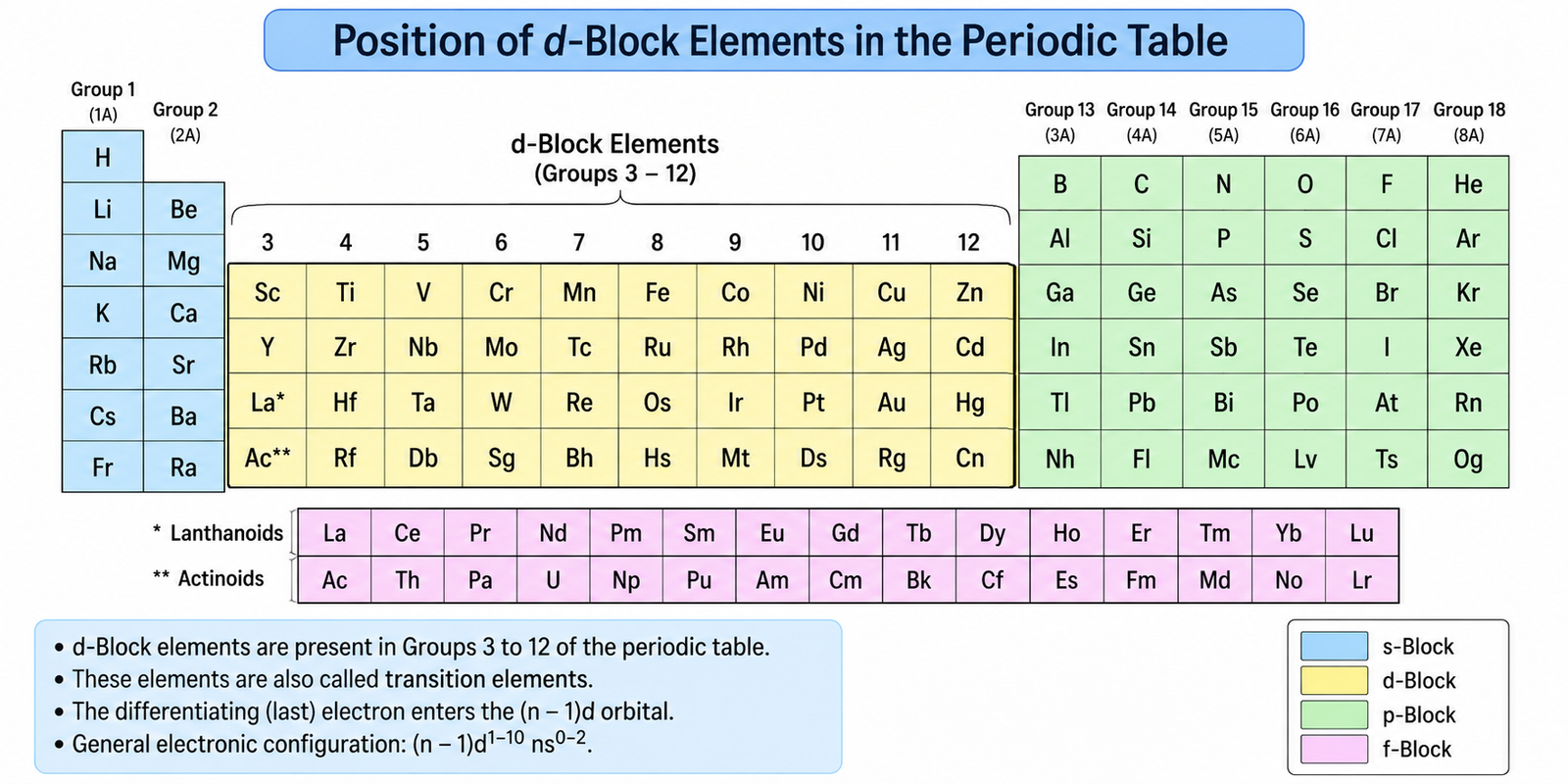
2. Transition Elements
Transition elements are those elements which have partially filled d-orbitals in their atoms or in at least one of their common oxidation states.
Most d-block elements are transition elements. However, Group 12 elements such as Zn, Cd and Hg are generally not considered transition elements because their atoms and common ions have completely filled d-orbitals.
Example:
Zn = [Ar] 3d104s2
Zn2+ = [Ar] 3d10
3. Electronic Configuration of d-Block Elements
The general electronic configuration of d-block elements is:
(n−1)d1–10 ns0–2
First Transition Series (3d Series)
The first transition series extends from scandium (Sc) to zinc (Zn).
- Sc: [Ar] 3d14s2
- Ti: [Ar] 3d24s2
- V: [Ar] 3d34s2
- Cr: [Ar] 3d54s1
- Mn: [Ar] 3d54s2
- Fe: [Ar] 3d64s2
- Co: [Ar] 3d74s2
- Ni: [Ar] 3d84s2
- Cu: [Ar] 3d104s1
- Zn: [Ar] 3d104s2
Chromium and copper show exceptional electronic configurations because half-filled and completely filled d-subshells have extra stability.
4. General Characteristics of Transition Elements
- Metallic character
- High melting points
- High enthalpy of atomisation
- Variable oxidation states
- Formation of coloured ions and compounds
- Catalytic properties
- Formation of interstitial compounds
- Alloy formation
- Magnetic properties
- Complex formation
5. Metallic Character
Transition elements are metals. They are generally hard, malleable and ductile and possess good thermal and electrical conductivity.
The metallic character is associated with strong metallic bonding involving the valence electrons.
Greater participation of unpaired electrons generally results in stronger metallic bonding.
6. Melting Points
Transition metals generally have high melting points because of strong metallic bonding.
The strength of metallic bonding depends upon the number of electrons available for bonding.
In the first transition series, melting points generally rise towards the middle of the series and then decrease.
Keep preparing
Available in the app
- Complete NotesConfirmed for this chapter
- Important QuestionsConfirmed for this chapter
- Previous Year QuestionsConfirmed for this chapter
- Revision NotesConfirmed for this chapter
- Practice TestsConfirmed for this chapter