Chapter 9
Biotechnology: Principles and Processes
Preview Biotechnology: Principles and Processes for Biology in JAC 12th (SCI.).
A quick look
Study material preview
Notes
1. Biotechnology
Biotechnology deals with the techniques of using living organisms or enzymes from organisms to produce products and processes useful to humans.
- The term Biotechnology was given by Karl Ereky in 1919.
- According to the European Federation of Biotechnology (EFB), biotechnology is the integration of natural science and organisms, cells, parts thereof and molecular analogues for products and services.
2. Principles of Biotechnology
The two core techniques that enabled the development of modern biotechnology are:
- Genetic Engineering
- Maintenance of Sterile Conditions
2.1 Genetic Engineering
Genetic engineering involves modification of the genetic material, i.e. DNA/RNA, and its introduction into another organism to change the phenotype or characteristics of the host.
2.2 Maintenance of Sterile Conditions
Sterile conditions are maintained to allow the growth of only the desired microorganisms or cells in large quantities for the manufacture of biotechnology products such as antibiotics, vaccines and enzymes.
3. Basic Steps in Genetic Engineering
- Identification of DNA with the desirable gene.
- Introduction of the identified DNA into the host to form recombinant DNA (rDNA).
- Maintenance of introduced DNA in the host and transfer of the DNA to its progeny.
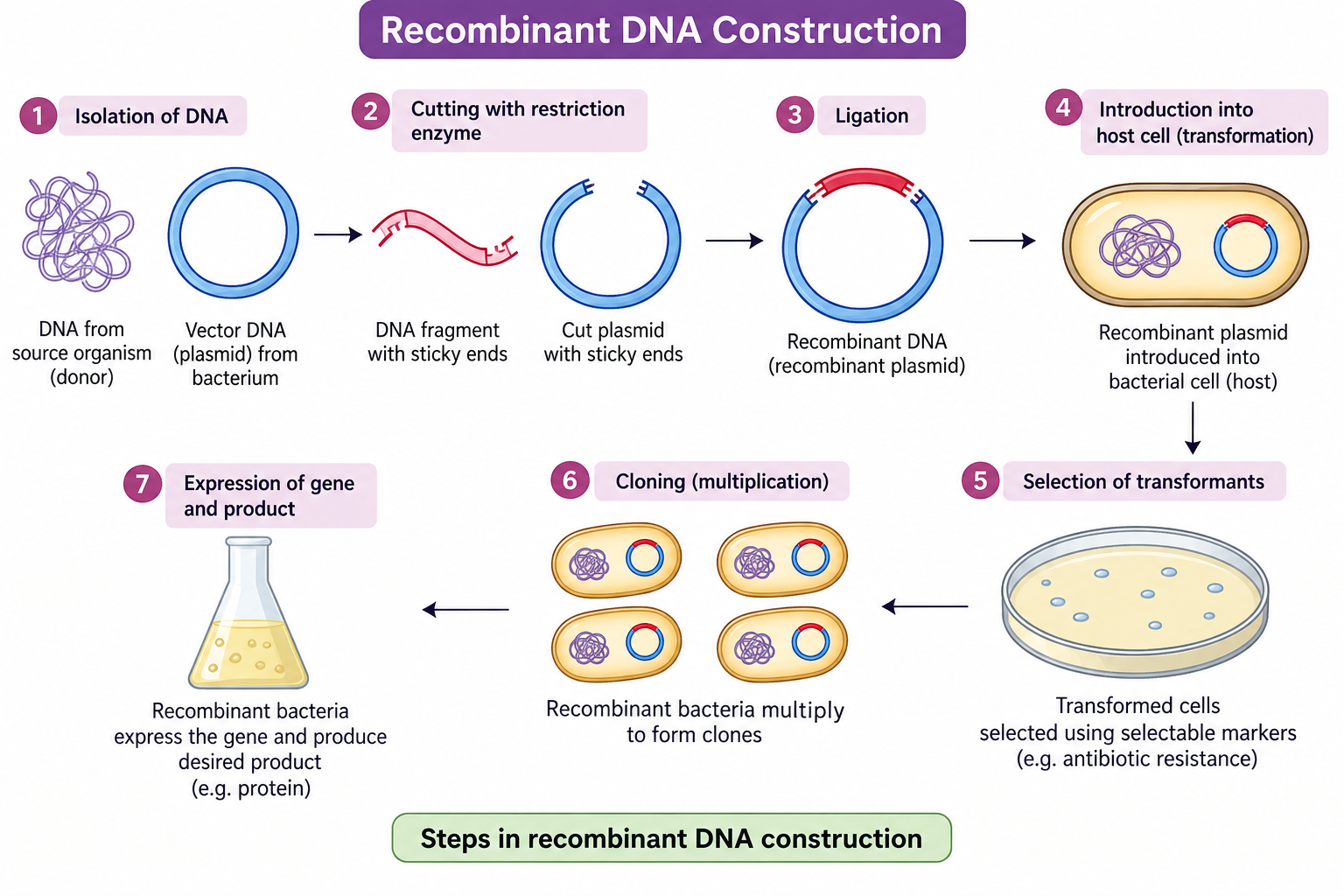
4. Construction of First Recombinant DNA
In 1973, Stanley Cohen and Herbert Boyer constructed the first recombinant DNA.
- A gene encoding antibiotic resistance was isolated from a plasmid.
- The desired DNA was cut at specific locations using restriction enzymes.
- The cut DNA was linked with plasmid DNA.
- This resulted in the formation of recombinant DNA.
5. Tools of Recombinant DNA Technology
The major tools required in recombinant DNA technology are:
- Enzymes
- Cloning vectors
- Competent host
6. Enzymes Used in Recombinant DNA Technology
Important enzymes used in genetic engineering include:
- Restriction enzymes
- DNA ligase
- Alkaline phosphatase
- DNA polymerase
7. Restriction Enzymes
Restriction enzymes are also called molecular scissors because they cut DNA at specific sites.
- They occur naturally in bacteria.
- They form part of a bacterial defence mechanism called the restriction-modification system.
- The first restriction endonuclease, HindII, was isolated by Smith, Wilcox and Kelley in 1968.
- It recognises a specific DNA sequence called the recognition sequence.
8. Naming of Restriction Enzymes
Keep preparing
Available in the app
- Complete NotesConfirmed for this chapter
- Important QuestionsConfirmed for this chapter
- Previous Year QuestionsConfirmed for this chapter
- Revision NotesConfirmed for this chapter