Chapter 5
Molecular Basis of Inheritance
Preview Molecular Basis of Inheritance for Biology in JAC 12th (SCI.).
A quick look
Study material preview
Notes
Chapter 5: Molecular Basis of Inheritance
1. DNA (Deoxyribonucleic Acid)
- DNA stands for Deoxyribonucleic Acid.
- DNA is an acidic substance present in the nucleus.
- It was first identified by Friedrich Miescher in 1869. He called it nuclein.
- DNA is a polynucleotide made up of deoxyribonucleotides.
2. Components of DNA
A DNA nucleotide consists of three components:
- Nitrogenous base – Adenine (A), Guanine (G), Cytosine (C) and Thymine (T)
- Deoxyribose sugar – a pentose sugar
- Phosphate group
The human haploid DNA contains approximately 3.6 × 10⁹ base pairs, while E. coli contains approximately 4.6 × 10⁶ base pairs.
3. Genetic Material
Genetic material is the substance that controls the inheritance of characters from one generation to the next.
Properties of Genetic Material
- It should be able to replicate itself.
- It should be chemically and structurally stable.
- It should provide scope for slow changes required for evolution.
- It should be able to express itself in the form of Mendelian characters.
4. Search for Genetic Material
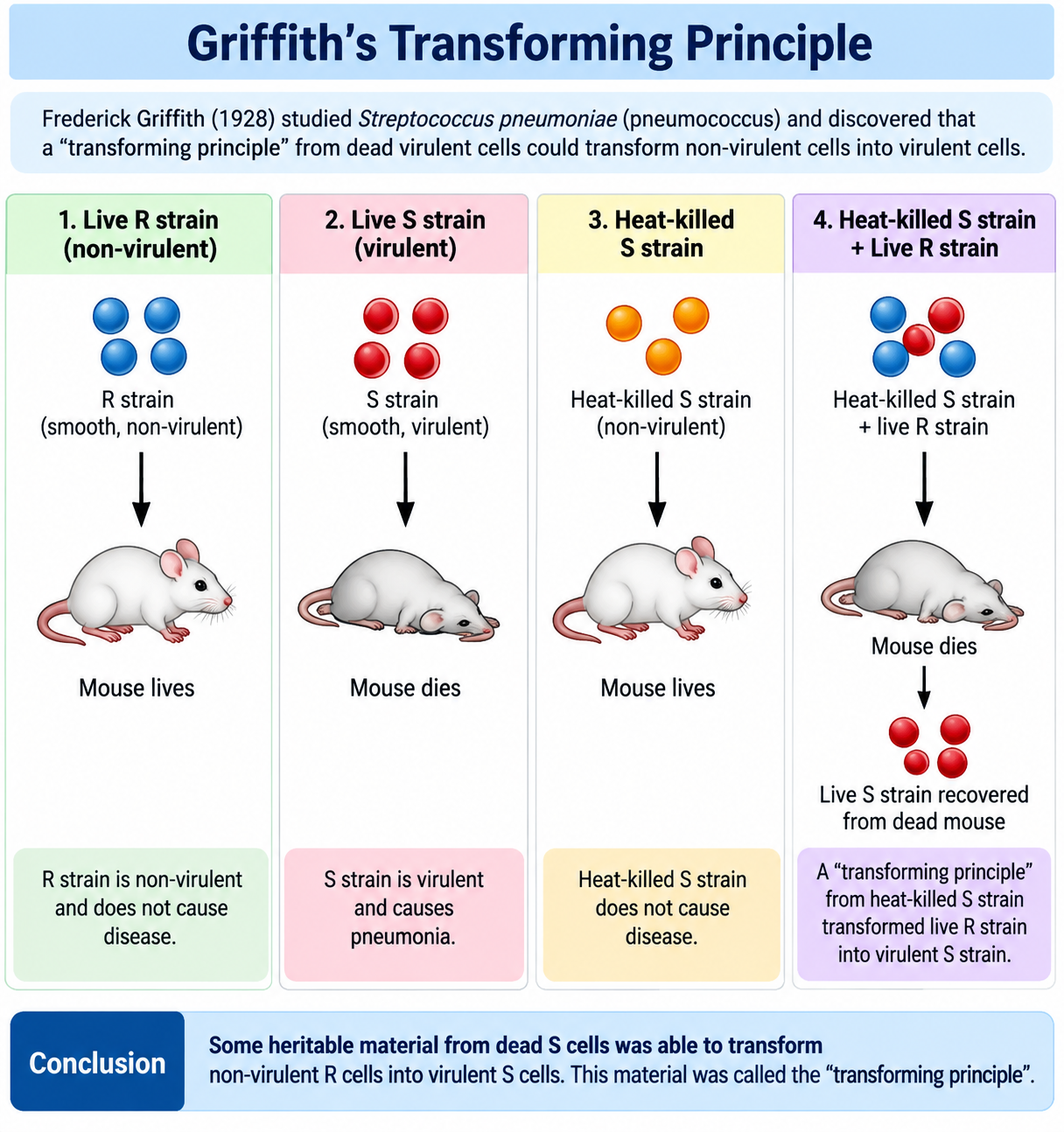
Griffith's Transforming Principle
Frederick Griffith performed an experiment in 1928 using two strains of Streptococcus pneumoniae.
- R-strain: Non-virulent and non-poisonous.
- S-strain: Virulent. Its cell wall contains a polysaccharide coat.
Griffith performed the following experiments:
- Live R-strain injected into mice → mice survived.
- Live S-strain injected into mice → mice died.
- Heat-killed S-strain injected into mice → mice survived.
- Heat-killed S-strain + live R-strain injected into mice → mice died.
Griffith concluded that some substance from the heat-killed S-strain transformed the non-virulent R-strain into the virulent form. He called it the transforming principle.
5. Biochemical Characterisation of Transforming Principle
Oswald Avery, Colin MacLeod and Maclyn McCarty investigated the nature of the transforming principle.
They considered protein, RNA and DNA as possible genetic materials and used:
- Protease to digest protein
- RNase to digest RNA
- DNase to digest DNA
Transformation continued when protein or RNA was destroyed, but it did not occur when DNA was destroyed.
Conclusion: DNA is the hereditary material responsible for transformation.
6. Hershey and Chase Experiment
Hershey and Chase performed experiments using T2 bacteriophages.
DNA contains phosphorus but not sulphur, whereas proteins contain sulphur. Therefore:
- DNA was labelled using radioactive phosphorus (32P).
- Protein was labelled using radioactive sulphur (35S).
Keep preparing
Available in the app
- Complete NotesConfirmed for this chapter
- Important QuestionsConfirmed for this chapter
- Previous Year QuestionsConfirmed for this chapter
- Revision NotesConfirmed for this chapter
- Practice TestsConfirmed for this chapter