Chapter 7
Alcohols, Phenols and Ethers
Preview Alcohols, Phenols and Ethers for Chemistry in JAC 12th (SCI.).
A quick look
Study material preview
Notes
Chapter 7 – Alcohols, Phenols and Ethers
1. Hydroxy Derivatives
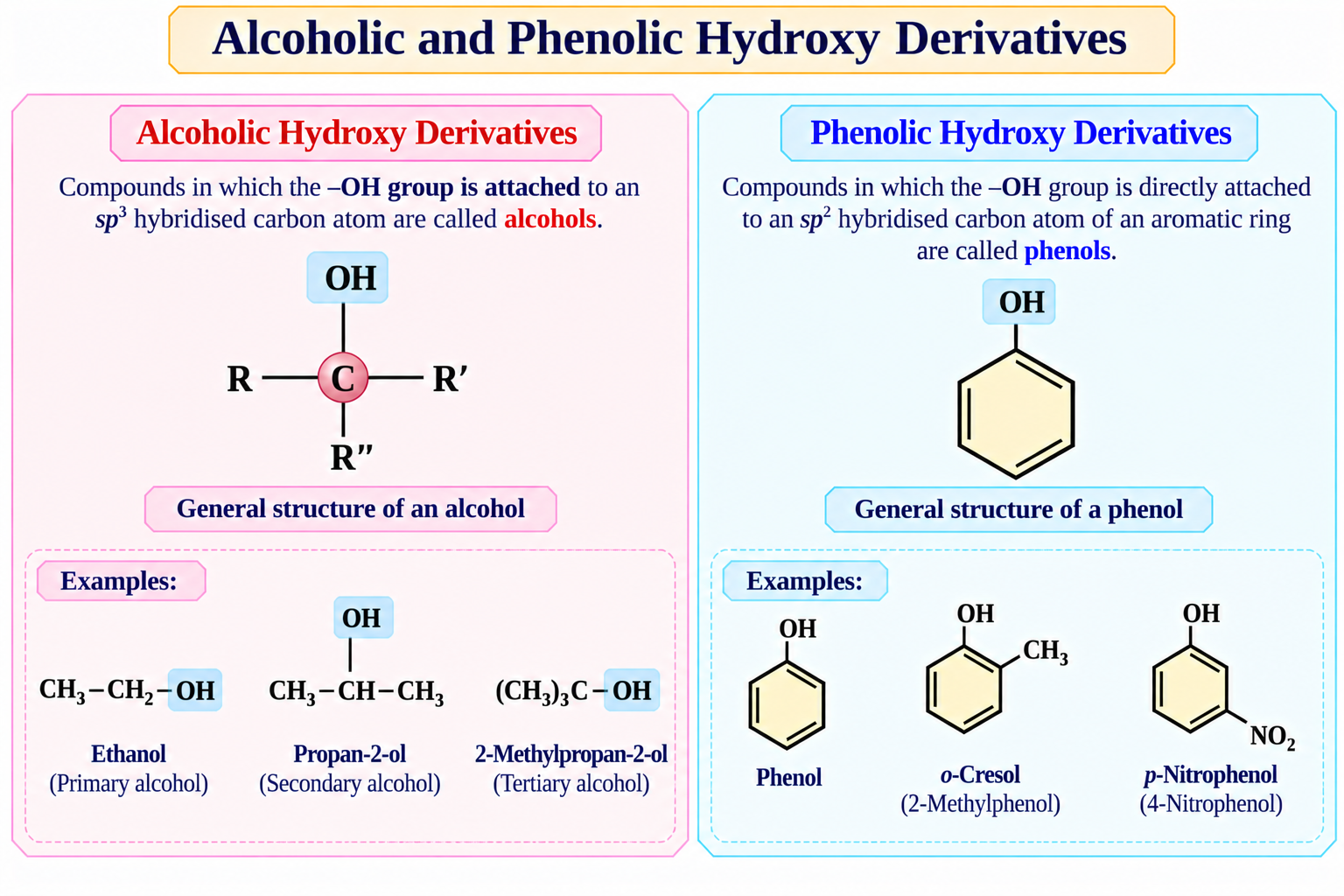
Compounds containing a hydroxyl group (–OH) are called hydroxy derivatives.
On the basis of the carbon atom to which the –OH group is attached, they can be broadly classified as:
- Alcoholic: –OH group is attached to an sp³ hybridised carbon atom.
- Phenolic: –OH group is directly attached to an sp² hybridised carbon atom of an aromatic ring.
2. Classification of Alcohols
On the Basis of Number of –OH Groups
- Monohydric alcohol: Contains one –OH group.
- Dihydric alcohol: Contains two –OH groups.
- Trihydric alcohol: Contains three –OH groups.
- Tetrahydric alcohol: Contains four –OH groups.
Examples:
Monohydric: R–OH
Dihydric: HO–CH₂–CH₂–OH
Trihydric: HO–CH₂–CH(OH)–CH₂–OH
Primary, Secondary and Tertiary Alcohols
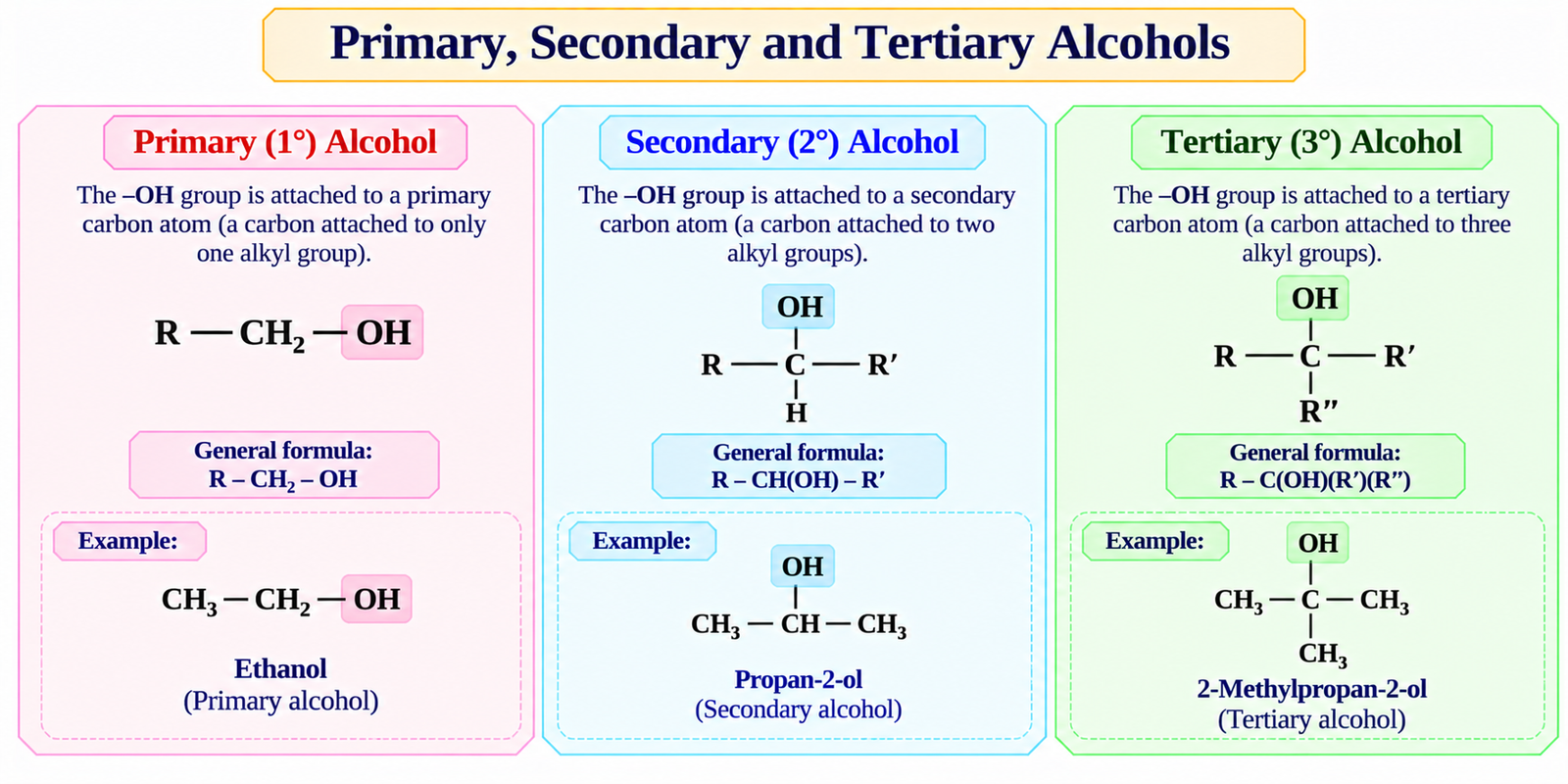
Monohydric alcohols can further be classified according to the nature of the carbon atom carrying the –OH group.
Primary (1°) alcohol:
R–CH₂–OH
Secondary (2°) alcohol:
R–CH(OH)–R'
Tertiary (3°) alcohol:
R–C(OH)(R')(R'')
3. Nomenclature of Alcohols
In IUPAC nomenclature, alcohols are named by replacing the terminal 'e' of the corresponding alkane with the suffix –ol.
The position of the –OH group is indicated by a number.
Example:
CH₃OH → Methanol
CH₃CH₂OH → Ethanol
When –OH is not the principal functional group, the prefix hydroxy– is used.
4. General Methods of Preparation of Alcohols
4.1 From Alkyl Halides
Alkyl halides react with aqueous KOH to give alcohols.
R–X + KOH(aq) → R–OH + KX
Example:
CH₃CH₂Cl + KOH(aq) → CH₃CH₂OH + KCl
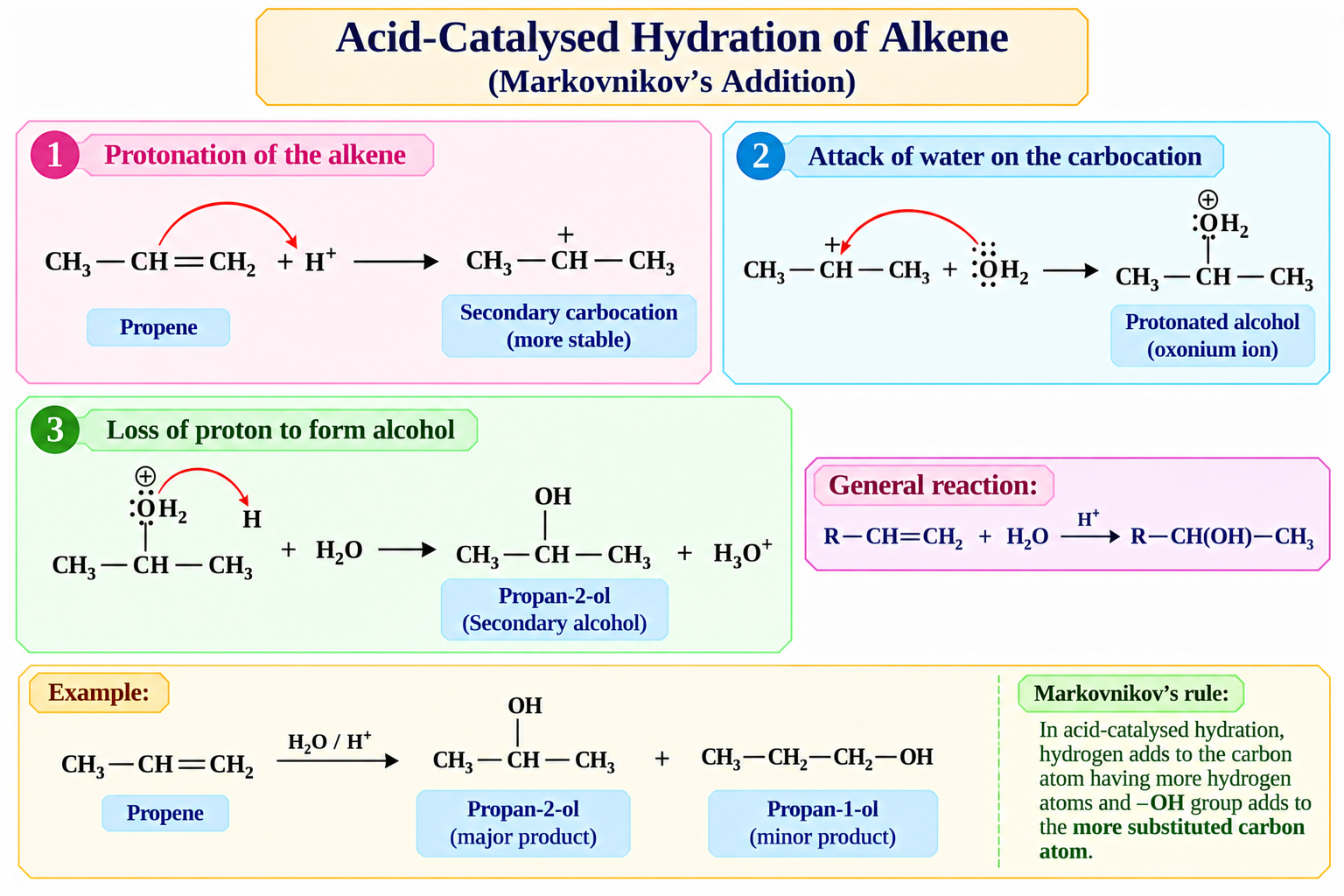
4.2 From Alkenes – Acid-Catalysed Hydration
Alkenes react with water in the presence of an acid to form alcohols.
Reagent: H₂O/H⁺ or H₃O⁺
The reaction follows Markovnikov's rule.
The reaction proceeds through a carbocation intermediate.
General steps:
- Protonation of the alkene.
- Formation of carbocation.
- Attack of water on the carbocation.
- Loss of proton to form alcohol.
4.3 Hydroboration–Oxidation
Alkenes undergo hydroboration followed by oxidation to form alcohols.
Reagents:
1. BH₃ or B₂H₆ / THF
2. H₂O₂ / OH⁻
This reaction follows anti-Markovnikov addition.
For example:
R–CH=CH₂ → R–CH₂–CH₂OH
Keep preparing
Available in the app
- Complete NotesConfirmed for this chapter
- Important QuestionsConfirmed for this chapter
- Previous Year QuestionsConfirmed for this chapter
- Revision NotesConfirmed for this chapter