Chapter 10
Biomolecules
Preview Biomolecules for Chemistry in JAC 12th (SCI.).
A quick look
Study material preview
Notes
Biomolecules
Biomolecules are organic compounds present in living organisms. Important biomolecules include carbohydrates, proteins, vitamins and nucleic acids.
1. Carbohydrates
Carbohydrates are commonly defined as polyhydroxy aldehydes or ketones, or compounds which produce such units on hydrolysis.
They generally contain carbon, hydrogen and oxygen.
The general formula of many carbohydrates can be represented as:
Cx(H2O)y
However, all compounds having this formula are not carbohydrates and all carbohydrates do not strictly follow this formula.
2. Classification of Carbohydrates
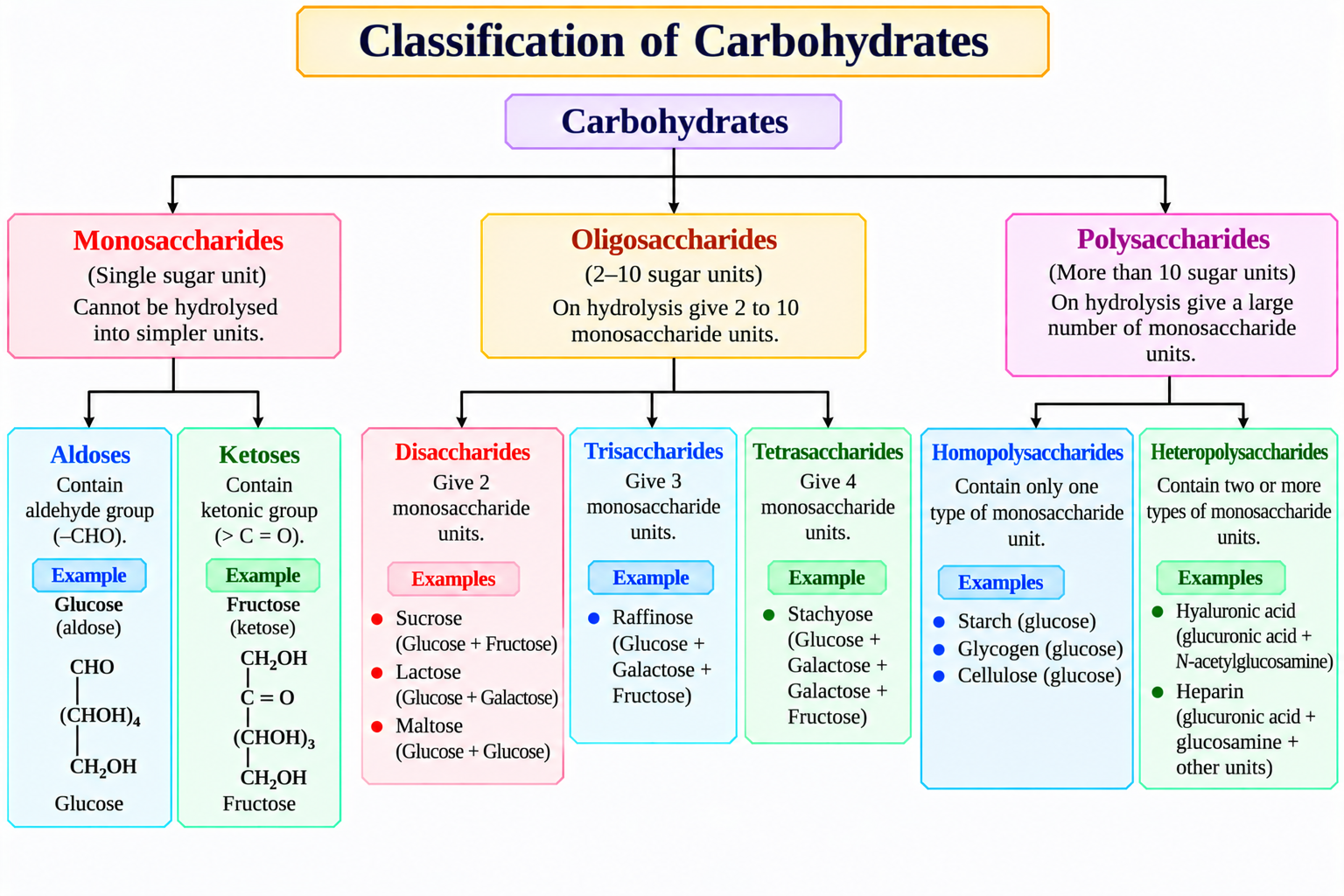
Carbohydrates can be classified on the basis of their behaviour on hydrolysis.
2.1 Monosaccharides
Carbohydrates which cannot be hydrolysed into simpler carbohydrate units are called monosaccharides.
Examples: Glucose and fructose.
2.2 Oligosaccharides
Carbohydrates which on hydrolysis give two to ten monosaccharide units are called oligosaccharides.
Depending upon the number of monosaccharide units, they may be called disaccharides, trisaccharides, etc.
Examples of disaccharides include:
- Sucrose
- Maltose
- Lactose
2.3 Polysaccharides
Carbohydrates which on hydrolysis give a large number of monosaccharide units are called polysaccharides.
Examples:
- Starch
- Cellulose
- Glycogen
3. Classification of Monosaccharides
Monosaccharides are classified on the basis of:
- The functional group present.
- The number of carbon atoms present.
On the Basis of Functional Group
Aldoses: Monosaccharides containing an aldehyde group.
Ketoses: Monosaccharides containing a ketone group.
On the Basis of Number of Carbon Atoms
- 3 carbon atoms → Triose
- 4 carbon atoms → Tetrose
- 5 carbon atoms → Pentose
- 6 carbon atoms → Hexose
Thus, glucose is an aldohexose while fructose is a ketohexose.
4. Glucose
Glucose is one of the most important monosaccharides.
Its molecular formula is:
C6H12O6
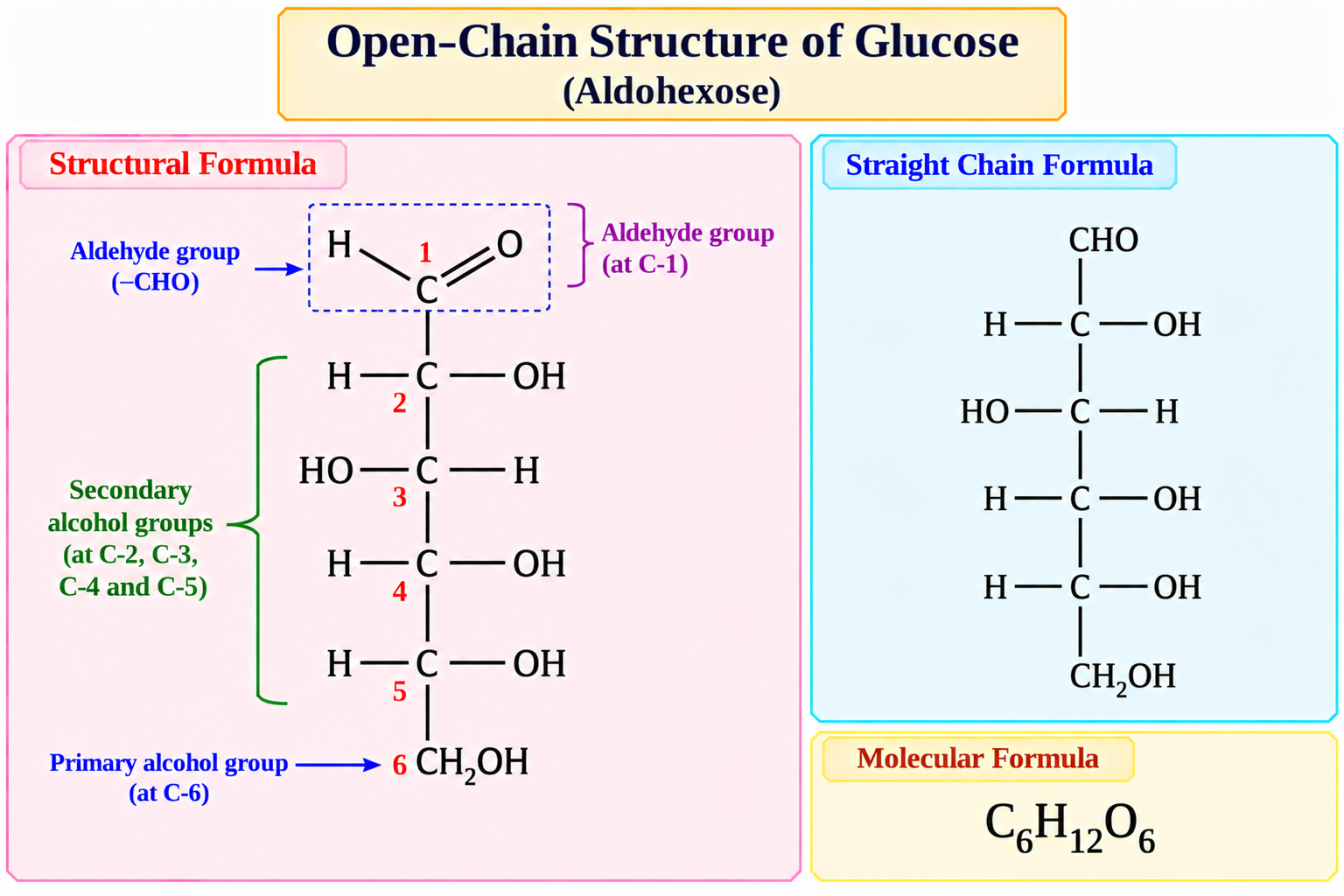
Glucose is an aldohexose because it contains six carbon atoms and an aldehyde group in its open-chain form.
4.1 Open-Chain Structure of Glucose
The open-chain structure of glucose contains:
- One aldehyde group (–CHO).
- Five hydroxyl groups (–OH).
- A six-carbon chain.
4.2 Reactions Supporting the Structure of Glucose
1. Reaction with Hydroxylamine:
Glucose reacts with hydroxylamine to form an oxime, showing the presence of a carbonyl group.
2. Reaction with Hydrogen Cyanide:
Glucose reacts with HCN to form a cyanohydrin, indicating the presence of a carbonyl group.
3. Oxidation:
Glucose is oxidised by bromine water to form gluconic acid. This indicates the presence of an aldehyde group.
Keep preparing
Available in the app
- Complete NotesConfirmed for this chapter
- Important QuestionsConfirmed for this chapter
- Previous Year QuestionsConfirmed for this chapter
- Revision NotesConfirmed for this chapter