Chapter 6
Haloalkanes and Haloarenes
Preview Haloalkanes and Haloarenes for Chemistry in JAC 12th (SCI.).
A quick look
Study material preview
Notes
Haloalkanes and Haloarenes
Haloalkanes and haloarenes are organic compounds containing one or more halogen atoms. The halogen atom may be fluorine (F), chlorine (Cl), bromine (Br) or iodine (I).
1. Classification of Halo Compounds
1.1 On the Basis of Number of Halogen Atoms
(a) Monohalogen compounds: Compounds containing one halogen atom.
Example: CH₃Cl
(b) Dihalogen compounds: Compounds containing two halogen atoms.
Example: CH₂Cl₂
(c) Trihalogen compounds: Compounds containing three halogen atoms.
Example: CHCl₃
1.2 On the Basis of Carbon to which Halogen is Attached
(a) Alkyl halides or Haloalkanes: The halogen atom is attached to an sp³ hybridised carbon atom of an alkyl group.
General representation: R–X
(b) Allylic halides: The halogen atom is bonded to an sp³ hybridised carbon atom next to a carbon-carbon double bond.
Example: CH₂=CH–CH₂–X
(c) Benzylic halides: The halogen atom is bonded to an sp³ hybridised carbon atom next to an aromatic ring.
Example: C₆H₅–CH₂–X
(d) Vinylic halides: The halogen atom is directly bonded to an sp² hybridised carbon atom of a carbon-carbon double bond.
Example: CH₂=CH–X
(e) Aryl halides or Haloarenes: The halogen atom is directly attached to an sp² hybridised carbon atom of an aromatic ring.
Example: C₆H₅–X
2. Nomenclature of Haloalkanes and Haloarenes
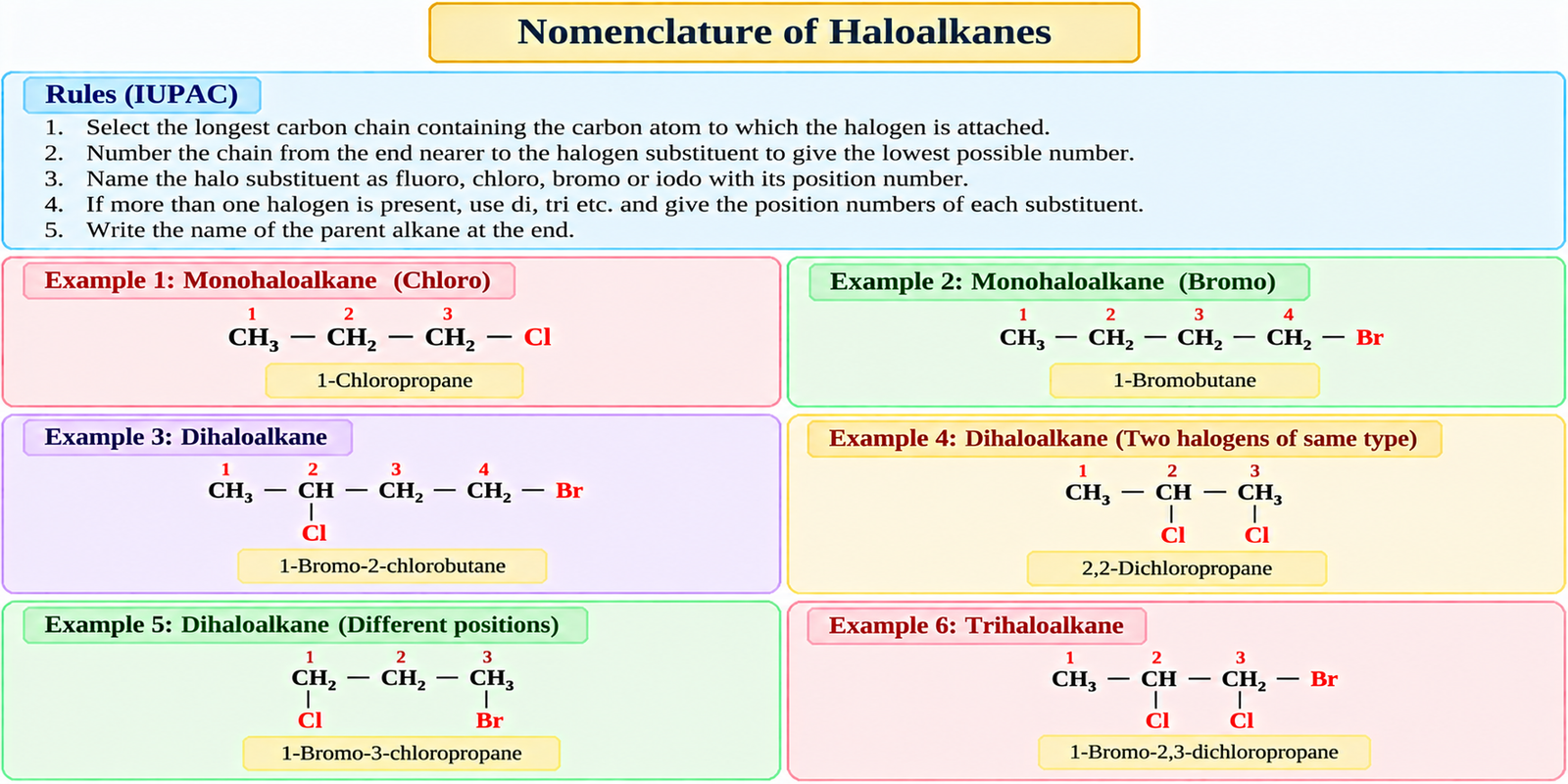
In IUPAC nomenclature, halogens are treated as substituents and are represented by the prefixes:
- F → Fluoro
- Cl → Chloro
- Br → Bromo
- I → Iodo
The longest carbon chain is selected as the parent chain and numbered in such a way that the substituents get the lowest possible locants.
Examples include:
- CH₃Cl → Chloromethane
- CH₃CH₂Br → Bromoethane
- CH₃CH₂CH₂Cl → 1-Chloropropane
- CH₃CHClCH₃ → 2-Chloropropane
- C₆H₅Cl → Chlorobenzene
- C₆H₅Br → Bromobenzene
When more than one halogen atom is present, prefixes such as di-, tri- and tetra- are used.
3. Nature of C–X Bond
Halogen atoms are more electronegative than carbon. Therefore, the carbon-halogen bond is polar.
Cδ+ – Xδ−
The carbon atom acquires a partial positive charge and the halogen atom acquires a partial negative charge.
Keep preparing
Available in the app
- Complete NotesConfirmed for this chapter
- Important QuestionsConfirmed for this chapter
- Previous Year QuestionsConfirmed for this chapter
- Revision NotesConfirmed for this chapter