Chapter 1
Electric Charges and Fields
Preview Electric Charges and Fields for Physics in JAC 12th (SCI.).
A quick look
Study material preview
Notes
Chapter 1: Electric Charges and Fields
Electrostatics is the branch of physics which deals with electric charges at rest.
1. Electric Charge
Electric charge is a fundamental property of matter which gives rise to electric force.
- Electric charge is denoted by q or Q.
- SI unit of charge is coulomb (C).
- Charge is a scalar quantity.
- CGS unit of charge is statcoulomb (statC).
- The derived SI unit of charge is ampere-second (A s).
Dimensional formula:
[Q] = [AT]
Conversion:
1 C = 3 × 10⁹ statC
Elementary Charge
The magnitude of the elementary charge is:
e = 1.6 × 10⁻¹⁹ C
- Charge on an electron = −1.6 × 10⁻¹⁹ C
- Charge on a proton = +1.6 × 10⁻¹⁹ C
- Charge on a neutron = 0
An atom is electrically neutral because it contains equal amounts of positive and negative charge.
2. Quarks
Quarks are particles having fractional electric charge. They are constituents of particles such as protons and neutrons.
- Up quark (u) = +2e/3
- Charm quark (c) = +2e/3
- Top quark (t) = +2e/3
- Down quark (d) = −e/3
- Strange quark (s) = −e/3
- Bottom quark (b) = −e/3
3. Frictional Electricity
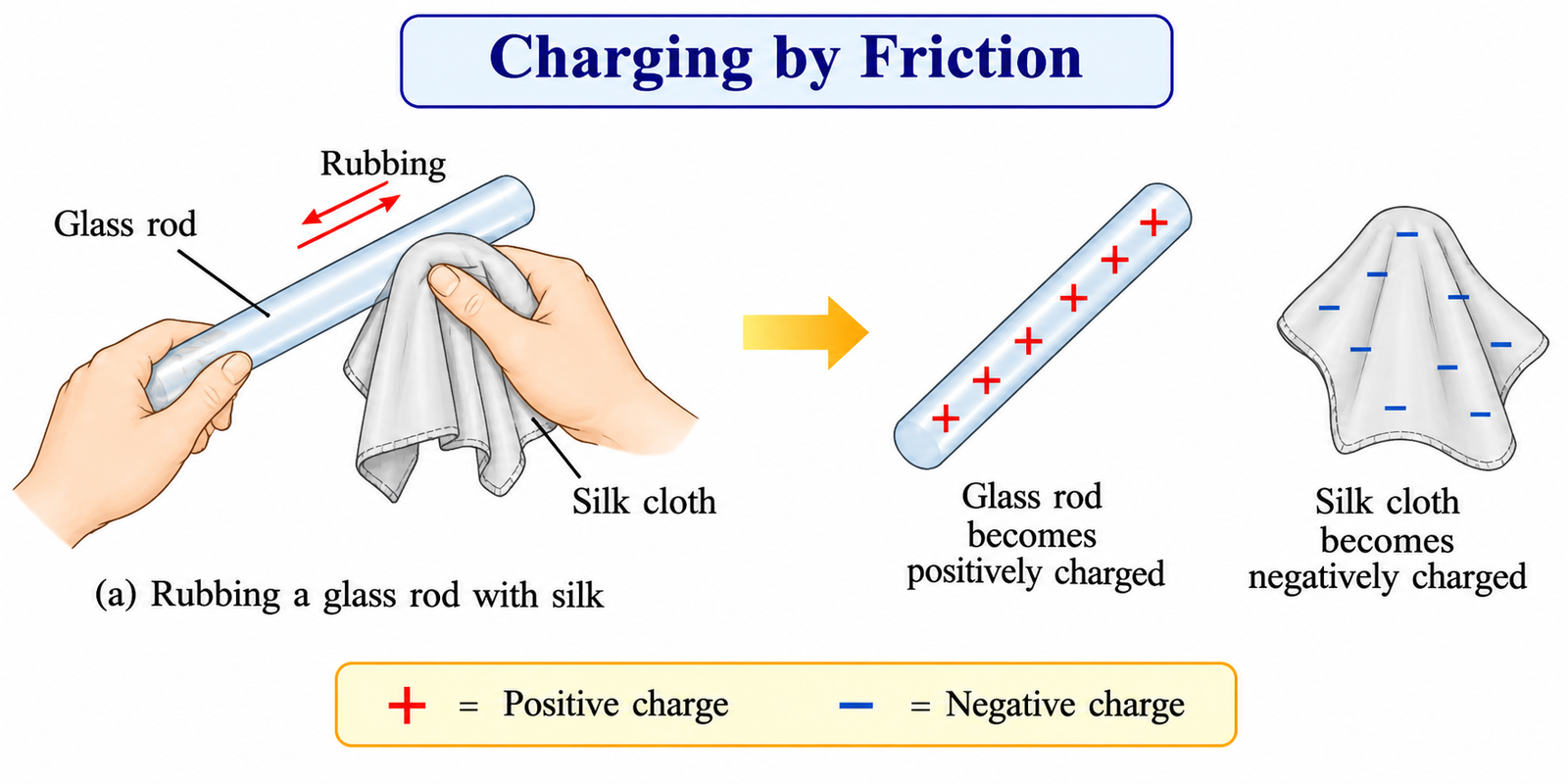
When two different materials are rubbed against each other, they may acquire electric charges. This phenomenon is called frictional electricity.
It is one of the methods of charging a body.
Examples
- When a glass rod is rubbed with silk, the glass rod becomes positively charged and the silk becomes negatively charged.
- When ebonite is rubbed with fur or wool, the ebonite becomes negatively charged and the fur or wool becomes positively charged.
4. Types of Electric Charge
There are two types of electric charge:
Positive Charge
When a neutral atom loses one or more electrons, it becomes positively charged.
Negative Charge
When a neutral atom gains one or more electrons, it becomes negatively charged.
5. Source Charge
A charge which produces an electric field is called a source charge.
6. Test Charge
A small positive charge used to detect the presence of an electric field around a source charge is called a test charge.
It is generally denoted by q0.
7. Polarity of Charge
The property which distinguishes the two kinds of electric charge is called polarity of charge.
Keep preparing
Available in the app
- Complete NotesConfirmed for this chapter
- Important QuestionsConfirmed for this chapter
- Previous Year QuestionsConfirmed for this chapter
- Revision NotesConfirmed for this chapter
- Practice TestsConfirmed for this chapter