Chapter 2
Electrostatic Potential and Capacitance
Preview Electrostatic Potential and Capacitance for Physics in JAC 12th (SCI.).
A quick look
Study material preview
Notes
1. Electrostatic Potential Energy
The electrostatic potential energy of a system of charges is the work done in bringing the charges from infinity to their respective positions without acceleration.
For two point charges q₁ and q₂ separated by a distance r:
U = (1/4πε₀)(q₁q₂/r)
- For like charges, potential energy is positive.
- For unlike charges, potential energy is negative.
- Potential energy is a scalar quantity.
- SI unit of potential energy is joule (J).
2. Electrostatic Potential
The electrostatic potential at a point in an electric field is defined as the work done in bringing a unit positive test charge from infinity to that point without acceleration.
V = W/q₀
where:
- V = electric potential
- W = work done
- q₀ = test charge
Electric potential is a scalar quantity.
SI Unit
The SI unit of electric potential is volt (V).
1 volt = 1 joule/coulomb
or
1 V = 1 J C−1
One volt is the potential at a point when one joule of work is done in bringing one coulomb of positive charge from infinity to that point.
3. Potential Difference
The potential difference between two points is equal to the work done per unit positive test charge in moving it from one point to another.
VB − VA = W/q₀
Work done in moving a charge q through a potential difference V is:
W = qV
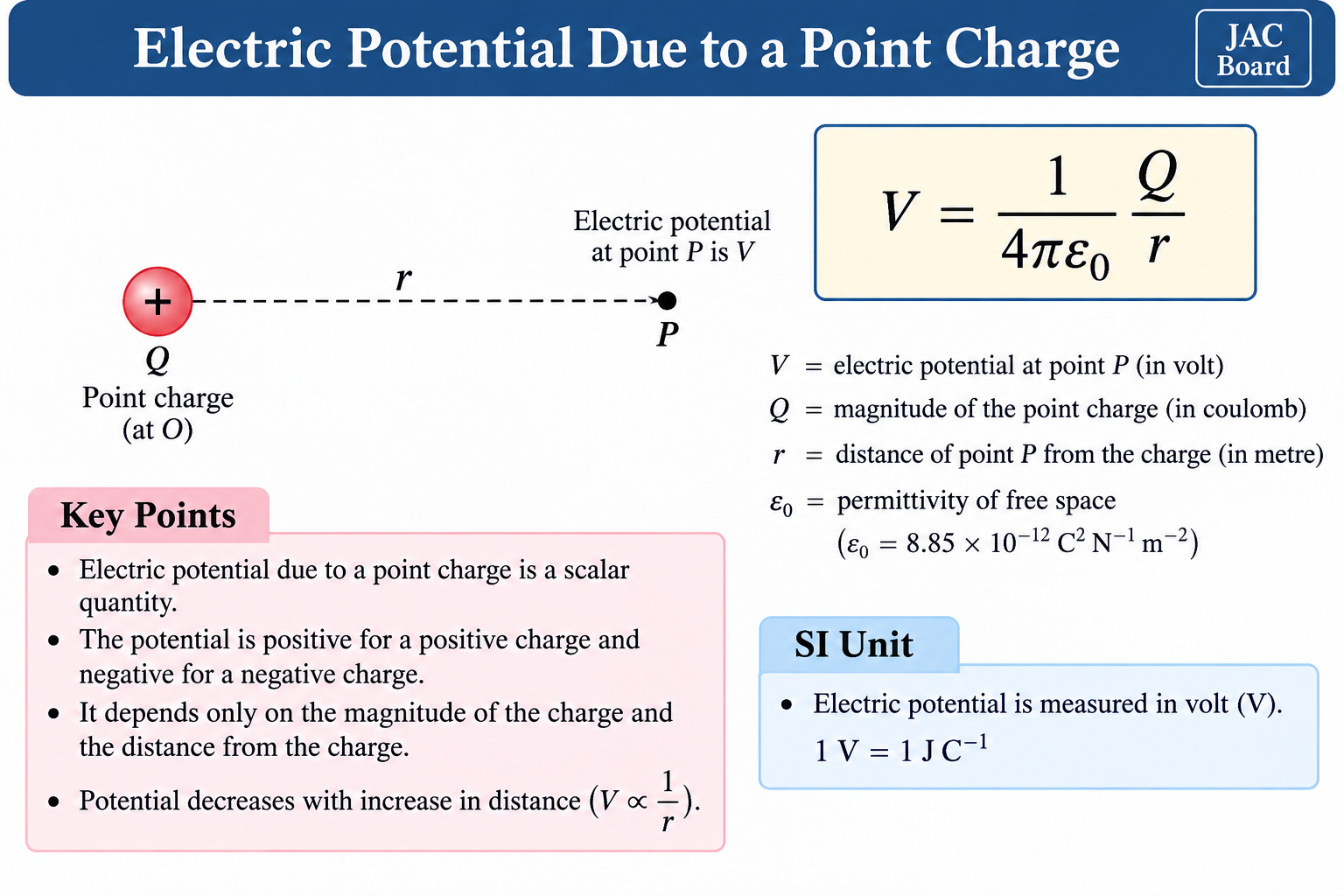
4. Electric Potential Due to a Point Charge
Consider a point charge q. The electric potential at a point situated at a distance r from the charge is:
V = (1/4πε₀)(q/r)
where:
- q = source charge
- r = distance of the point from the charge
- ε₀ = permittivity of free space
The potential due to a positive charge is positive and that due to a negative charge is negative.
5. Potential Due to a System of Point Charges
Since electric potential is a scalar quantity, the total potential due to a number of point charges is obtained by algebraic addition of their individual potentials.
V = V₁ + V₂ + V₃ + ...
Therefore:
V = (1/4πε₀)[q₁/r₁ + q₂/r₂ + q₃/r₃ + ...]
6. Electric Potential Due to an Electric Dipole
Keep preparing
Available in the app
- Complete NotesConfirmed for this chapter
- Important QuestionsConfirmed for this chapter
- Previous Year QuestionsConfirmed for this chapter
- Revision NotesConfirmed for this chapter