Chapter 2
Electrostatic Potential and Capacitance
Preview Electrostatic Potential and Capacitance for Physics in JAC 12th (SCI.).
A quick look
Study material preview
Notes
1. स्थिर वैद्युत स्थितिज ऊर्जा (Electrostatic Potential Energy)
आवेशों के किसी निकाय की स्थिर वैद्युत स्थितिज ऊर्जा वह कार्य है, जो आवेशों को बिना त्वरण के अनंत से उनके संबंधित स्थानों तक लाने में किया जाता है।
r दूरी से अलग दो बिंदु आवेश q₁ तथा q₂ के लिए:
U = (1/4πε₀)(q₁q₂/r)
- समान प्रकृति के आवेशों के लिए स्थितिज ऊर्जा धनात्मक होती है।
- विपरीत प्रकृति के आवेशों के लिए स्थितिज ऊर्जा ऋणात्मक होती है।
- स्थितिज ऊर्जा एक अदिश राशि (Scalar Quantity) है।
- स्थितिज ऊर्जा का SI मात्रक जूल (J) है।
2. स्थिर वैद्युत विभव (Electrostatic Potential)
वैद्युत क्षेत्र में किसी बिंदु पर स्थिर वैद्युत विभव को उस कार्य के रूप में परिभाषित किया जाता है, जो इकाई धनात्मक परीक्षण आवेश को बिना त्वरण के अनंत से उस बिंदु तक लाने में किया जाता है।
V = W/q₀
जहाँ:
- V = वैद्युत विभव
- W = किया गया कार्य
- q₀ = परीक्षण आवेश (Test Charge)
वैद्युत विभव एक अदिश राशि (Scalar Quantity) है।
SI मात्रक
वैद्युत विभव का SI मात्रक वोल्ट (V) है।
1 वोल्ट = 1 जूल/कूलॉम
या
1 V = 1 J C−1
किसी बिंदु का विभव एक वोल्ट तब कहलाता है, जब एक कूलॉम धनात्मक आवेश को अनंत से उस बिंदु तक लाने में एक जूल कार्य किया जाता है।
3. विभवांतर (Potential Difference)
दो बिंदुओं के बीच विभवांतर, इकाई धनात्मक परीक्षण आवेश को एक बिंदु से दूसरे बिंदु तक ले जाने में किए गए कार्य के बराबर होता है।
VB − VA = W/q₀
किसी आवेश q को विभवांतर V के बीच ले जाने में किया गया कार्य है:
W = qV
4. बिंदु आवेश के कारण वैद्युत विभव
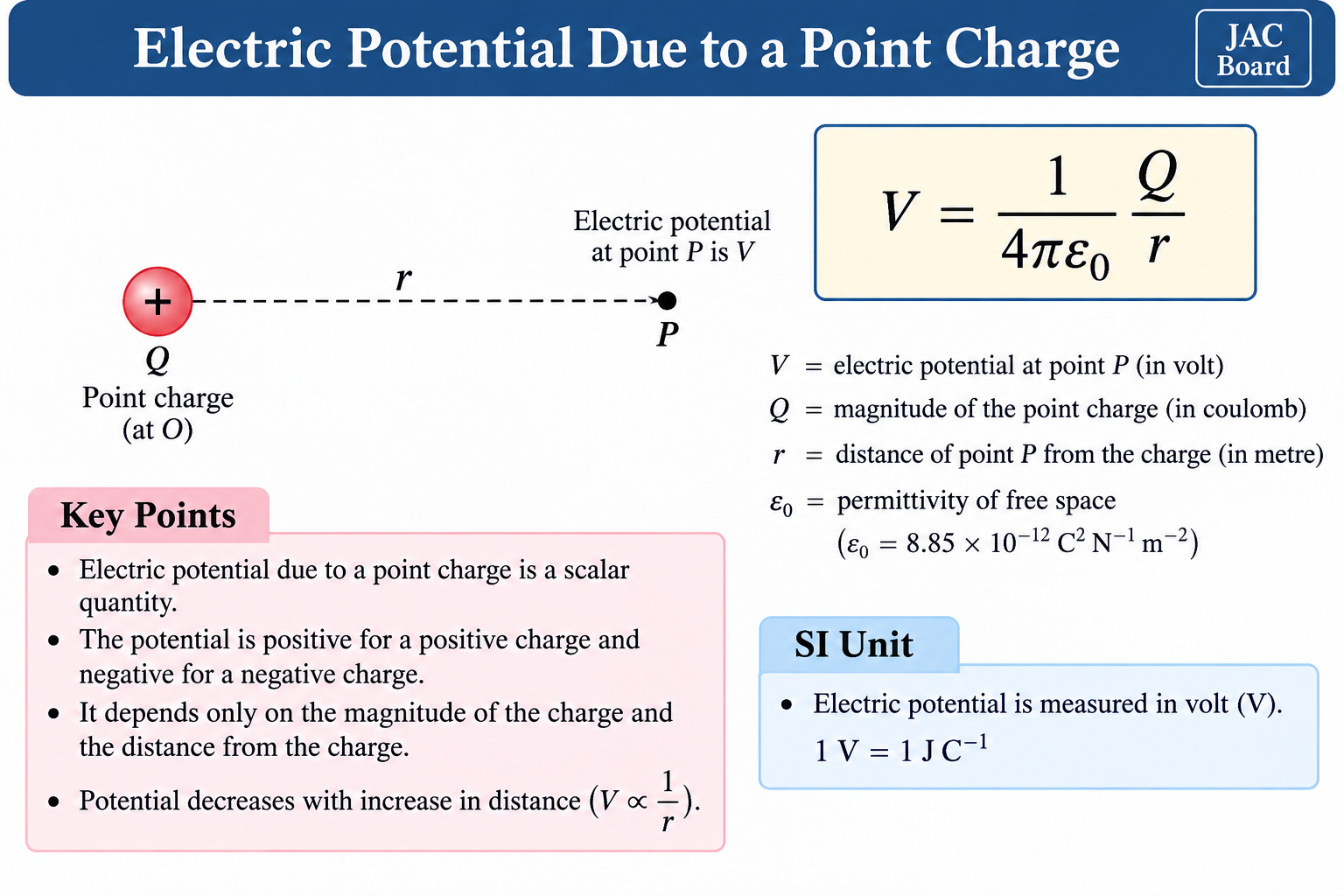
एक बिंदु आवेश q पर विचार कीजिए। आवेश से r दूरी पर स्थित किसी बिंदु पर वैद्युत विभव है:
V = (1/4πε₀)(q/r)
जहाँ:
- q = स्रोत आवेश (Source Charge)
- r = आवेश से बिंदु की दूरी
- ε₀ = निर्वात की विद्युतशीलता (Permittivity of Free Space)
धनात्मक आवेश के कारण विभव धनात्मक तथा ऋणात्मक आवेश के कारण विभव ऋणात्मक होता है।
5. बिंदु आवेशों के निकाय के कारण विभव
चूँकि वैद्युत विभव एक अदिश राशि है, इसलिए अनेक बिंदु आवेशों के कारण उत्पन्न कुल विभव उनके अलग-अलग विभवों के बीजगणितीय योग से प्राप्त किया जाता है।
V = V₁ + V₂ + V₃ + ...
अतः:
V = (1/4πε₀)[q₁/r₁ + q₂/r₂ + q₃/r₃ + ...]
6. वैद्युत द्विध्रुव के कारण वैद्युत विभव
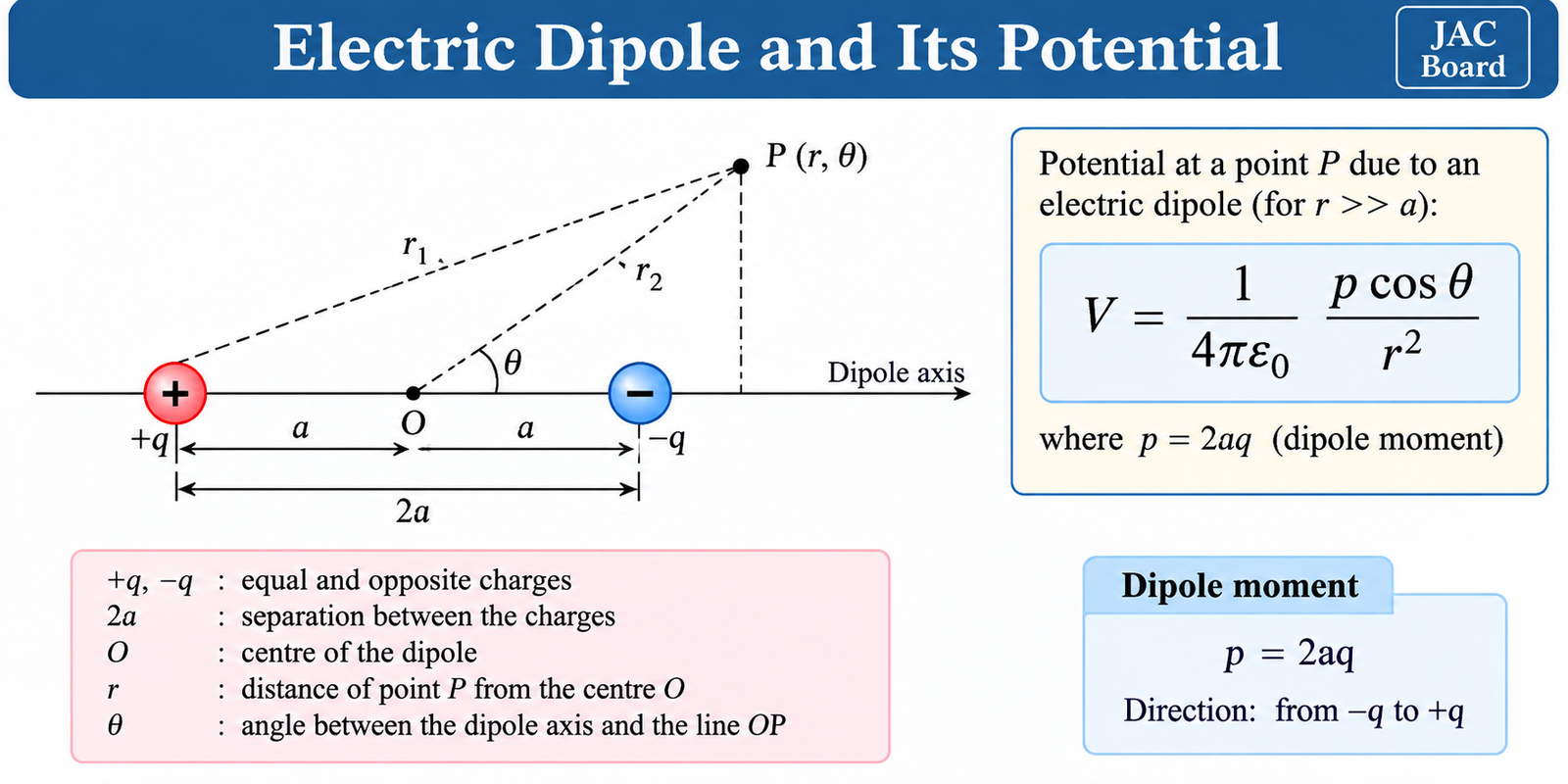
एक वैद्युत द्विध्रुव समान परिमाण के दो विपरीत आवेशों +q तथा −q से मिलकर बना होता है, जो एक छोटी दूरी 2a से अलग होते हैं।
वैद्युत द्विध्रुव आघूर्ण है:
p = q(2a)
अक्षीय बिंदु पर विभव (Potential at an Axial Point)
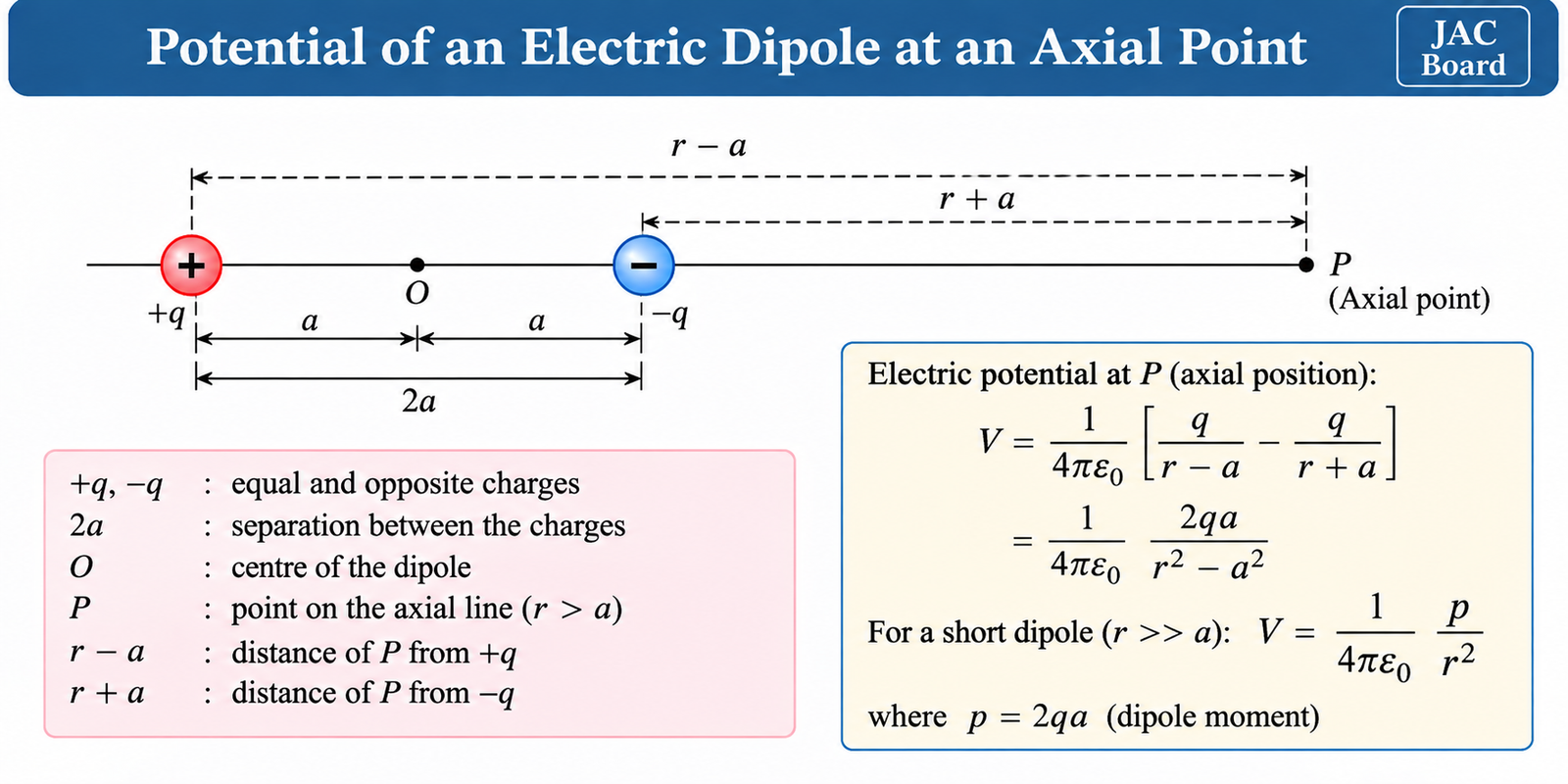
वैद्युत द्विध्रुव की अक्षीय रेखा पर उसके केंद्र से r दूरी पर स्थित एक बिंदु P पर विचार कीजिए।
दोनों आवेशों के कारण बिंदु P पर कुल विभव है:
V = (1/4πε₀)[q/(r − a) − q/(r + a)]
सरलीकरण करने पर:
V = (1/4πε₀)[2qa/(r² − a²)]
चूँकि p = 2qa:
V = (1/4πε₀)[p/(r² − a²)]
लघु द्विध्रुव के लिए, जब r >> a:
V = (1/4πε₀)(p/r²)
निरक्षीय बिंदु पर विभव (Potential at an Equatorial Point)
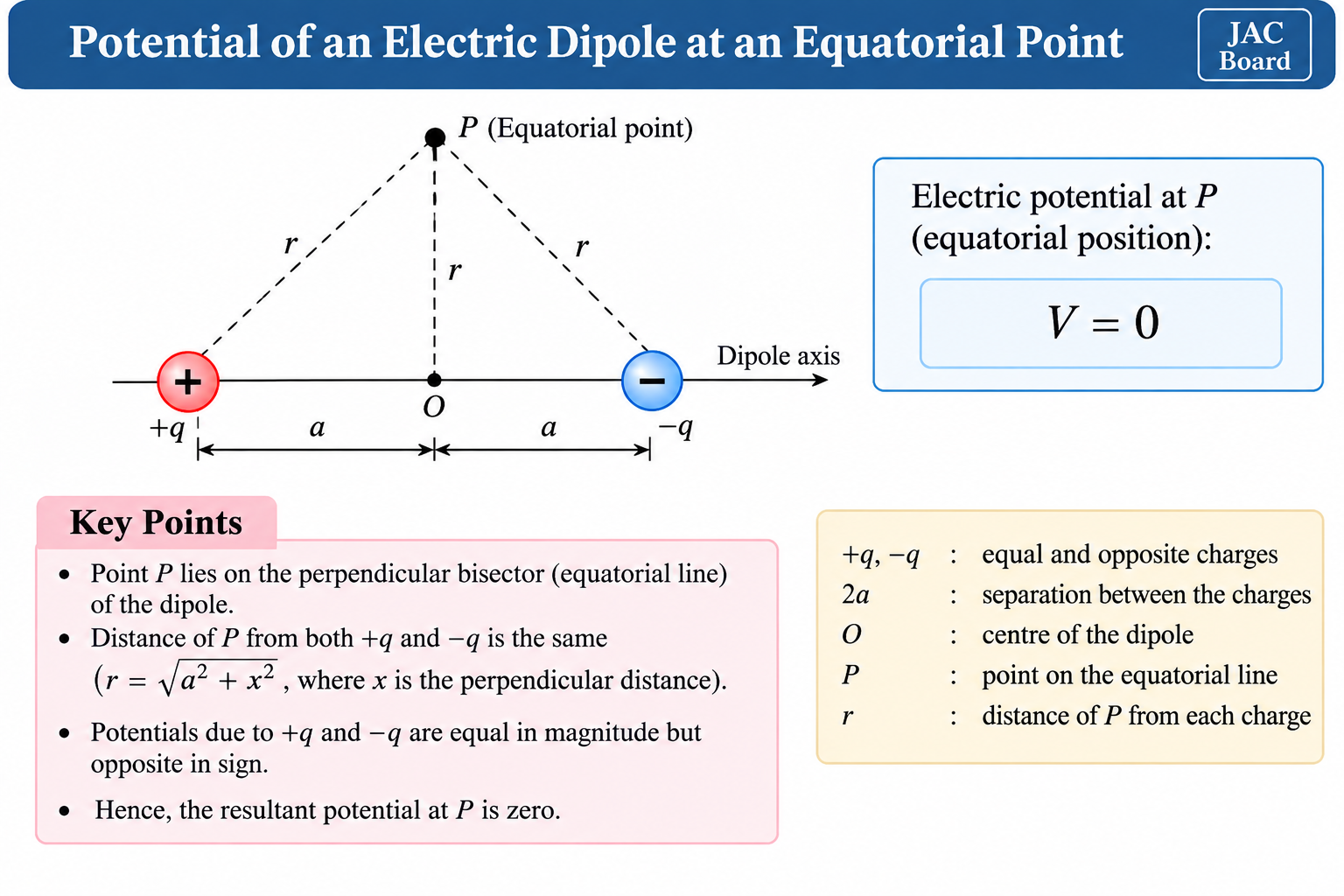
वैद्युत द्विध्रुव की निरक्षीय रेखा पर स्थित किसी भी बिंदु की +q तथा −q आवेशों से दूरियाँ समान होती हैं।
दोनों आवेशों के कारण उत्पन्न विभव परिमाण में समान लेकिन चिह्न में विपरीत होते हैं।
अतः:
V = 0
किसी सामान्य बिंदु पर विभव (Potential at a General Point)
एक लघु वैद्युत द्विध्रुव के लिए, द्विध्रुव अक्ष के साथ θ कोण बनाने वाले किसी दूरस्थ बिंदु पर विभव है:
V = (1/4πε₀)(p cos θ/r²)
- θ = 0° के लिए बिंदु अक्षीय रेखा पर स्थित होता है।
- θ = 90° के लिए बिंदु निरक्षीय रेखा पर स्थित होता है तथा V = 0 होता है।
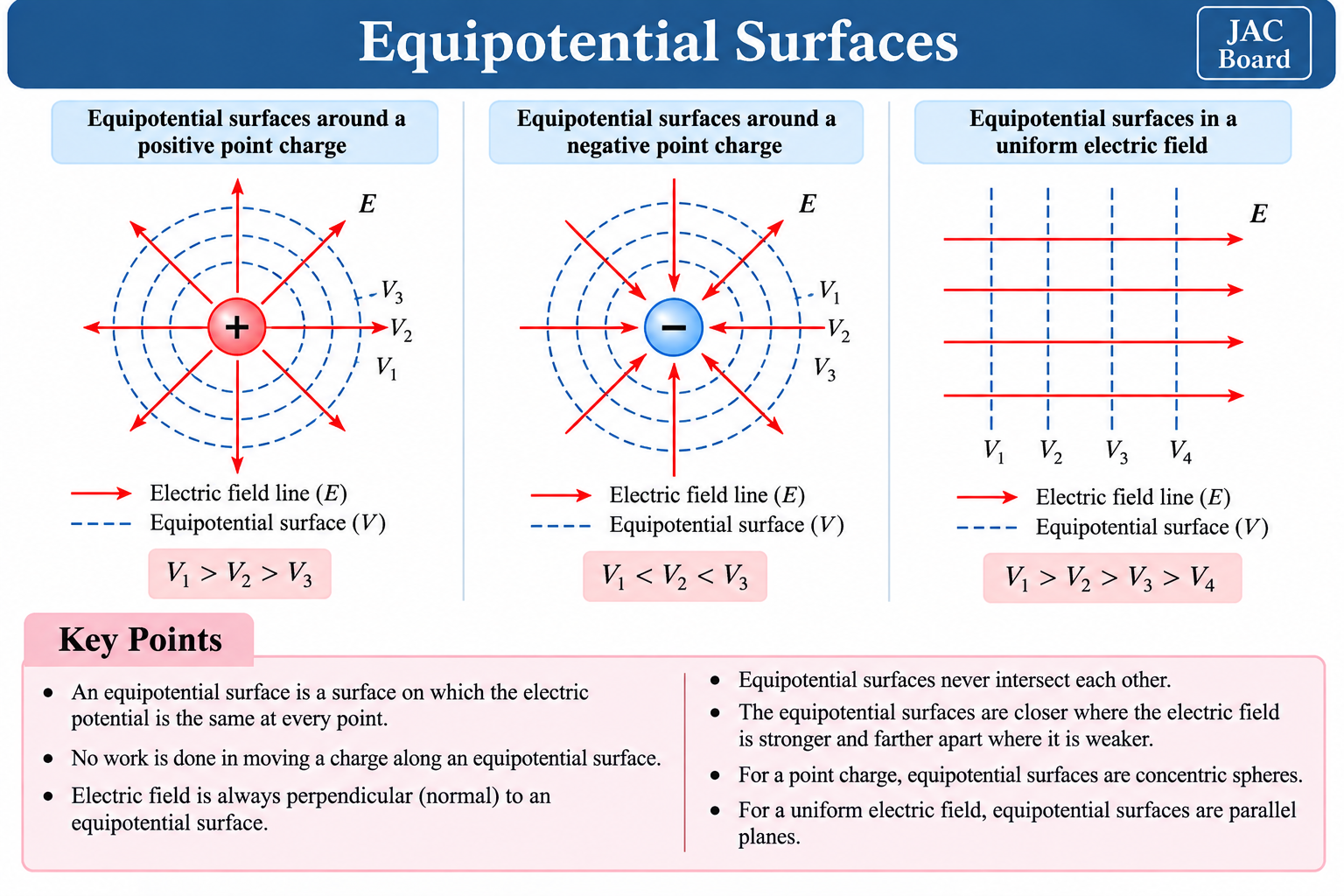
7. समविभव पृष्ठ (Equipotential Surface)
वह पृष्ठ जिसके प्रत्येक बिंदु पर वैद्युत विभव समान होता है, समविभव पृष्ठ (Equipotential Surface) कहलाता है।
समविभव पृष्ठ के गुण
- समविभव पृष्ठ के सभी बिंदुओं पर विभव समान होता है।
- एक ही समविभव पृष्ठ पर किसी आवेश को एक बिंदु से दूसरे बिंदु तक ले जाने में कोई कार्य नहीं किया जाता है।
- वैद्युत क्षेत्र सदैव समविभव पृष्ठ के लंबवत होता है।
- दो समविभव पृष्ठ कभी एक-दूसरे को नहीं काट सकते हैं।
8. वैद्युत क्षेत्र एवं विभव के बीच संबंध
वैद्युत क्षेत्र, दूरी के साथ वैद्युत विभव में परिवर्तन की दर से संबंधित होता है।
अत्यल्प विस्थापन dr के लिए:
dV = −E dr
अतः:
E = −dV/dr
ऋणात्मक चिह्न यह दर्शाता है कि वैद्युत क्षेत्र की दिशा घटते हुए विभव की ओर होती है।
विभव प्रवणता (Potential Gradient)
दूरी के साथ विभव में परिवर्तन की दर को विभव प्रवणता (Potential Gradient) कहते हैं।
विभव प्रवणता = dV/dr
अतः:
वैद्युत क्षेत्र = − विभव प्रवणता
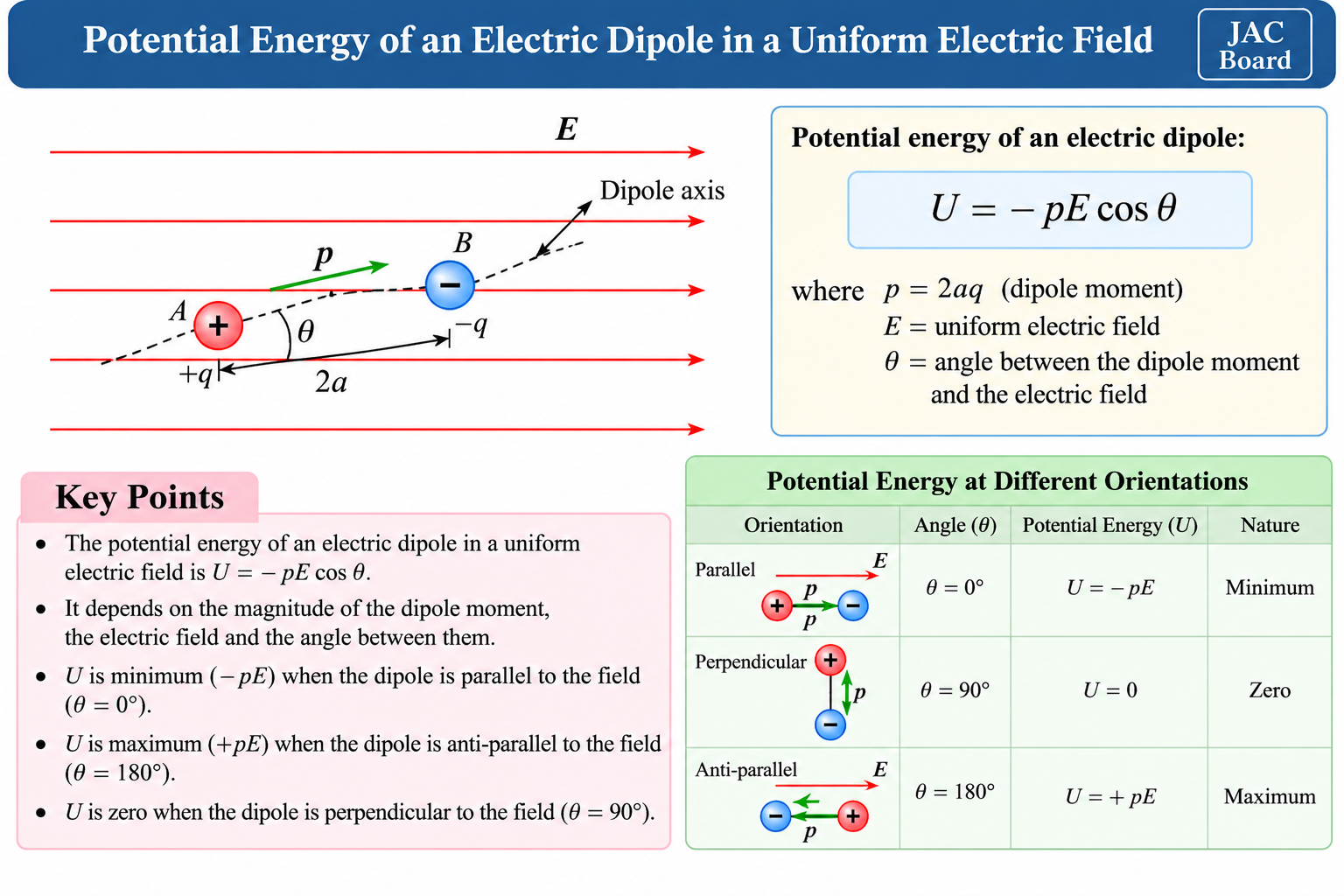
9. एकसमान वैद्युत क्षेत्र में वैद्युत द्विध्रुव की स्थितिज ऊर्जा
एकसमान वैद्युत क्षेत्र E में θ कोण पर रखे गए द्विध्रुव आघूर्ण p वाले वैद्युत द्विध्रुव पर विचार कीजिए।
द्विध्रुव पर लगने वाला बल आघूर्ण है:
τ = pE sin θ
द्विध्रुव को अत्यल्प कोण dθ से घुमाने में किया गया कार्य है:
dW = pE sin θ dθ
समाकलन करने पर द्विध्रुव की स्थितिज ऊर्जा है:
U = −pE cos θ
या
U = −p · E
विशेष स्थितियाँ
- θ = 0° पर: U = −pE (न्यूनतम स्थितिज ऊर्जा)
- θ = 90° पर: U = 0
- θ = 180° पर: U = +pE (अधिकतम स्थितिज ऊर्जा)
10. परावैद्युत पदार्थ (Dielectrics)
परावैद्युत (Dielectric) एक विद्युतरोधी पदार्थ है, जो अपने भीतर वैद्युत आवेशों की मुक्त गति की अनुमति नहीं देता है, लेकिन बाहरी वैद्युत क्षेत्र में ध्रुवित हो सकता है।
इसके उदाहरणों में काँच, अभ्रक (Mica) तथा अन्य विद्युतरोधी पदार्थ शामिल हैं।
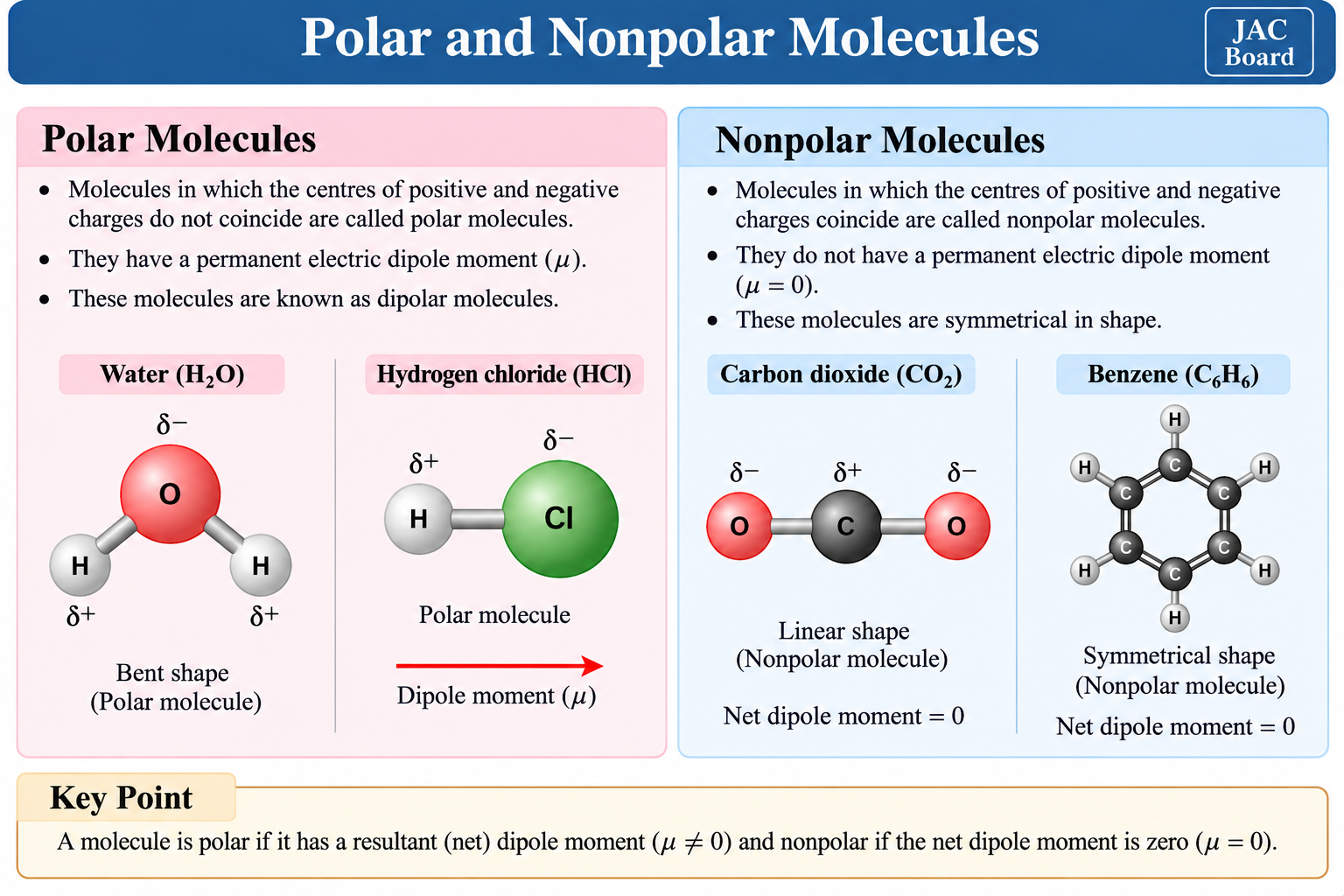
11. ध्रुवीय एवं अध्रुवीय परावैद्युत
ध्रुवीय अणु (Polar Molecules)
ध्रुवीय अणुओं में धनात्मक तथा ऋणात्मक आवेशों के केंद्र एक-दूसरे पर संपाती नहीं होते हैं। इसलिए अणु में स्थायी वैद्युत द्विध्रुव आघूर्ण (Permanent Electric Dipole Moment) होता है।
अध्रुवीय अणु (Non-Polar Molecules)
अध्रुवीय अणुओं में धनात्मक तथा ऋणात्मक आवेशों के केंद्र एक-दूसरे पर संपाती होते हैं। इसलिए बाहरी वैद्युत क्षेत्र की अनुपस्थिति में अणु का कोई स्थायी वैद्युत द्विध्रुव आघूर्ण नहीं होता है।
12. परावैद्युत का ध्रुवण (Polarisation of a Dielectric)
जब किसी परावैद्युत पदार्थ को बाहरी वैद्युत क्षेत्र में रखा जाता है, तो उसके अणु एक निश्चित दिशा में अभिविन्यस्त हो जाते हैं अथवा प्रेरित द्विध्रुव उत्पन्न हो जाते हैं। इस घटना को ध्रुवण (Polarisation) कहते हैं।
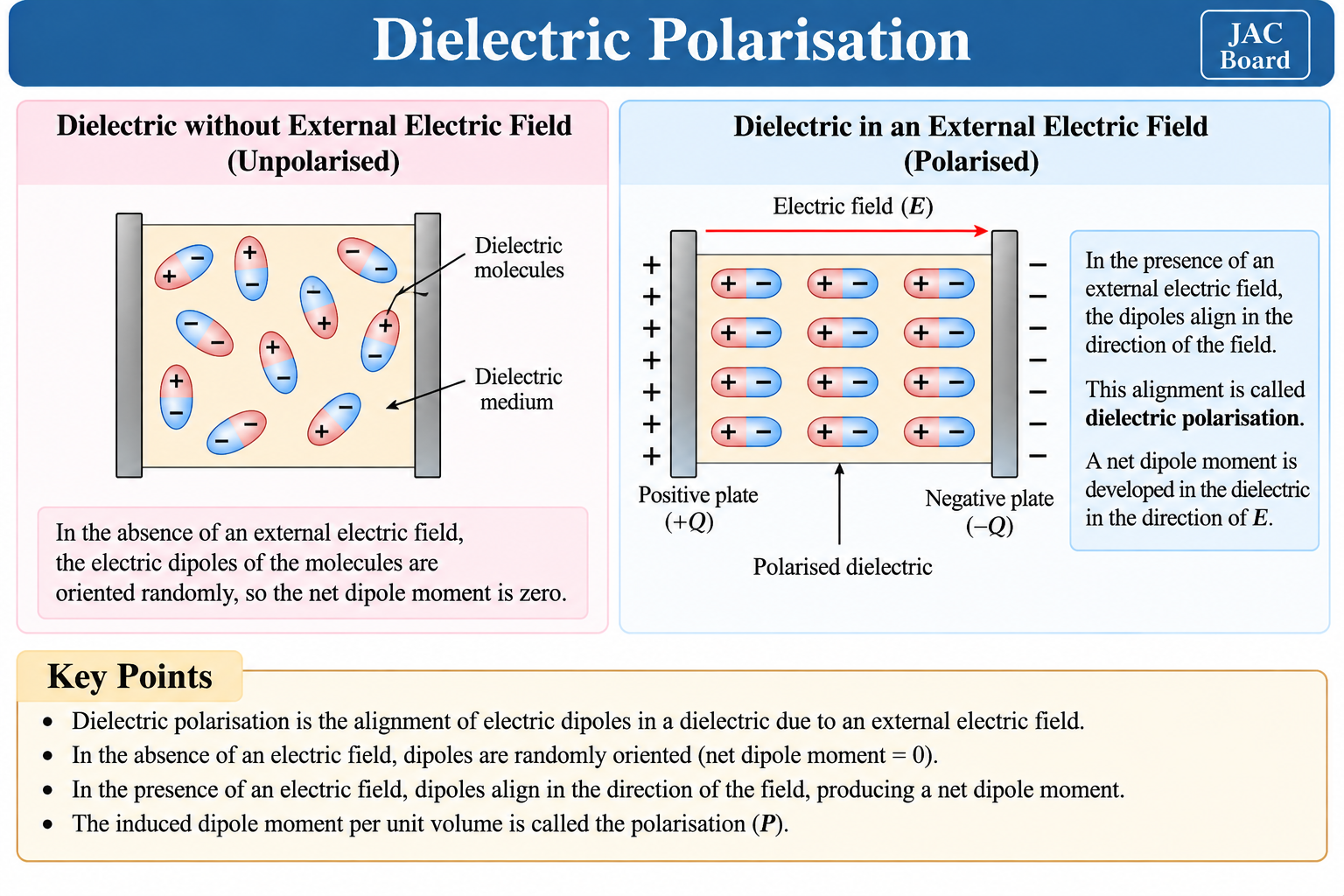
ध्रुवण सदिश (Polarisation Vector)
किसी परावैद्युत पदार्थ के प्रति इकाई आयतन में उपस्थित द्विध्रुव आघूर्ण को ध्रुवण सदिश (Polarisation Vector) कहते हैं।
P = द्विध्रुव आघूर्ण / आयतन
वैद्युत सुग्राहिता (Electric Susceptibility)
किसी परावैद्युत पदार्थ का ध्रुवण वैद्युत क्षेत्र से निम्न संबंध द्वारा जुड़ा होता है:
P = ε₀χeE
जहाँ χe पदार्थ की वैद्युत सुग्राहिता (Electric Susceptibility) है।
13. संधारित्र (Capacitor)
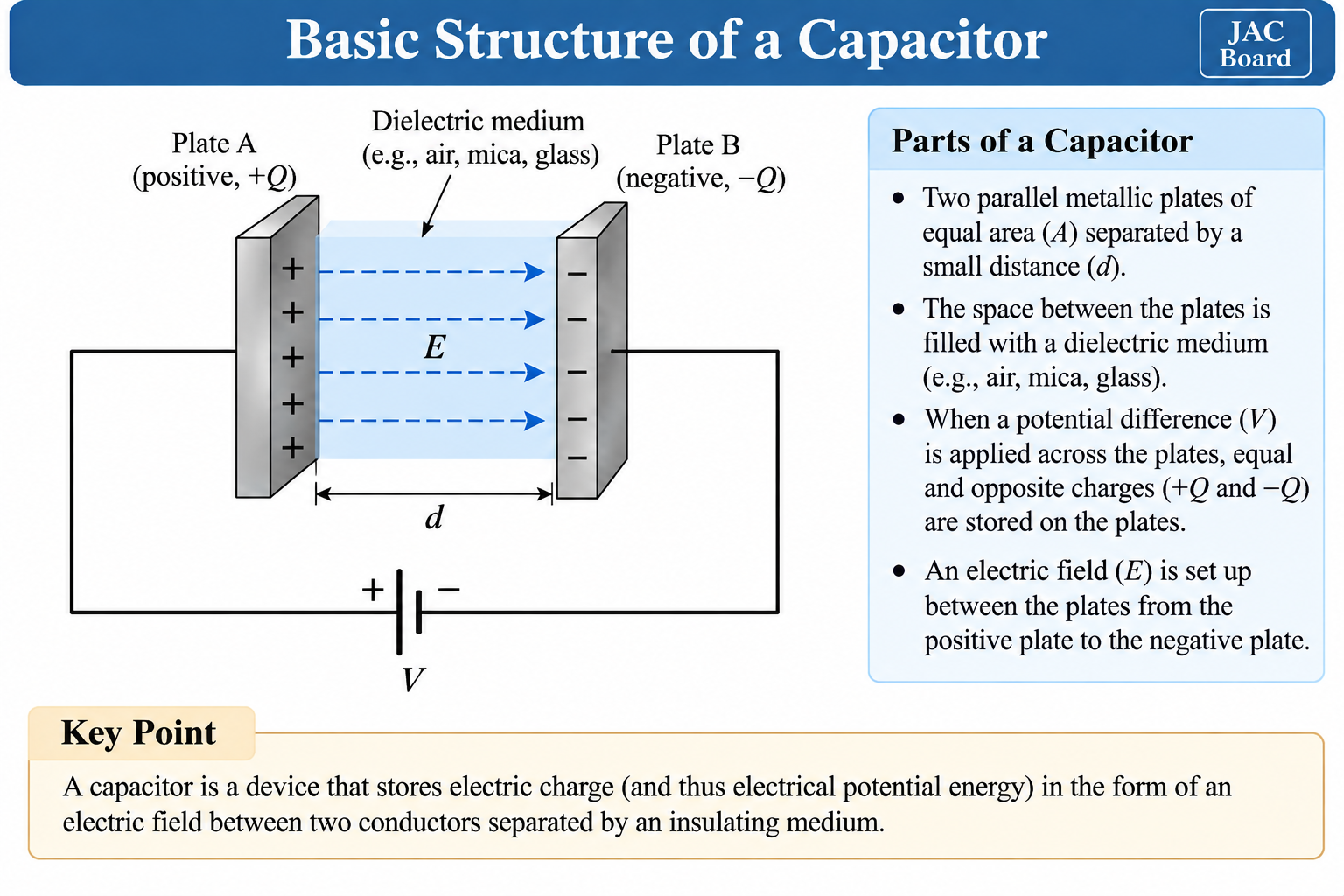
संधारित्र एक ऐसा उपकरण है जिसका उपयोग वैद्युत आवेश तथा स्थिर वैद्युत ऊर्जा को संचित करने के लिए किया जाता है।
यह सामान्यतः दो चालक प्लेटों से मिलकर बना होता है, जिन्हें एक विद्युतरोधी माध्यम द्वारा अलग किया जाता है।
14. धारिता (Capacitance)
किसी चालक की धारिता को चालक को दिए गए आवेश तथा उस पर उत्पन्न विभव के अनुपात के रूप में परिभाषित किया जाता है।
C = Q/V
अतः:
Q = CV
धारिता चालक के आकार एवं आकृति तथा उसके चारों ओर उपस्थित माध्यम की प्रकृति पर निर्भर करती है।
धारिता का SI मात्रक
धारिता का SI मात्रक फैरड (F) है।
1 F = 1 C/V
किसी चालक की धारिता एक फैरड तब होती है, जब एक कूलॉम आवेश देने पर उसका विभव एक वोल्ट बढ़ जाता है।
15. विलगित गोलीय चालक की धारिता
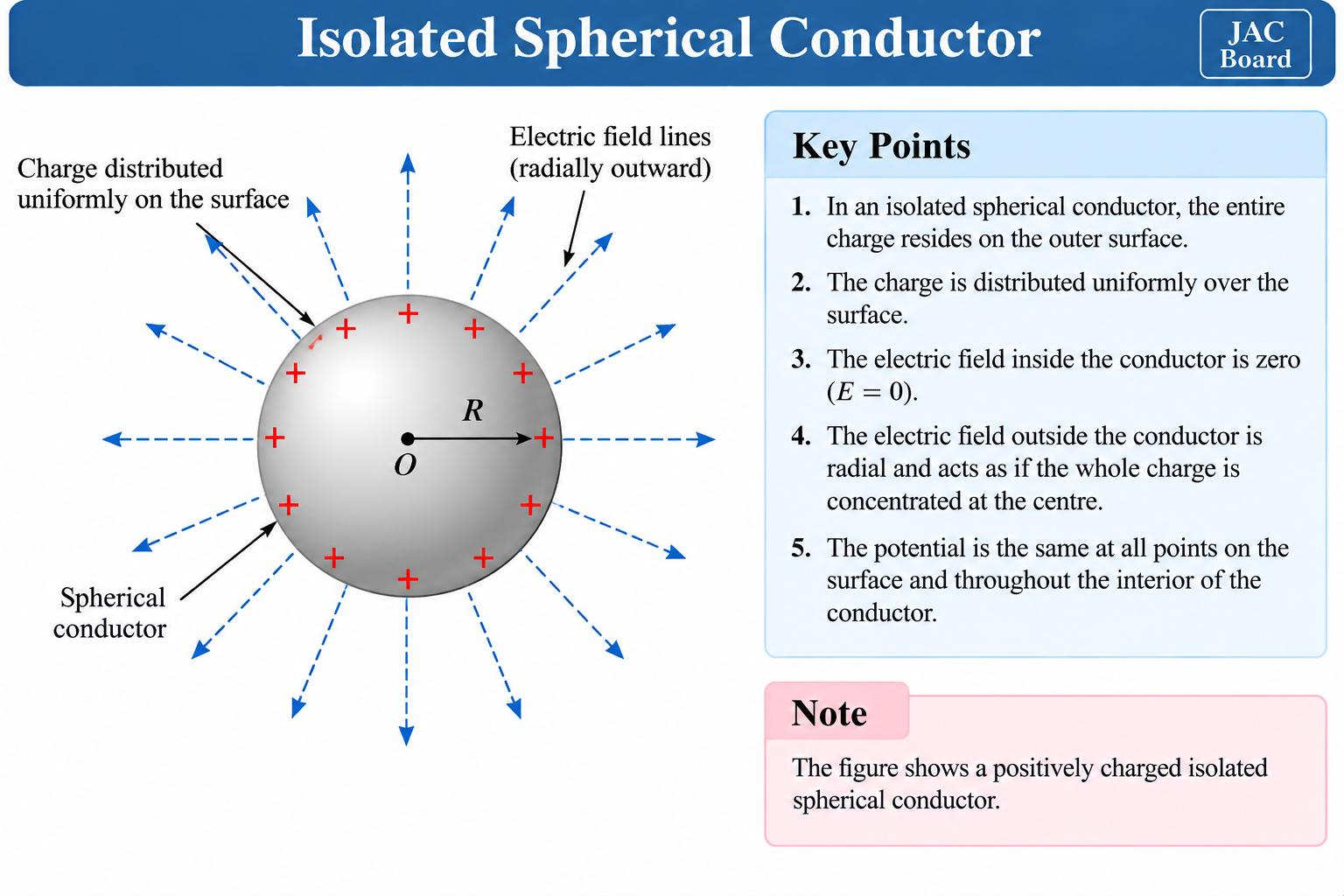
R त्रिज्या वाले एक विलगित गोलीय चालक पर विचार कीजिए, जिस पर Q आवेश है।
उसकी सतह पर विभव है:
V = (1/4πε₀)(Q/R)
चूँकि:
C = Q/V
अतः:
C = 4πε₀R
इस प्रकार, विलगित गोलीय चालक की धारिता उसकी त्रिज्या के समानुपाती होती है।
16. धारिता को प्रभावित करने वाले कारक
किसी चालक या संधारित्र की धारिता निम्न कारकों पर निर्भर करती है:
- चालक का आकार एवं आकृति।
- चालकों अथवा प्लेटों के बीच की दूरी।
- उनके बीच उपस्थित परावैद्युत माध्यम की प्रकृति।
17. समानांतर प्लेट संधारित्र (Parallel Plate Capacitor)
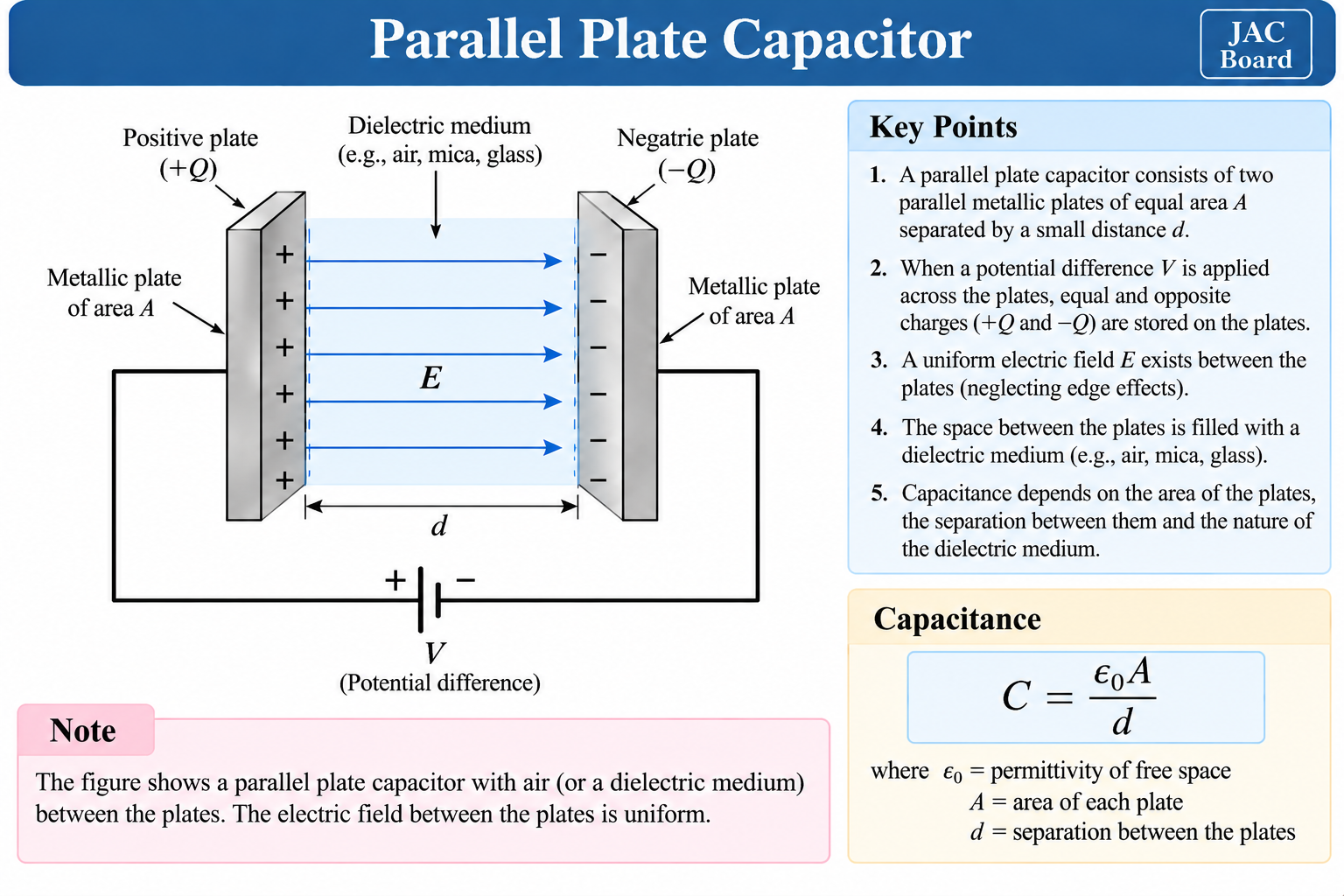
समानांतर प्लेट संधारित्र दो बड़ी चालक प्लेटों से मिलकर बना होता है, जिन्हें एक-दूसरे के समानांतर रखा जाता है तथा उनके बीच बहुत कम दूरी होती है।
माना:
- A = प्रत्येक प्लेट का क्षेत्रफल
- d = प्लेटों के बीच की दूरी
- +Q तथा −Q = प्लेटों पर आवेश
- σ = पृष्ठीय आवेश घनत्व
पृष्ठीय आवेश घनत्व:
σ = Q/A
प्लेटों के बीच वैद्युत क्षेत्र है:
E = σ/ε₀
अतः:
E = Q/(ε₀A)
प्लेटों के बीच विभवांतर:
V = Ed
अतः:
V = Qd/(ε₀A)
चूँकि:
C = Q/V
इसलिए:
C = ε₀A/d
महत्वपूर्ण परिणाम
- C ∝ A
- C ∝ 1/d
अतः प्लेटों का क्षेत्रफल बढ़ाने पर धारिता बढ़ती है तथा प्लेटों के बीच की दूरी बढ़ाने पर धारिता घटती है।
18. परावैद्युत के साथ समानांतर प्लेट संधारित्र
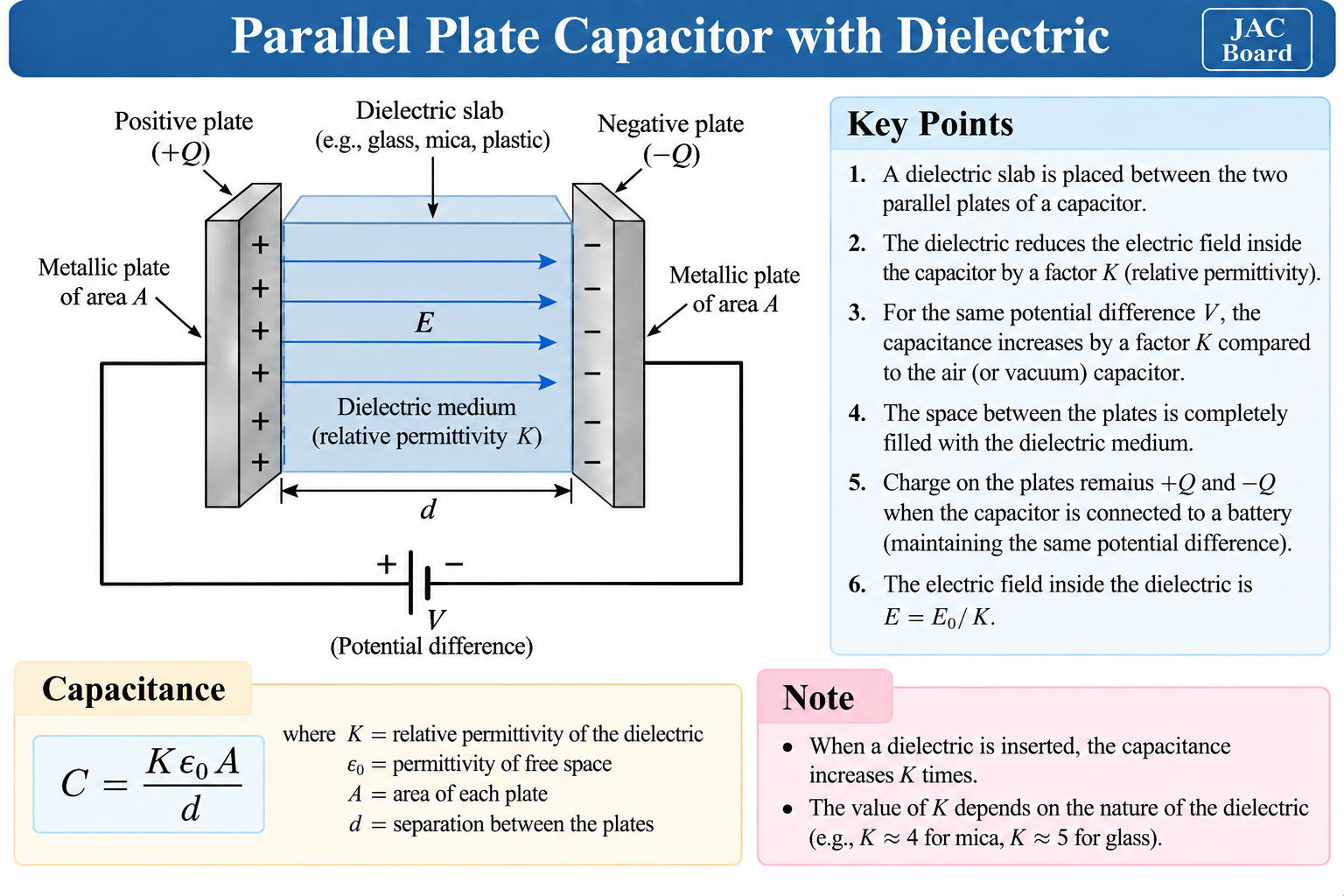
जब समानांतर प्लेट संधारित्र की प्लेटों के बीच कोई परावैद्युत पदार्थ रखा जाता है, तो उसकी धारिता बढ़ जाती है।
यदि पदार्थ का परावैद्युतांक (Dielectric Constant) K है, तो:
C = Kε₀A/d
अतः:
C = KC₀
जहाँ C₀ परावैद्युत पदार्थ के बिना संधारित्र की धारिता है।
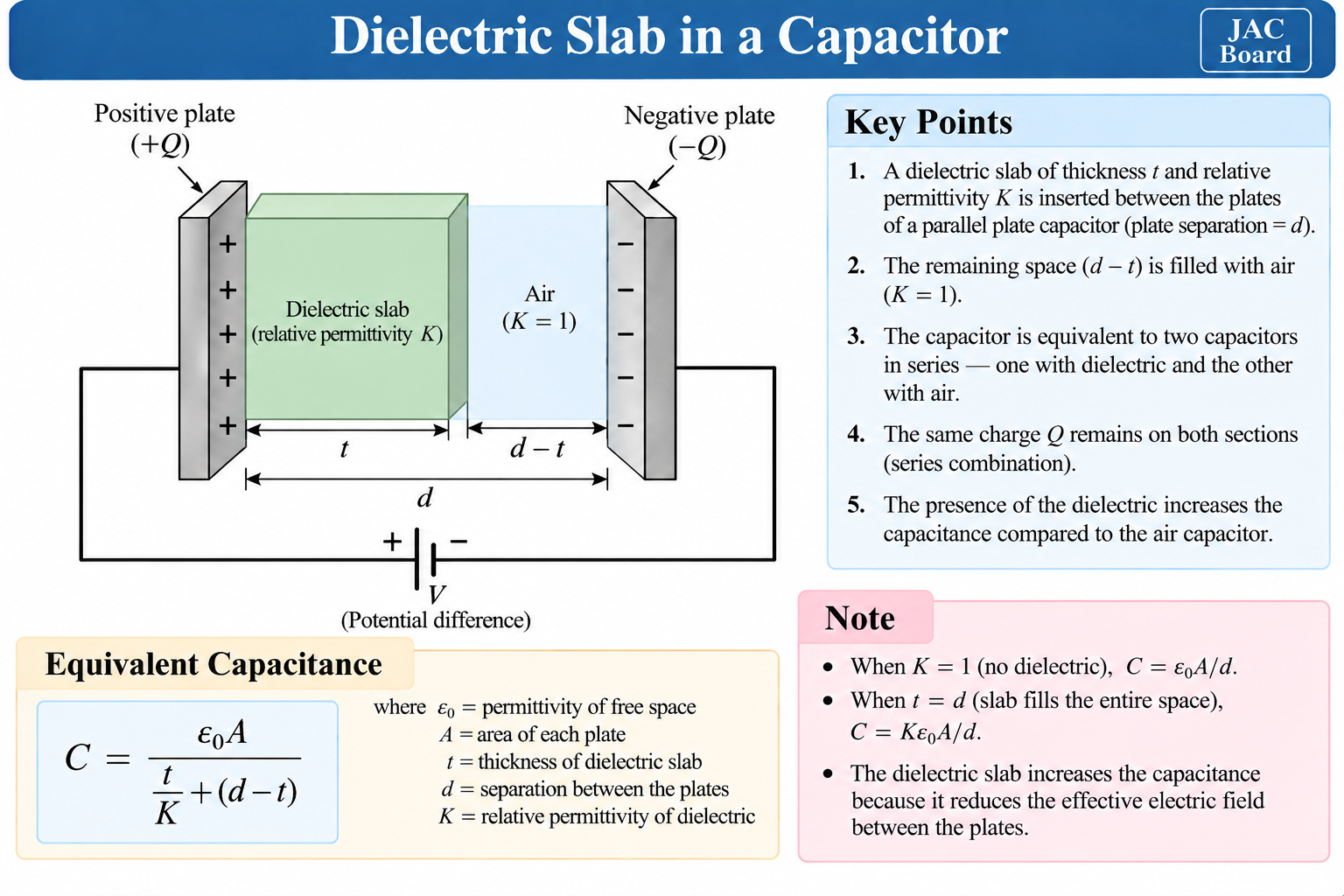
19. परावैद्युत पट्टी के साथ समानांतर प्लेट संधारित्र
एक समानांतर प्लेट संधारित्र पर विचार कीजिए, जिसकी प्लेटों के बीच की दूरी d है तथा उनके बीच t मोटाई एवं K परावैद्युतांक वाली एक परावैद्युत पट्टी (Dielectric Slab) रखी गई है।
प्रभावी दूरी होगी:
deffective = (d − t) + t/K
अतः धारिता है:
C = ε₀A / [(d − t) + t/K]
या
C = ε₀A / [d − t(1 − 1/K)]
20. संधारित्रों का संयोजन (Combination of Capacitors)
आवश्यक तुल्य धारिता (Equivalent Capacitance) प्राप्त करने के लिए संधारित्रों को श्रेणीक्रम (Series) अथवा समांतर क्रम (Parallel) में जोड़ा जा सकता है।
21. श्रेणीक्रम में संधारित्र (Capacitors in Series)
जब संधारित्रों को एक के बाद एक जोड़ा जाता है, तो उन्हें श्रेणीक्रम में जुड़ा हुआ कहा जाता है।
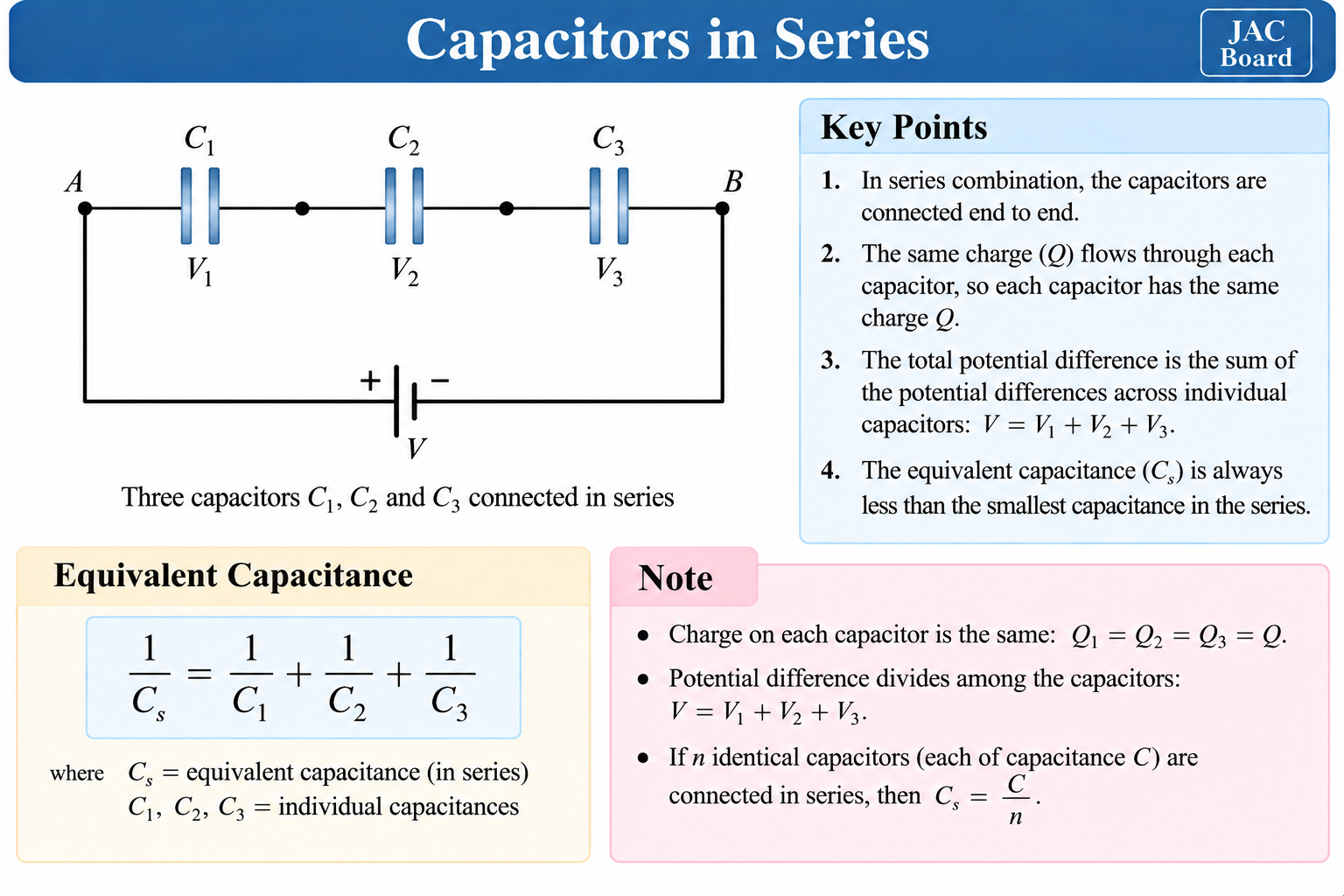
श्रेणीक्रम संयोजन में प्रत्येक संधारित्र पर आवेश समान होता है:
Q = Q₁ = Q₂ = Q₃
कुल विभवांतर:
V = V₁ + V₂ + V₃
V = Q/C का उपयोग करने पर:
Q/C = Q/C₁ + Q/C₂ + Q/C₃
अतः:
1/C = 1/C₁ + 1/C₂ + 1/C₃
दो संधारित्रों के लिए:
C = C₁C₂/(C₁ + C₂)
22. समांतर क्रम में संधारित्र (Capacitors in Parallel)
जब संधारित्रों की संगत प्लेटों को आपस में जोड़ा जाता है, तो संधारित्रों को समांतर क्रम में जुड़ा हुआ कहा जाता है।
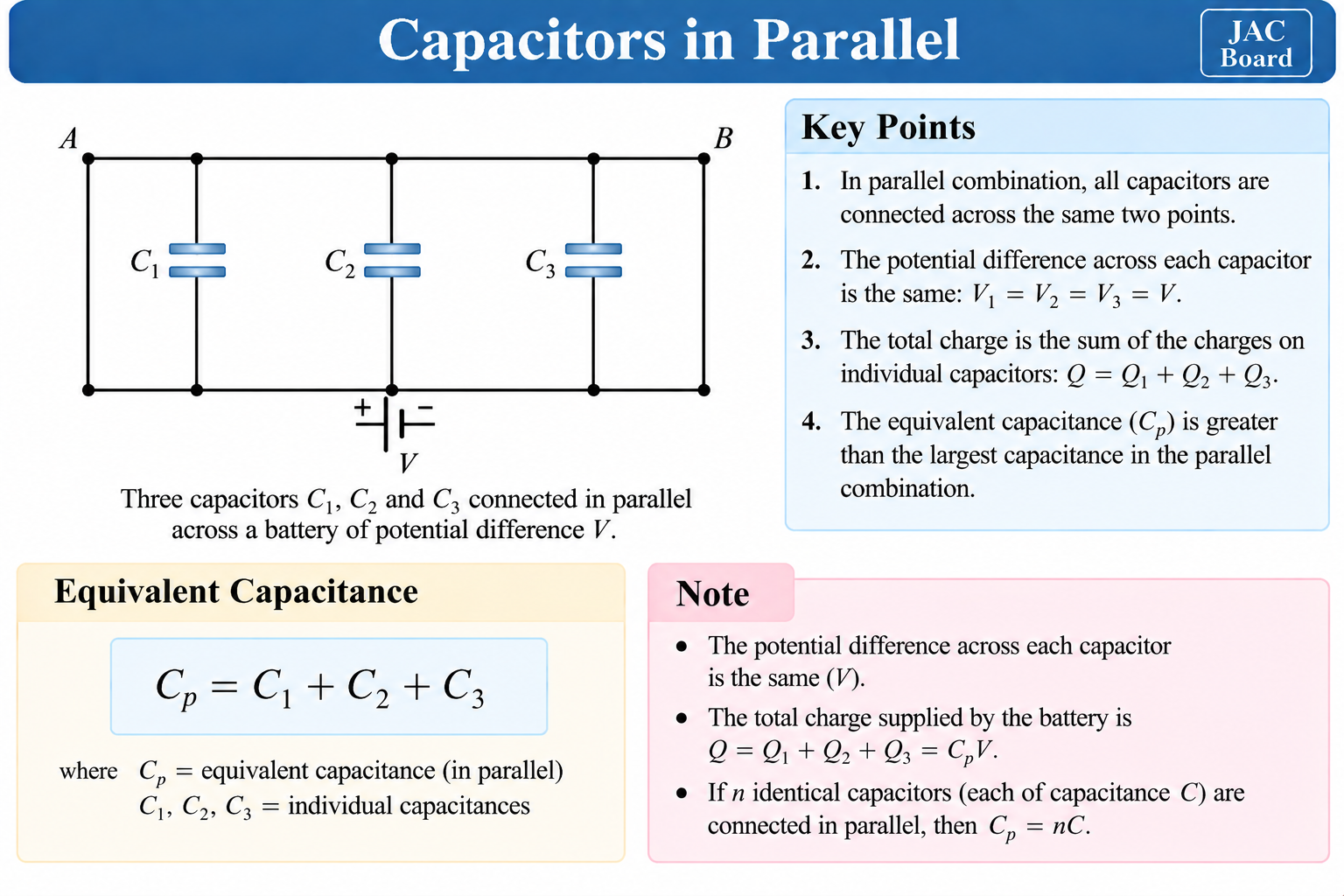
समांतर संयोजन में प्रत्येक संधारित्र के सिरों के बीच विभवांतर समान होता है:
V = V₁ = V₂ = V₃
कुल आवेश:
Q = Q₁ + Q₂ + Q₃
Keep preparing
Available in the app
- Complete NotesConfirmed for this chapter
- Important QuestionsConfirmed for this chapter
- Previous Year QuestionsConfirmed for this chapter
- Revision NotesConfirmed for this chapter