Chapter 4
Moving Charges and Magnetism
Preview Moving Charges and Magnetism for Physics in JAC 12th (SCI.).
A quick look
Study material preview
Notes
गतिमान आवेश और चुंबकत्व (Moving Charges and Magnetism)
1. चुंबकत्व (Magnetism)
भौतिकी की वह शाखा जिसमें चुंबकों, उनके गुणों, व्यवहार, प्रकृति तथा अनुप्रयोगों का अध्ययन किया जाता है, चुंबकत्व (Magnetism) कहलाती है।
विद्युत चुंबकत्व (Electromagnetism)
आवेशों के प्रवाह के कारण उत्पन्न चुंबकत्व को विद्युत चुंबकत्व (Electromagnetism) कहते हैं।
2. चुंबकीय क्षेत्र (Magnetic Field)
चुंबक के चारों ओर का वह क्षेत्र, जिसमें कोई अन्य चुंबक चुंबकीय बल का अनुभव करता है, चुंबकीय क्षेत्र (Magnetic Field) कहलाता है।
चुंबकीय बल (Magnetic Force)
दो चुंबकों के बीच लगने वाले बल को चुंबकीय बल (Magnetic Force) कहते हैं।
वैद्युत बल (Electric Force)
दो आवेशों के बीच लगने वाले बल को वैद्युत बल (Electric Force) कहते हैं।
Fe = qE
वैद्युत क्षेत्र उपस्थित हो सकता है, लेकिन चुंबकीय क्षेत्र का उपस्थित होना आवश्यक नहीं है।
वैद्युत क्षेत्र को E से दर्शाया जाता है।
चुंबकीय बल (Magnetic Force)
दो चुंबकों या दो धारावाही तारों के बीच लगने वाले बल को चुंबकीय बल कहते हैं।
Fm = q(v × B)
चुंबकीय क्षेत्र को B से दर्शाया जाता है।
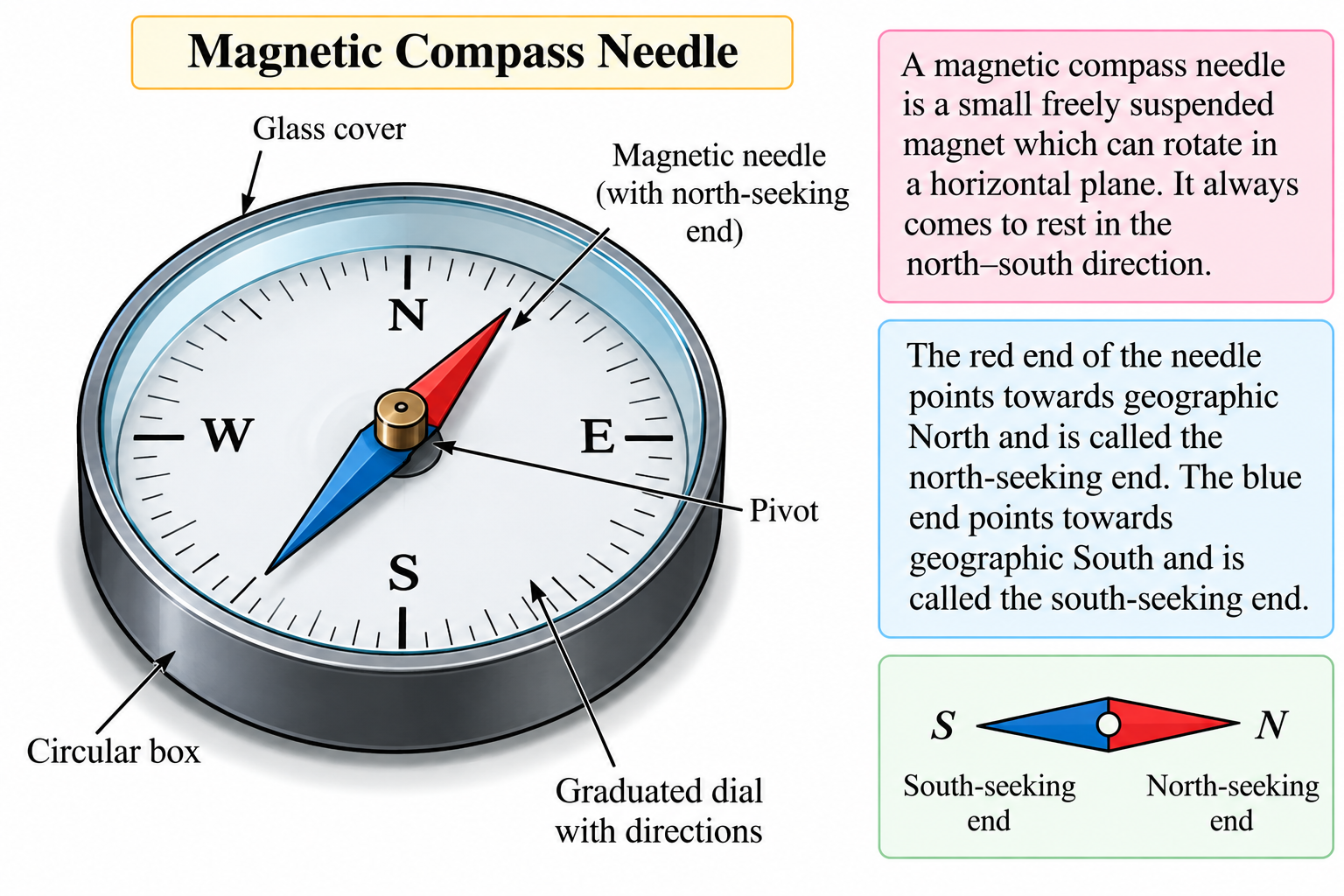
3. चुंबकीय कंपास सुई (Magnetic Compass Needle)
चुंबकीय कंपास सुई एक ऐसा उपकरण है, जो किसी चुंबक या धारावाही तार के चारों ओर चुंबकीय क्षेत्र की उपस्थिति का पता लगाती है।
4. ओर्स्टेड का प्रयोग (Oersted Experiment)
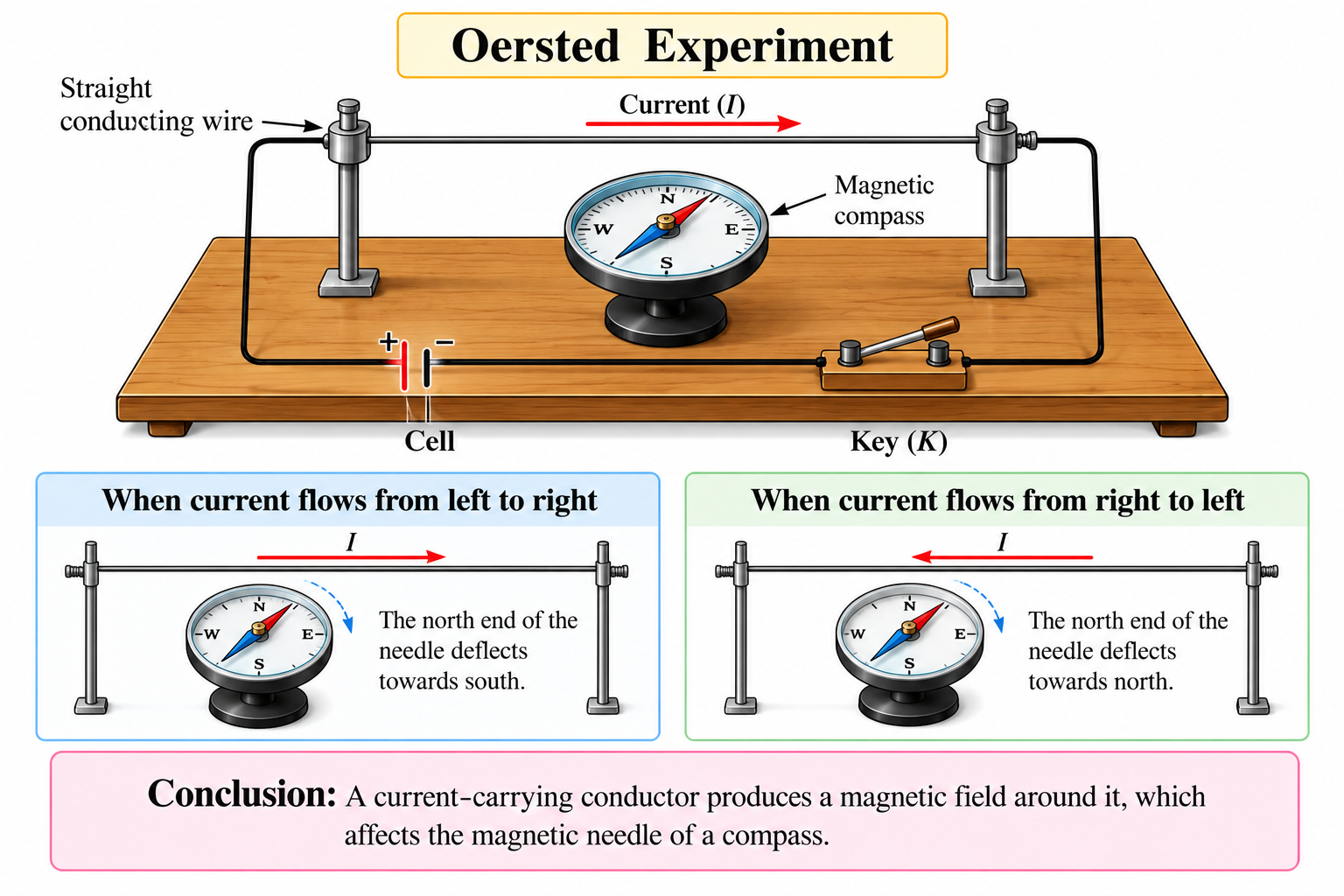
सन् 1820 में वैज्ञानिक हैंस क्रिश्चियन ओर्स्टेड (Hans Christian Oersted) ने यह प्रदर्शित करने के लिए एक प्रयोग किया कि गतिमान आवेश चुंबकीय क्षेत्र उत्पन्न करता है। इस प्रयोग को ओर्स्टेड का प्रयोग (Oersted Experiment) कहते हैं।
इस प्रयोग के लिए उन्होंने एक चालक तार, बैटरी, कुंजी तथा कंपास सुई का उपयोग किया।
प्रेक्षण (Observation)
- जब कुंजी खुली रहती है, तो कंपास सुई अपनी सामान्य स्थिति में रहती है।
- जब सुई को धारावाही तार के पास लाया जाता है, तो उसमें विक्षेप दिखाई देता है।
- जब सुई को तार के और पास लाया जाता है, तो विक्षेप अधिक हो जाता है।
निष्कर्ष (Conclusion)
ओर्स्टेड ने निष्कर्ष निकाला कि धारावाही चालक के चारों ओर एक विशेष गुण उपस्थित होता है, जो कंपास सुई को प्रभावित करता है।
अतः, गतिमान आवेश या धारावाही चालक चुंबकीय क्षेत्र उत्पन्न करता है।
5. चुंबकीय क्षेत्र – महत्वपूर्ण गुण
- चुंबकीय क्षेत्र एक सदिश राशि (Vector Quantity) है।
- इसकी प्रकृति तथा गुण त्रिविमीय (Three-Dimensional) होते हैं।
- यह अध्यारोपण सिद्धांत (Superposition Principle) का पालन करता है।
- यह गतिमान आवेशों के कारण उत्पन्न होता है।
- इसका SI मात्रक टेस्ला (T) है।
- इसका एक अन्य मात्रक वेबर प्रति मीटर वर्ग (Wb m−2) है।
- इसका CGS मात्रक गाउस (G) है।
1 T = 104 G
या:
1 G = 10−4 T
6. अध्यारोपण सिद्धांत (Superposition Principle)
अध्यारोपण सिद्धांत के अनुसार, परिणामी चुंबकीय क्षेत्र अलग-अलग चुंबकीय क्षेत्रों के सदिश योग के बराबर होता है।
Bnet = B₁ + B₂ + B₃ + ... + Bₙ
7. बायो-सावर्ट नियम (Biot–Savart Law)
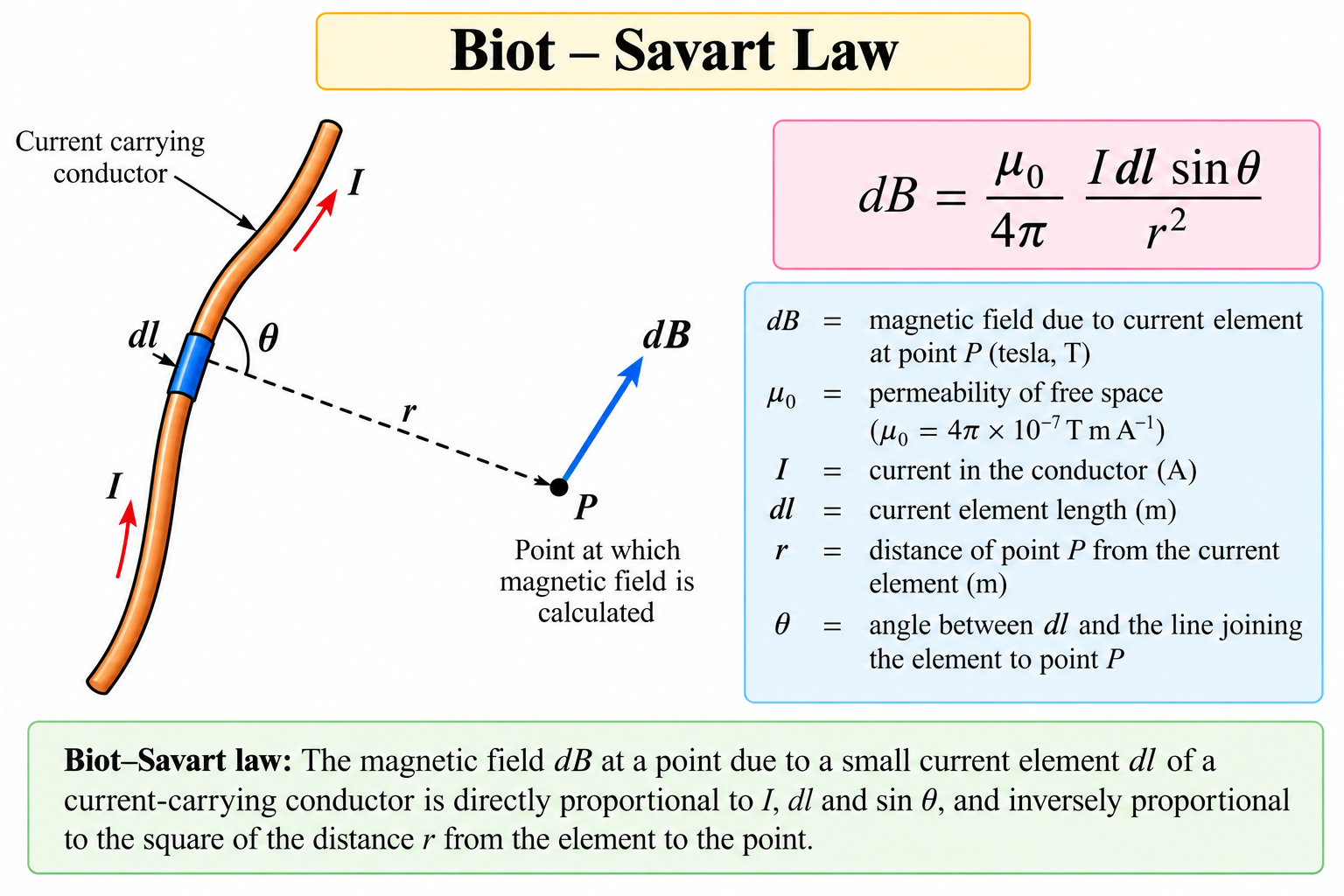
I धारा प्रवाहित करने वाले एक तार पर विचार कीजिए।
बायो-सावर्ट नियम के अनुसार, किसी धारावाही चालक के चारों ओर उत्पन्न चुंबकीय क्षेत्र:
- तार में प्रवाहित धारा I के समानुपाती होता है,
- छोटे लंबाई अवयव dl के समानुपाती होता है,
- sin θ के समानुपाती होता है, जहाँ θ तार के अवयव तथा प्रेक्षण बिंदु के बीच का कोण है,
- तार तथा प्रेक्षण बिंदु के बीच की दूरी के वर्ग के व्युत्क्रमानुपाती होता है।
dB ∝ I
dB ∝ dl
dB ∝ sin θ
dB ∝ 1/r²
इन सभी को मिलाने पर:
dB ∝ (I dl sin θ)/r²
अतः:
dB = (μ₀/4π)(I dl sin θ/r²)
जहाँ μ₀/4π समानुपाती नियतांक (Proportionality Constant) है।
8. वृत्ताकार कुंडली के केंद्र पर चुंबकीय क्षेत्र
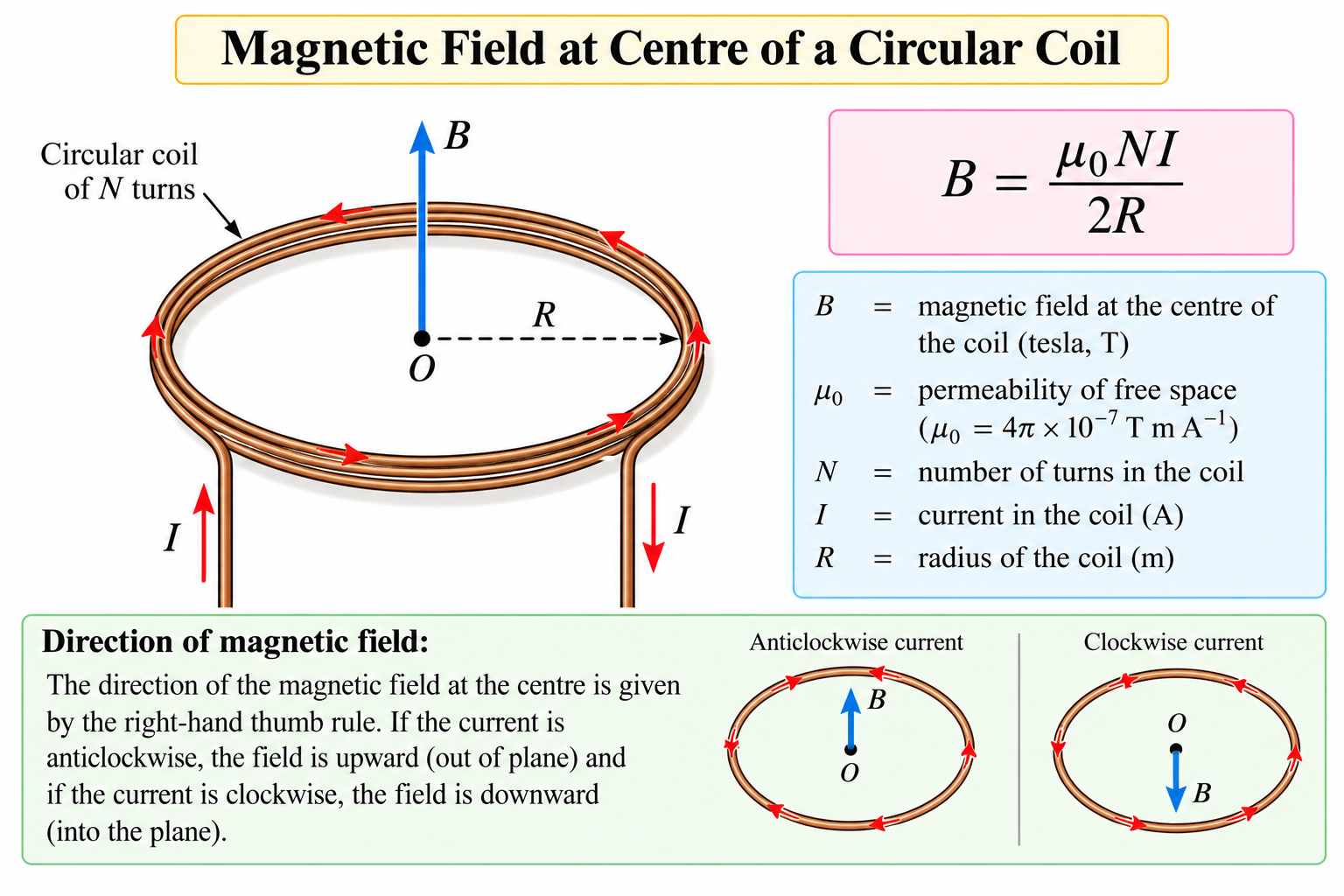
केंद्र O तथा त्रिज्या R वाली एक वृत्ताकार कुंडली पर विचार कीजिए। dl लंबाई का एक छोटा अवयव लीजिए, जिसमें I धारा प्रवाहित हो रही है।
बायो-सावर्ट नियम के अनुसार:
dB = (μ₀/4π)(I dl sin θ/R²)
यहाँ:
θ = 90°
अतः:
dB = (μ₀/4π)(I dl/R²)
कुल चुंबकीय क्षेत्र:
B = ∫dB
B = (μ₀I/4πR²) ∫dl
एक पूर्ण वृत्ताकार कुंडली के लिए:
∫dl = 2πR
अतः:
B = μ₀I/2R
N फेरों के लिए
N फेरों वाली वृत्ताकार कुंडली के लिए:
B = μ₀NI/2R
9. दाएँ हाथ के अंगूठे का नियम (Right-Hand Thumb Rule)
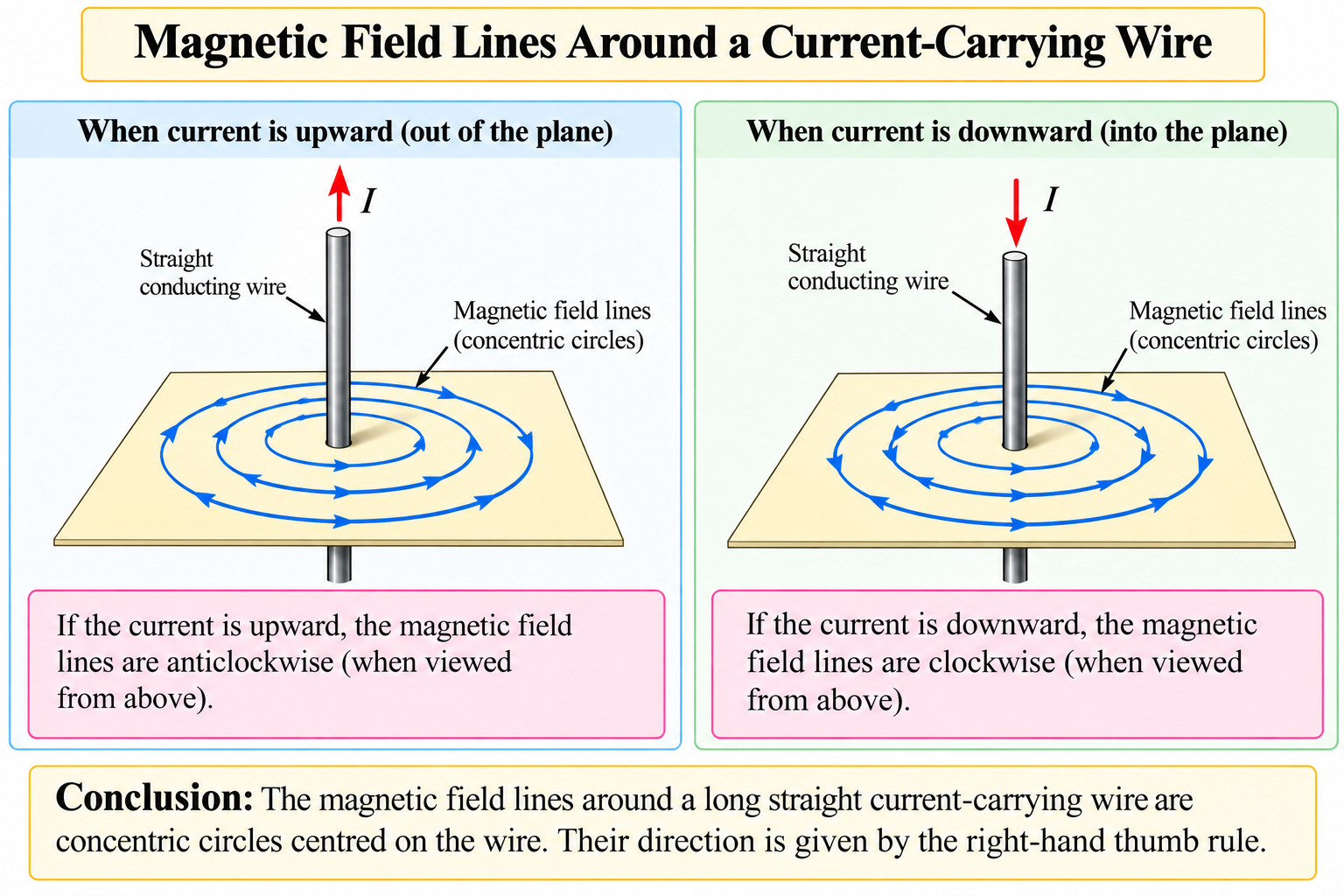
एक सीधे धारावाही तार को दाएँ हाथ की हथेली में पकड़ा हुआ मानिए। यदि अंगूठा धारा की दिशा को दर्शाता है, तो मुड़ी हुई उँगलियाँ चुंबकीय क्षेत्र की दिशा को दर्शाती हैं।
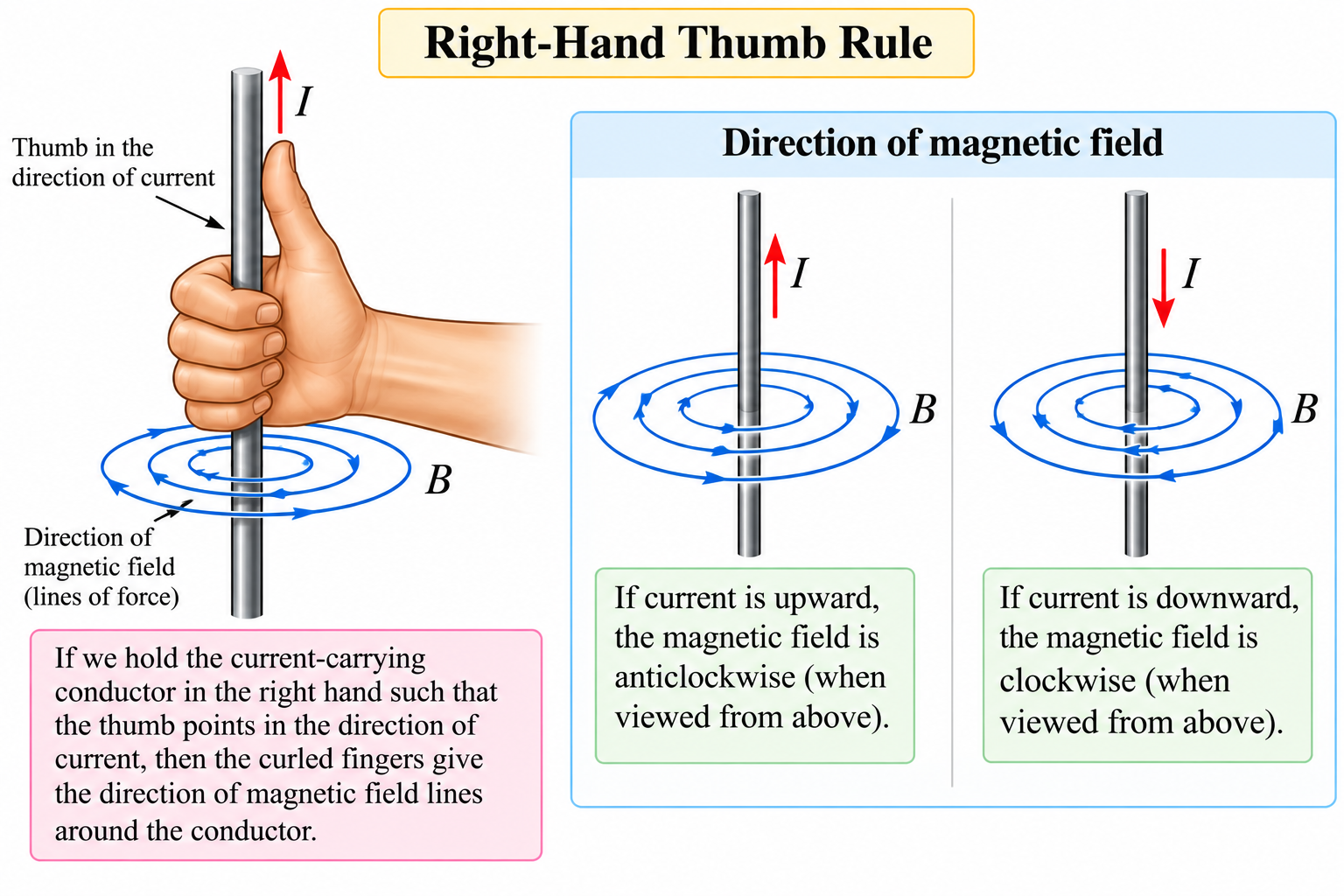
सीधे धारावाही चालक के चारों ओर चुंबकीय क्षेत्र रेखाएँ वृत्ताकार होती हैं।
10. धारावाही वृत्ताकार कुंडली की अक्ष पर चुंबकीय क्षेत्र
केंद्र O तथा त्रिज्या R वाली एक धारावाही वृत्ताकार कुंडली पर विचार कीजिए। कुंडली में I धारा प्रवाहित हो रही है।
माना P कुंडली की अक्ष पर उसके केंद्र से x दूरी पर स्थित एक बिंदु है।
बायो-सावर्ट नियम के अनुसार:
dB = (μ₀/4π)(I dl sin 90°/r²)
अतः:
dB = (μ₀/4π)(I dl/r²)
चुंबकीय क्षेत्र को विभिन्न घटकों में विभाजित किया जा सकता है।
अक्ष के लंबवत घटक एक-दूसरे को निरस्त कर देते हैं, जबकि अक्ष के अनुदिश घटक आपस में जुड़ जाते हैं।
ज्यामिति से:
sin θ = R/√(R² + x²)
अतः:
B = μ₀IR² / [2(R² + x²)3/2]
11. सीधे धारावाही चालक के कारण चुंबकीय क्षेत्र
I धारा प्रवाहित करने वाले सीधे तार XY पर विचार कीजिए। माना P तार से r लंबवत दूरी पर स्थित एक बिंदु है।
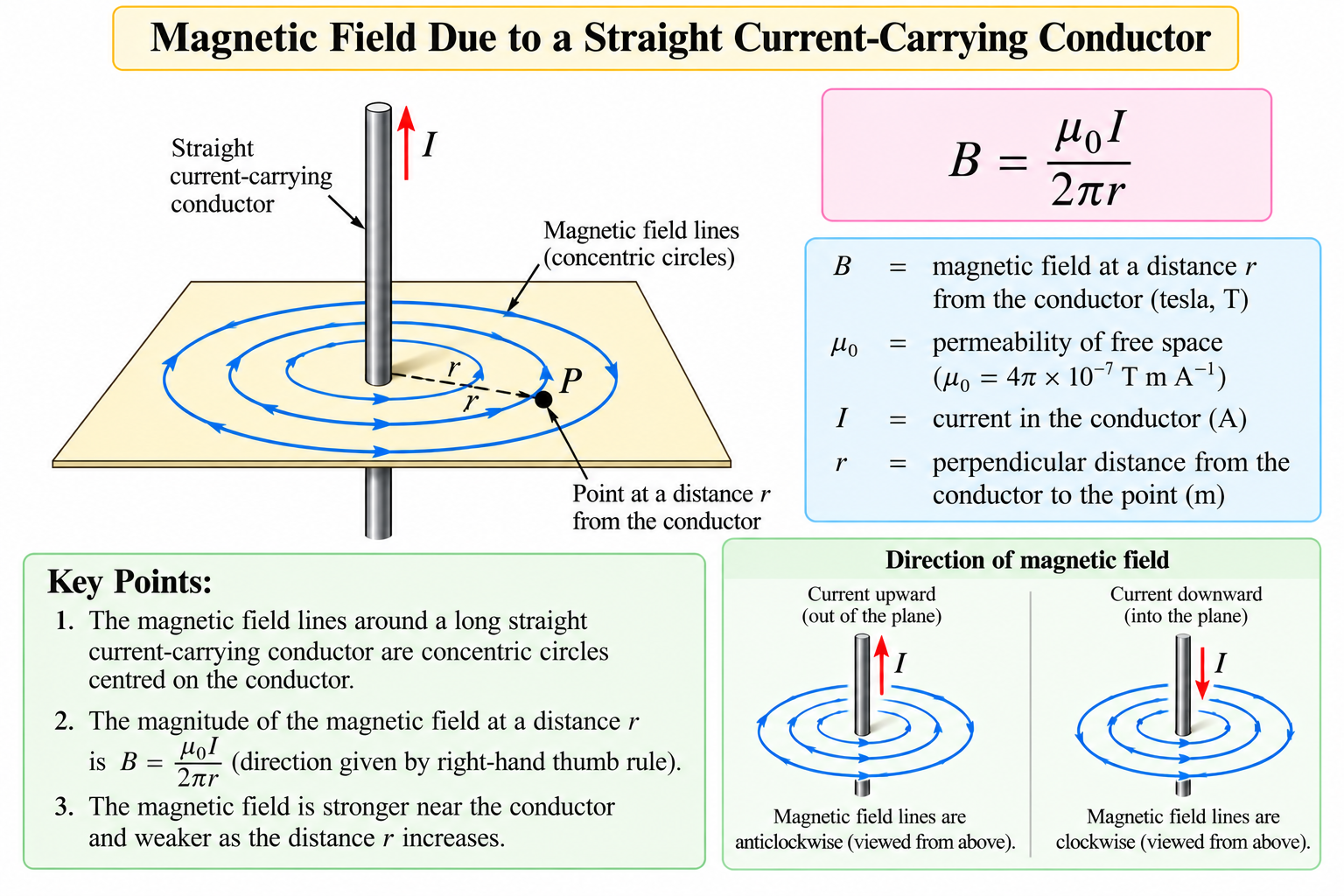
बायो-सावर्ट नियम के अनुसार:
dB = (μ₀/4π)(I dl sin(90° − θ)/x²)
चूँकि:
sin(90° − θ) = cos θ
अतः:
dB = (μ₀/4π)(I dl cos θ/x²)
ज्यामिति से:
dl = r sec²θ dθ
तथा:
x = r/cos θ
मान रखने तथा समाकलन करने पर:
B = (μ₀I/4πr)(sin θ₁ + sin θ₂)
अनंत लंबे सीधे तार के लिए
अनंत लंबे तार के लिए:
θ₁ = θ₂ = 90°
अतः:
B = μ₀I/2πr
12. एम्पियर का परिपथीय नियम (Ampere's Circuital Law)
एम्पियर के परिपथीय नियम के अनुसार, चुंबकीय क्षेत्र का रेखा समाकलन तार में प्रवाहित धारा के μ₀ गुना के बराबर होता है।
∮B · dl = μ₀I
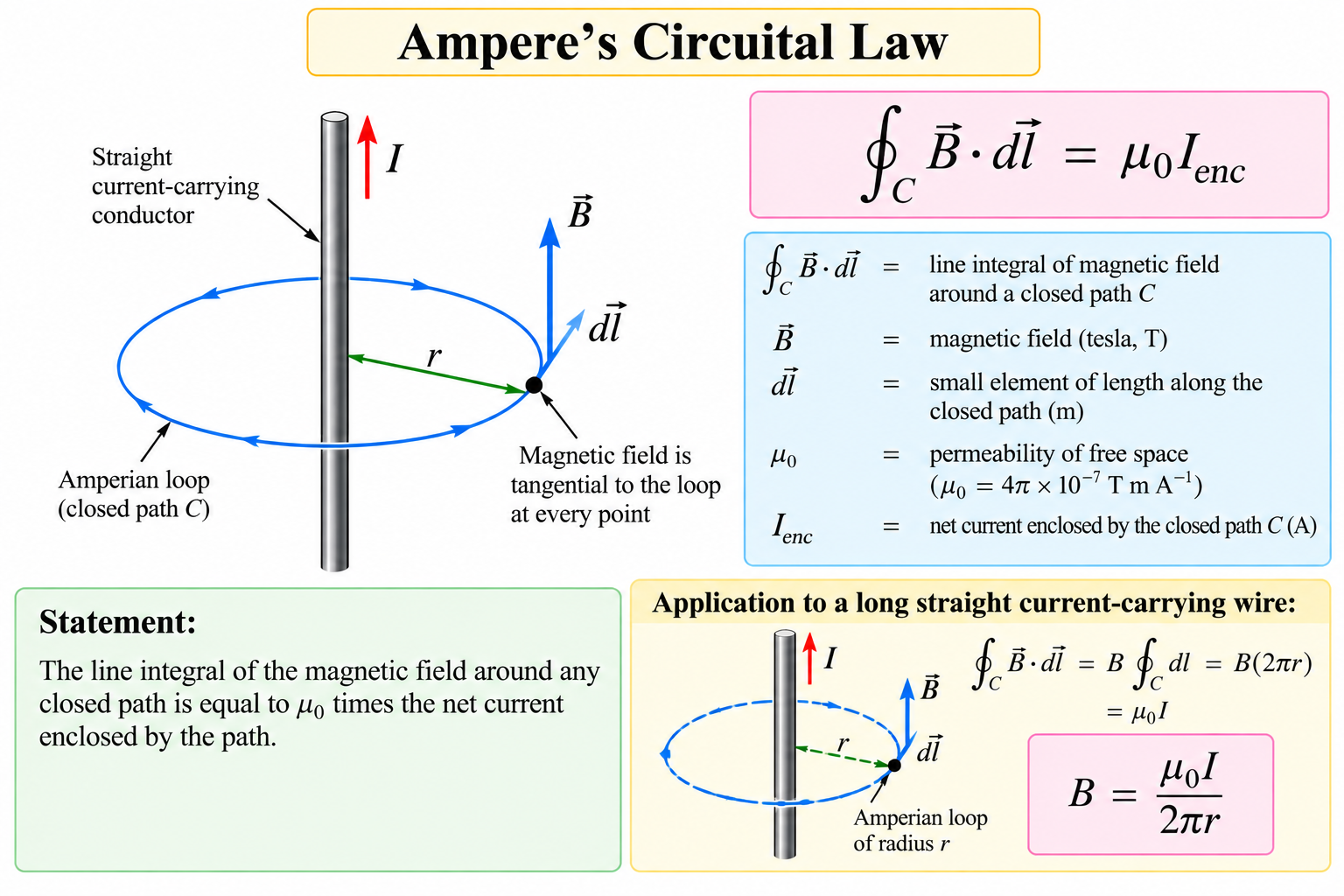
एम्पियर के परिपथीय नियम के अनुप्रयोग
- सीधे तार के कारण चुंबकीय क्षेत्र
- परिनालिका (Solenoid) के कारण चुंबकीय क्षेत्र
- टोरॉइड (Toroid) के कारण चुंबकीय क्षेत्र
13. एम्पियर के नियम द्वारा सीधे तार के कारण चुंबकीय क्षेत्र
एक धारावाही तार पर विचार कीजिए। माना तार के चारों ओर r त्रिज्या का एक वृत्ताकार एम्पियरी लूप (Amperian Loop) लिया गया है।
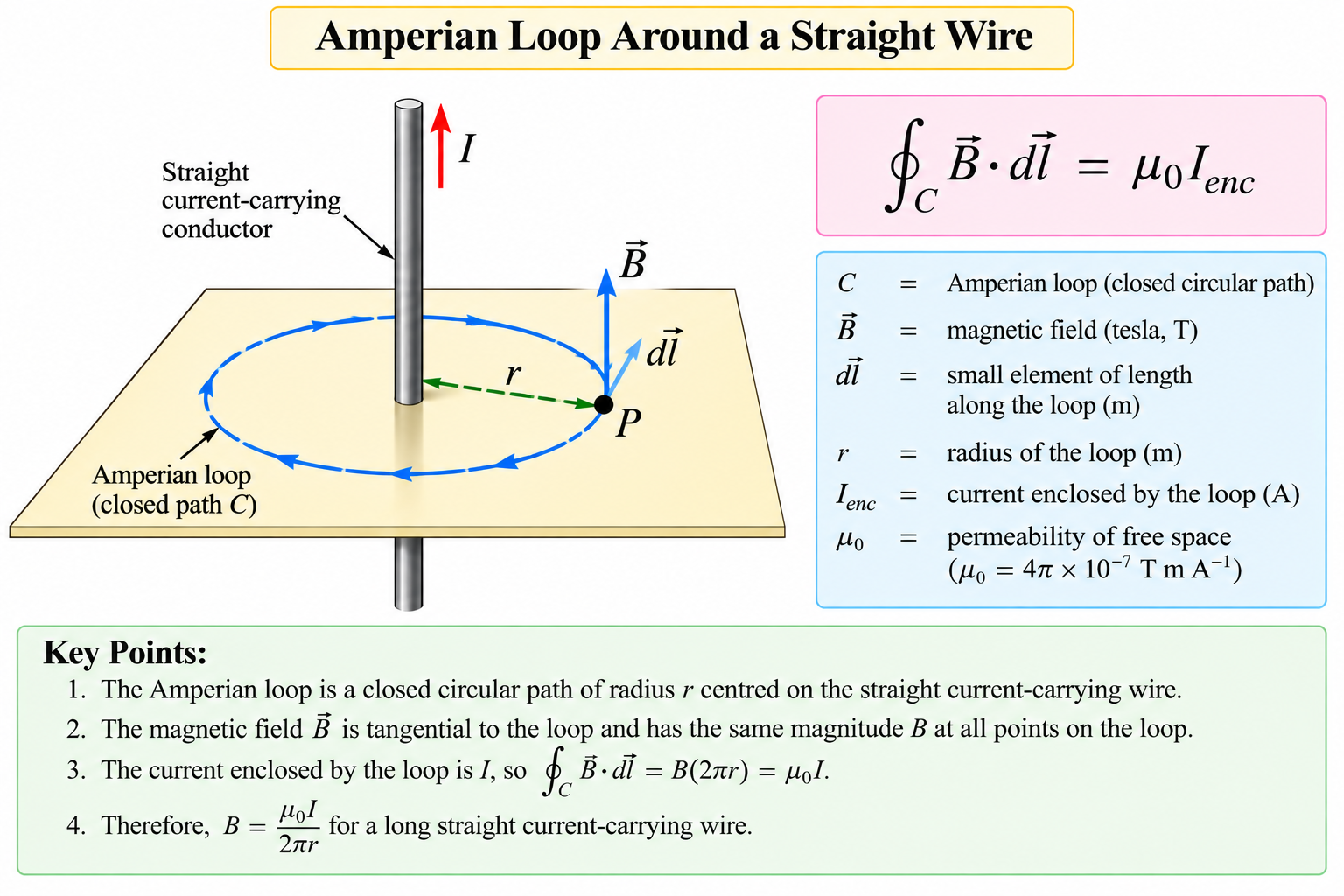
एम्पियर के परिपथीय नियम के अनुसार:
∮B · dl = μ₀I
चूँकि वृत्ताकार पथ पर चुंबकीय क्षेत्र का मान नियत रहता है:
B ∮dl = μ₀I
वृत्ताकार पथ के लिए:
∮dl = 2πr
अतः:
B(2πr) = μ₀I
इसलिए:
B = μ₀I/2πr
14. परिनालिका (Solenoid)
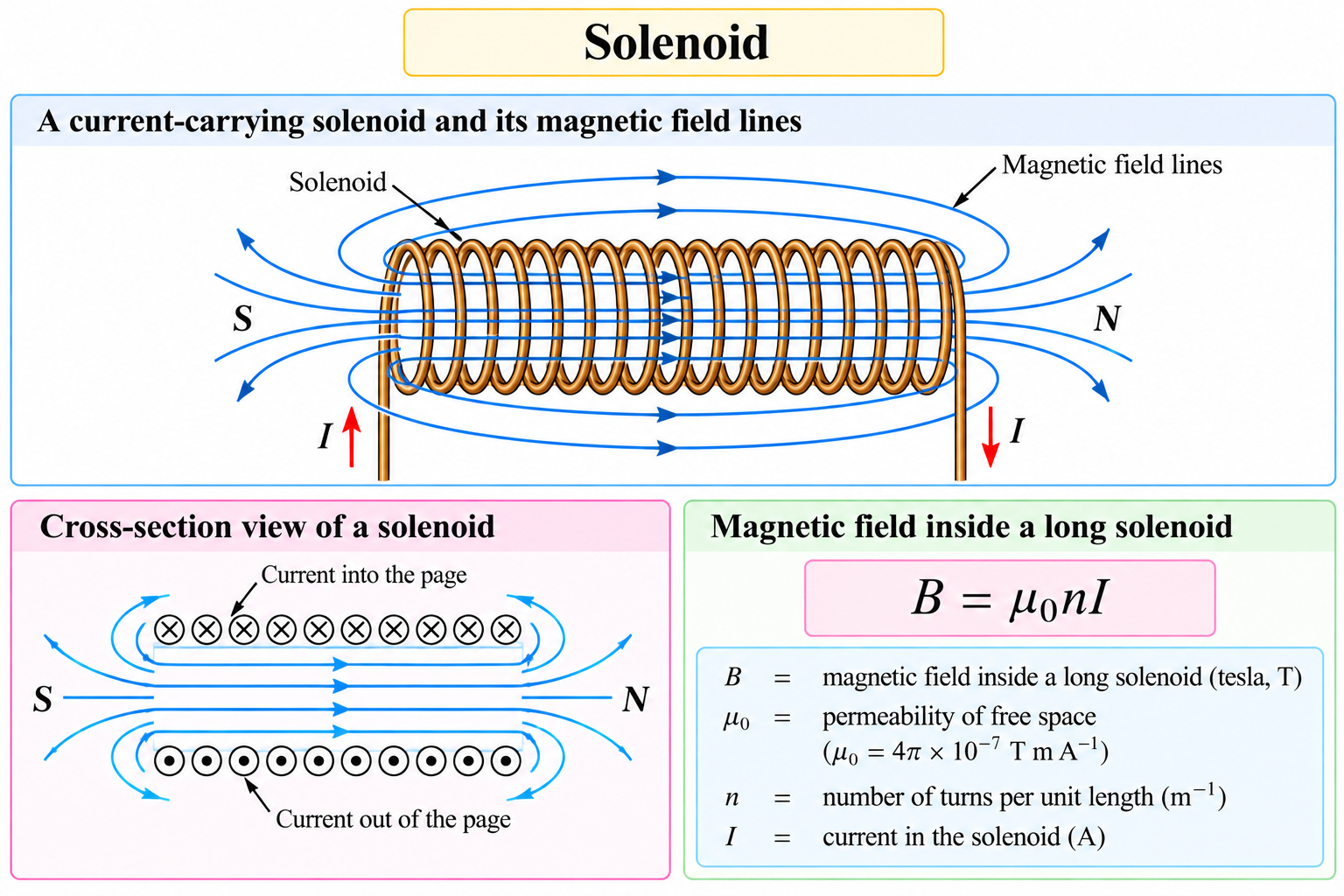
परिनालिका (Solenoid) एक लंबा विद्युतरोधी तार होता है, जिसे खोखले बेलनाकार कार्डबोर्ड पर कुंडलिनी (Helix) के रूप में लपेटा जाता है।
15. परिनालिका के बाहर चुंबकीय क्षेत्र
माना किसी परिनालिका में प्रति इकाई लंबाई फेरों की संख्या n है तथा उसमें I धारा प्रवाहित हो रही है।
परिनालिका के बाहर एक एम्पियरी लूप लिया जाता है।
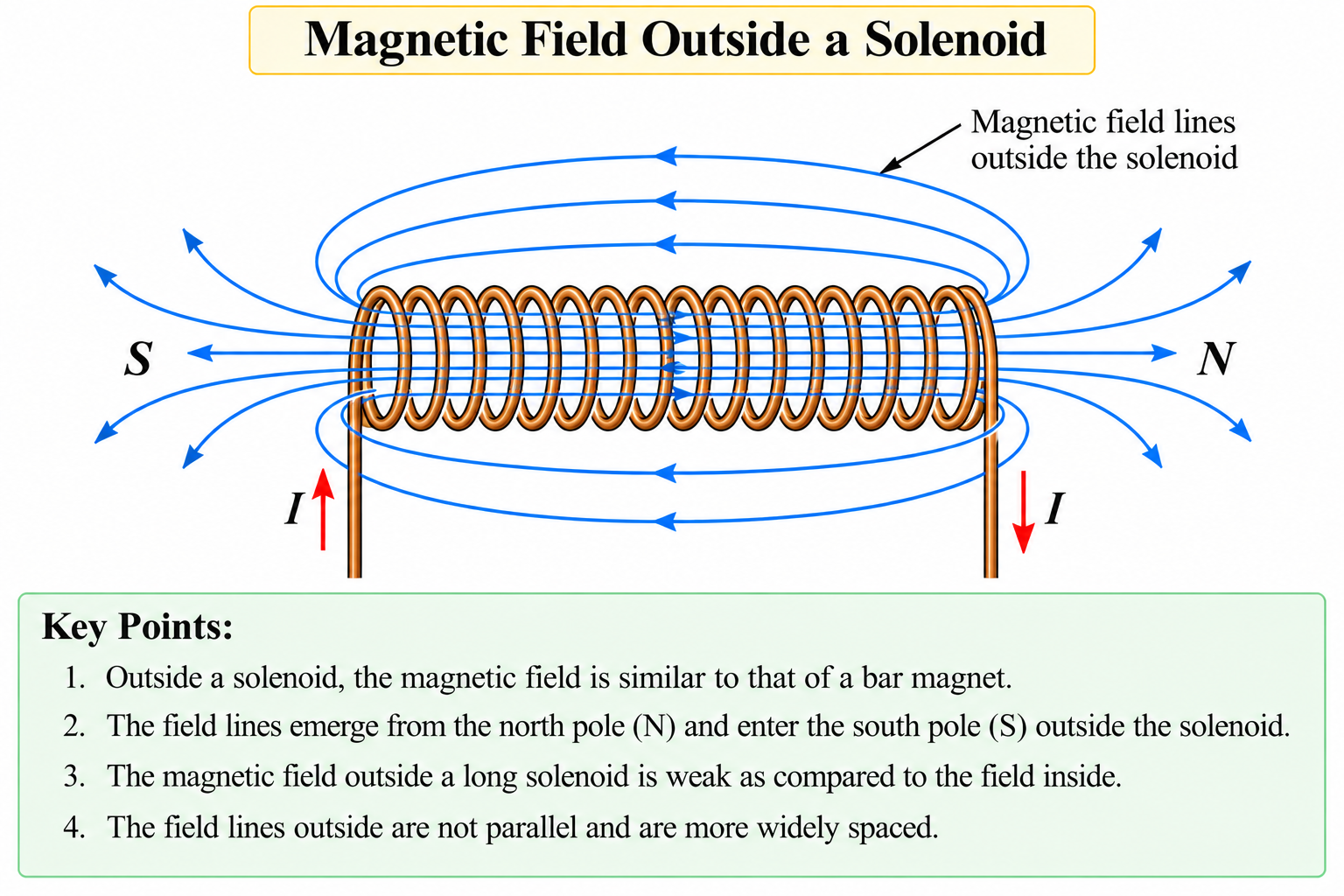
एम्पियर के परिपथीय नियम का उपयोग करने पर:
∮B · dl = μ₀nIl
परिनालिका के बाहर लिए गए पथ के लिए कुल परिबद्ध धारा (Enclosed Current) शून्य होती है।
अतः:
Bl = 0
इसलिए:
B = 0
16. परिनालिका के भीतर चुंबकीय क्षेत्र
माना किसी परिनालिका में प्रति इकाई लंबाई फेरों की संख्या n है तथा उसमें I धारा प्रवाहित हो रही है।
परिनालिका के भीतर एक आयताकार एम्पियरी लूप लिया जाता है।
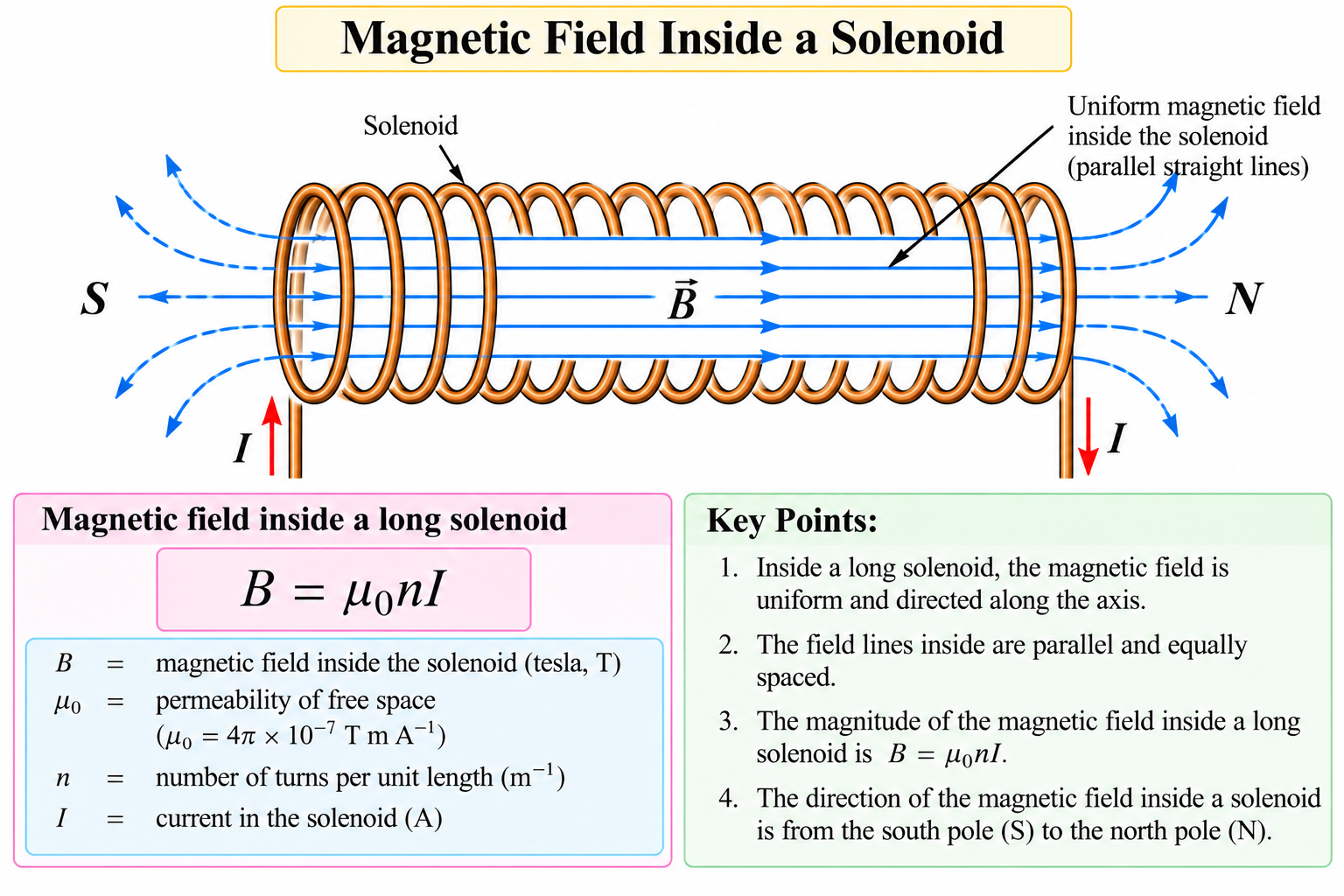
एम्पियर के परिपथीय नियम का उपयोग करने पर:
∮B · dl = μ₀nIl
चयनित एम्पियरी लूप में केवल परिनालिका के अंदर वाला भाग रेखा समाकलन में योगदान देता है।
अतः:
Bl = μ₀nIl
इसलिए:
B = μ₀nI
17. टोरॉइडी परिनालिका अथवा टोरॉइड (Toroidal Solenoid or Toroid)
वृत्ताकार वलय के रूप में बनी परिनालिका को टोरॉइडी परिनालिका अथवा टोरॉइड (Toroid) कहते हैं।
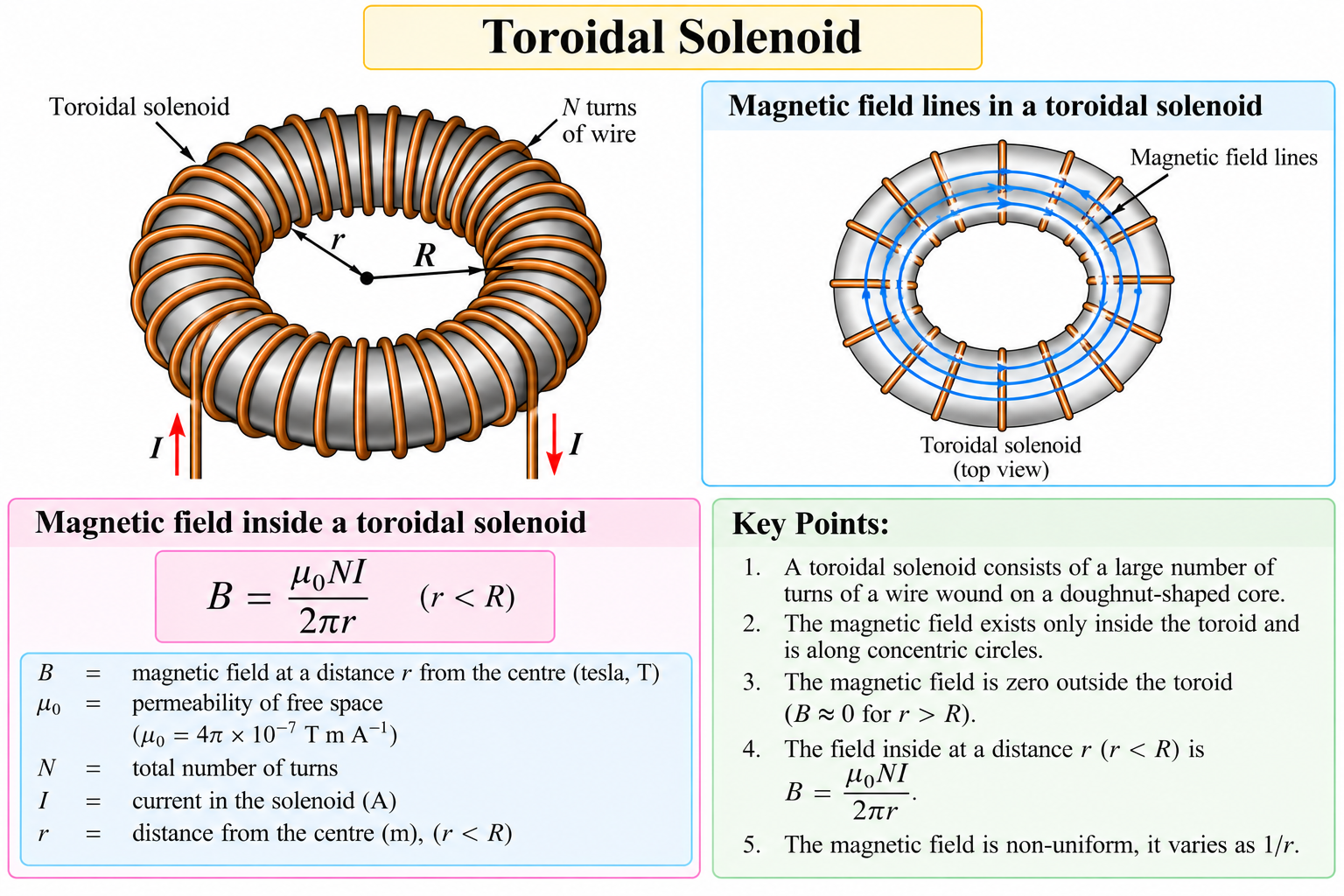
18. टोरॉइड के भीतर चुंबकीय क्षेत्र
माना किसी टोरॉइड में प्रति इकाई लंबाई फेरों की संख्या n है तथा उसमें I धारा प्रवाहित हो रही है।
टोरॉइड के भीतर एक वृत्ताकार एम्पियरी लूप लिया जाता है।
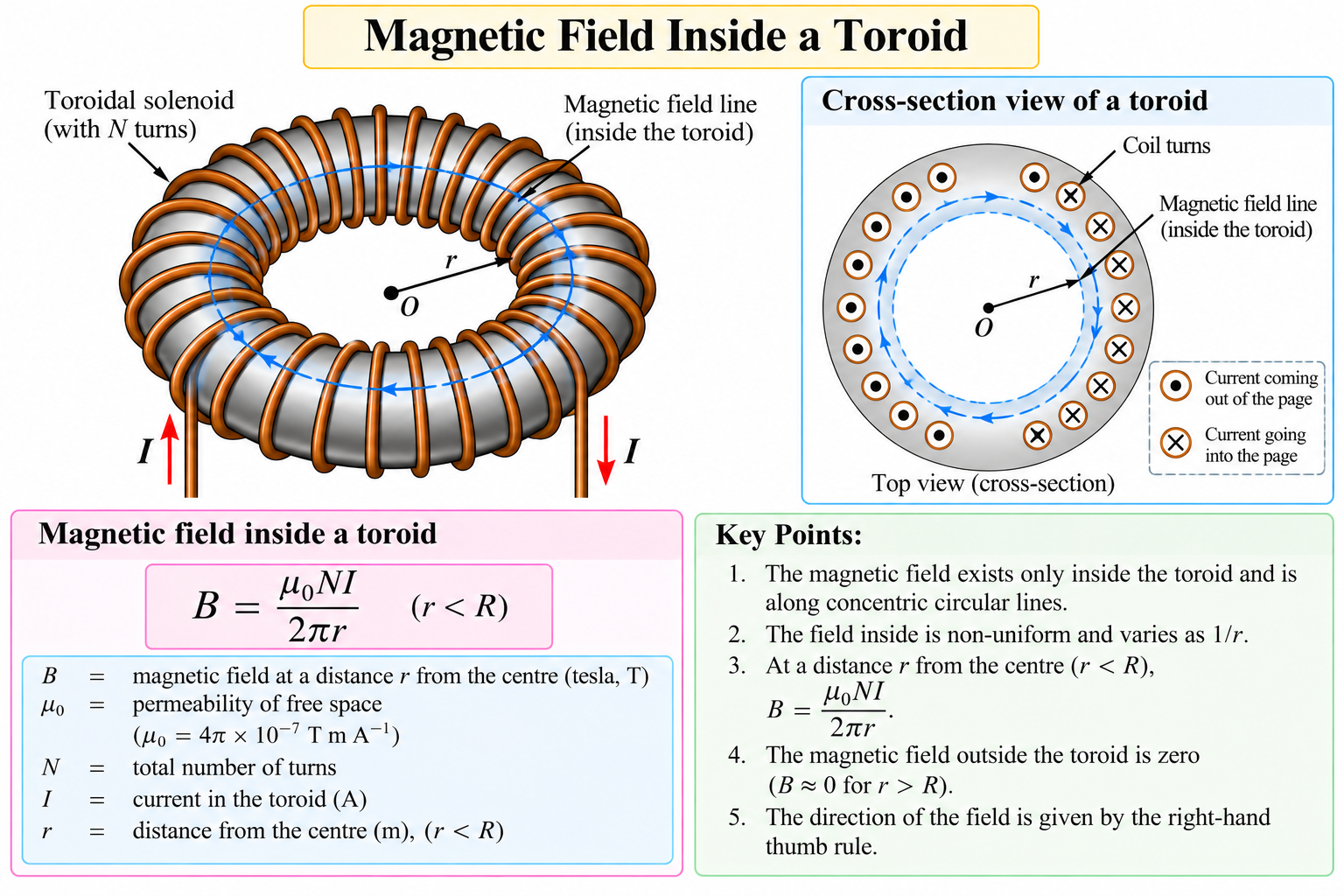
एम्पियर के परिपथीय नियम के अनुसार:
∮B · dl = μ₀ × लूप द्वारा परिबद्ध धारा
PDF में दर्शाए गए क्षेत्र के लिए चयनित लूप द्वारा परिबद्ध धारा शून्य है।
अतः:
∮B · dl = 0
इसलिए:
B = 0
19. टोरॉइड के बाहर चुंबकीय क्षेत्र
टोरॉइड के बाहर एक वृत्ताकार एम्पियरी लूप पर विचार कीजिए।
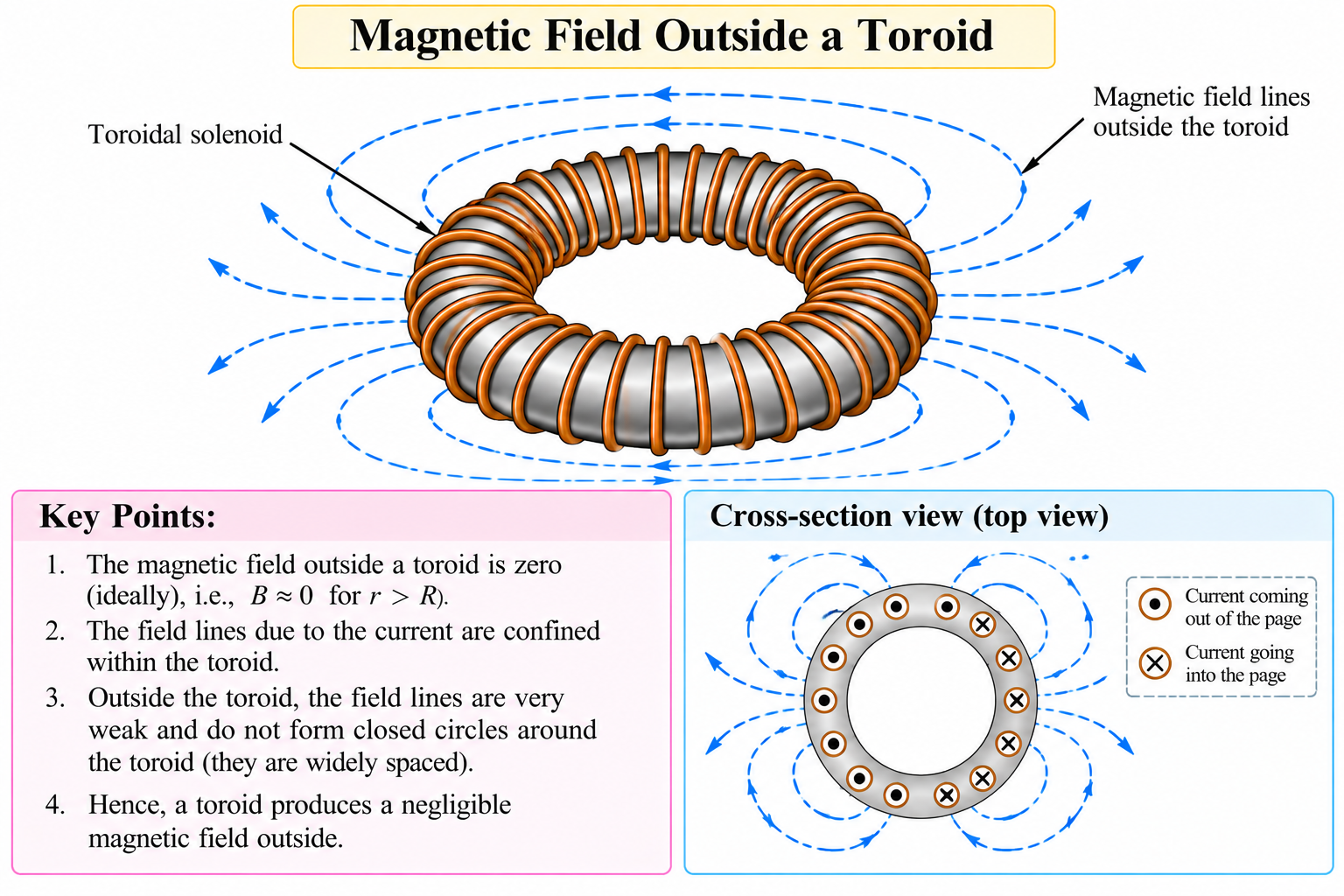
एम्पियर के परिपथीय नियम के अनुसार, लूप द्वारा परिबद्ध कुल धारा शून्य होती है।
अतः:
∮B · dl = 0
इसलिए:
B = 0
20. टोरॉइड की अक्ष पर चुंबकीय क्षेत्र
टोरॉइड की अक्ष के अनुदिश एक वृत्ताकार एम्पियरी लूप पर विचार कीजिए।
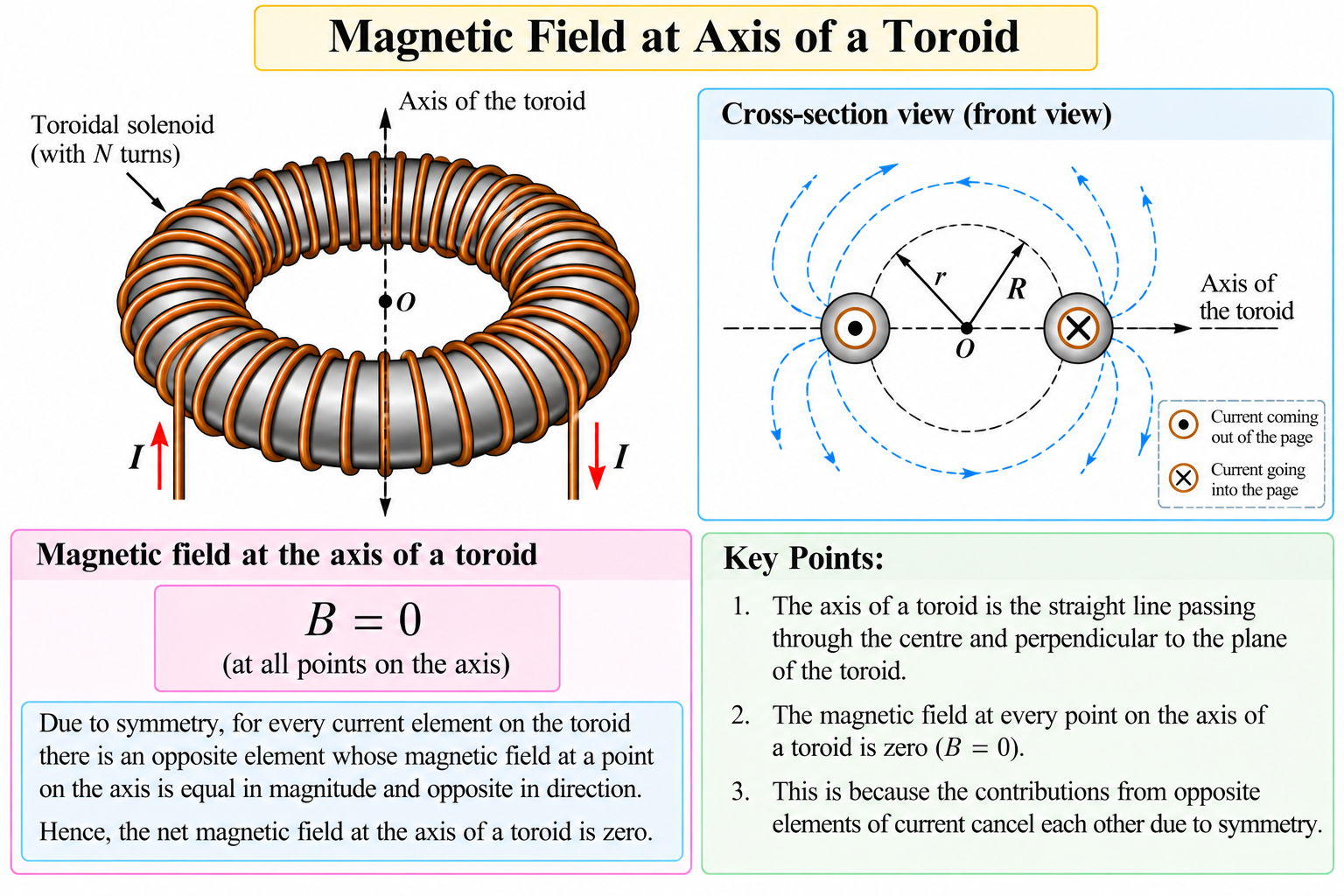
एम्पियर के परिपथीय नियम के अनुसार:
∮B · dl = μ₀ × परिबद्ध धारा
PDF में लिए गए क्षेत्र के लिए:
Bl = μ₀nIl
अतः:
B = μ₀nI
21. चुंबकीय क्षेत्र में आवेश पर बल
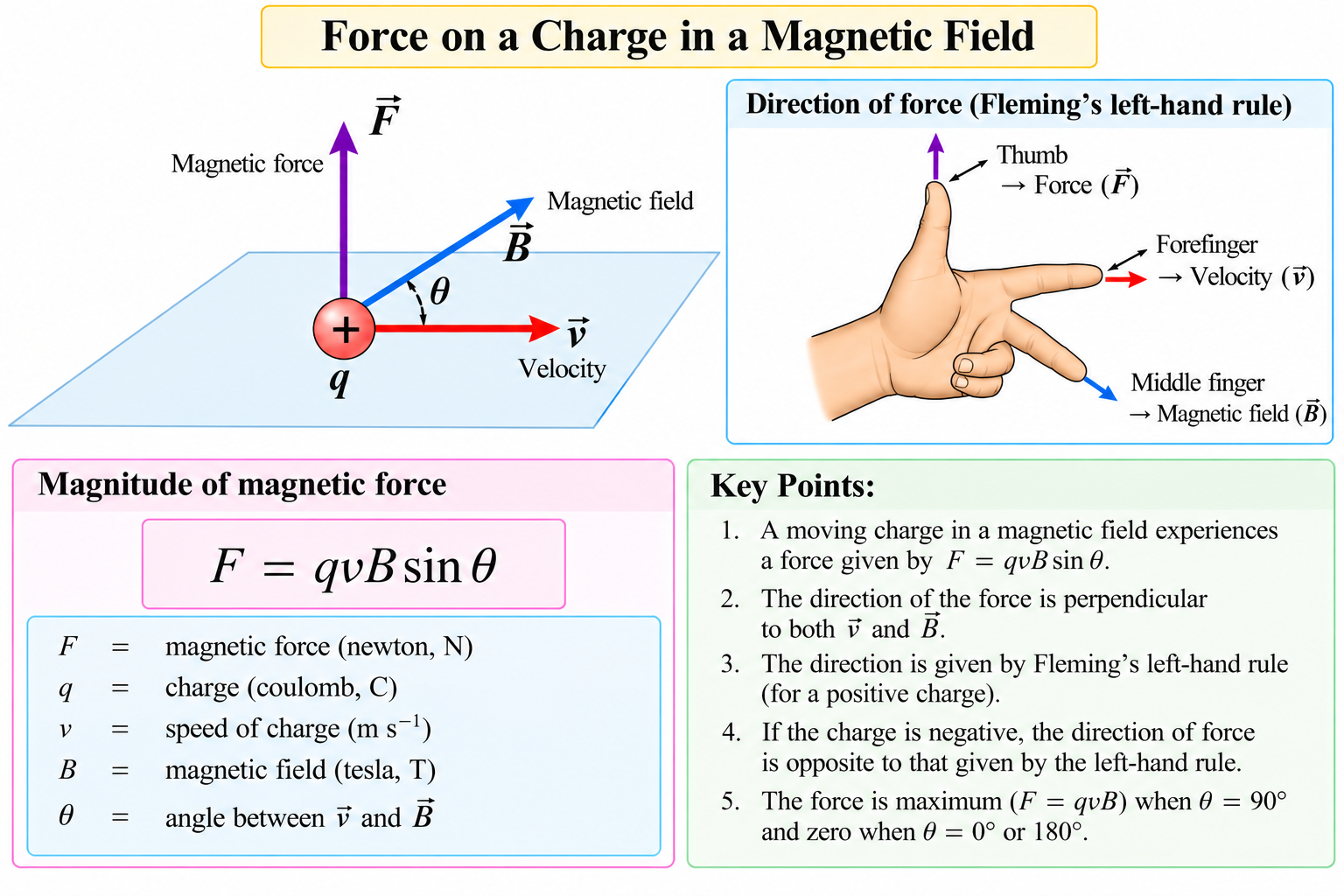
एकसमान चुंबकीय क्षेत्र B में v वेग से गतिमान q आवेश पर विचार कीजिए।
आवेश द्वारा अनुभव किया जाने वाला चुंबकीय बल निम्नलिखित पर निर्भर करता है:
- आवेश की मात्रा q
- वेग का परिमाण v
- चुंबकीय क्षेत्र की तीव्रता B
अतः:
Fm ∝ q
Fm ∝ v
Fm ∝ B
चूँकि बल, वेग तथा चुंबकीय क्षेत्र सदिश राशियाँ हैं:
Fm = q(v × B)
परिमाण में:
Fm = qvB sin θ
जहाँ θ, v तथा B के बीच का कोण है।
विशेष स्थितियाँ
- यदि θ = 90°, तो Fm = qvB। चुंबकीय बल अधिकतम होता है।
- यदि θ = 0°, तो Fm = 0।
- यदि θ = 180°, तो Fm = 0।
22. चुंबकीय प्रेरण (Magnetic Induction)
चुंबकीय प्रेरण संख्यात्मक रूप से उस चुंबकीय बल के बराबर होता है, जिसे एक कूलॉम आवेश वाला कण 1 m s−1 के वेग से चुंबकीय क्षेत्र के लंबवत प्रवेश करने पर अनुभव करता है।
सूत्र:
F = qvB
से:
B = F/qv
SI मात्रक
चुंबकीय प्रेरण का SI मात्रक टेस्ला (T) है।
1 T = 1 N A−1 m−1
एक टेस्ला वह चुंबकीय क्षेत्र है, जिसमें एक कूलॉम आवेश 1 m s−1 के वेग से चुंबकीय क्षेत्र के लंबवत गति करने पर एक न्यूटन बल का अनुभव करता है।
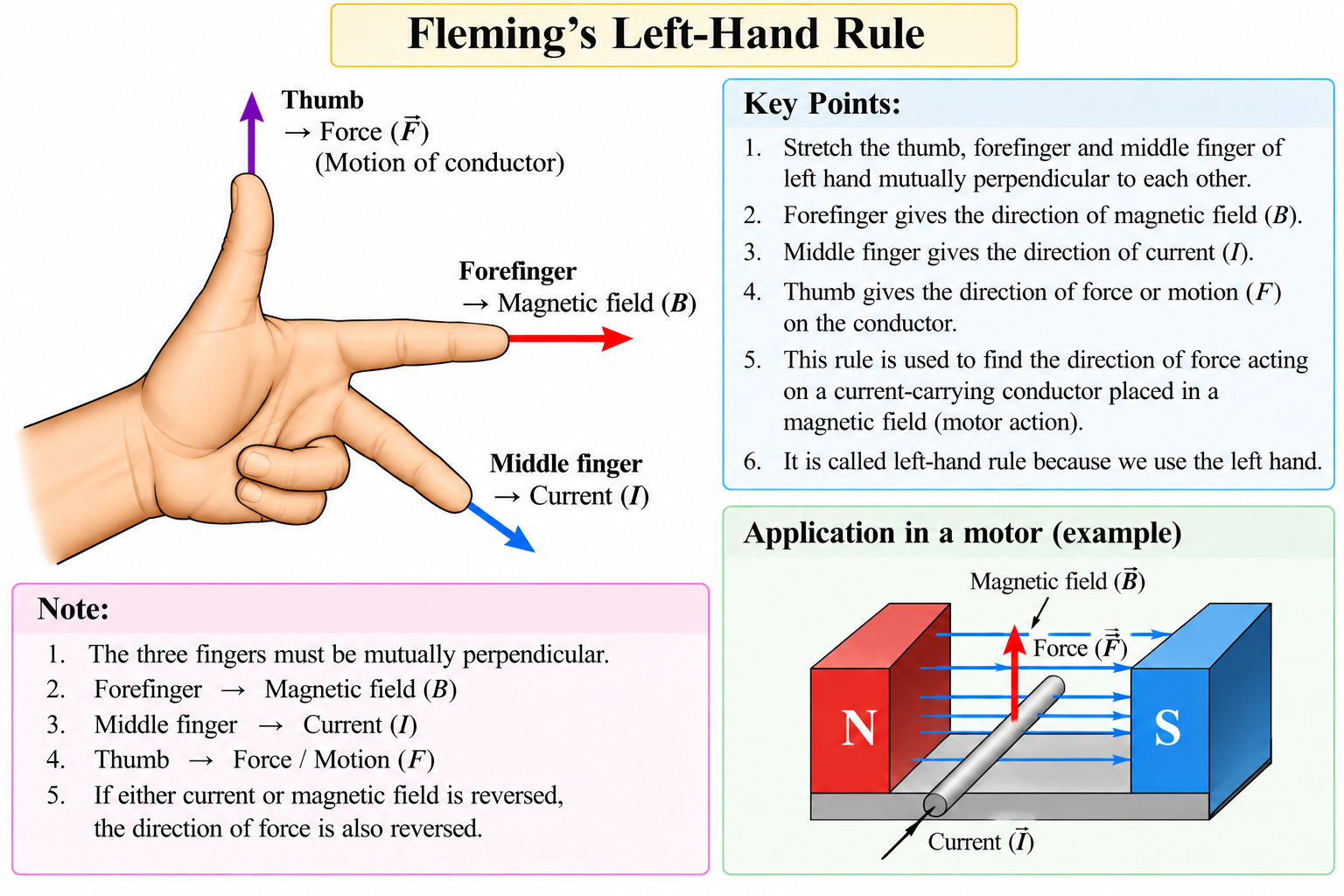
23. फ्लेमिंग के बाएँ हाथ का नियम (Fleming's Left-Hand Rule)
यदि बाएँ हाथ के अंगूठे, तर्जनी तथा मध्यमा उँगली को एक-दूसरे के परस्पर लंबवत फैलाया जाए, तो:
- अंगूठा (Thumb): बल की दिशा
- तर्जनी (Forefinger): चुंबकीय क्षेत्र की दिशा
- मध्यमा उँगली (Central Finger): धारा या वेग की दिशा
24. लॉरेंट्ज चुंबकीय बल (Lorentz Magnetic Force)
जब कोई आवेशित कण v वेग से एकसमान चुंबकीय क्षेत्र B में प्रवेश करता है, तो वह चुंबकीय बल का अनुभव करता है।
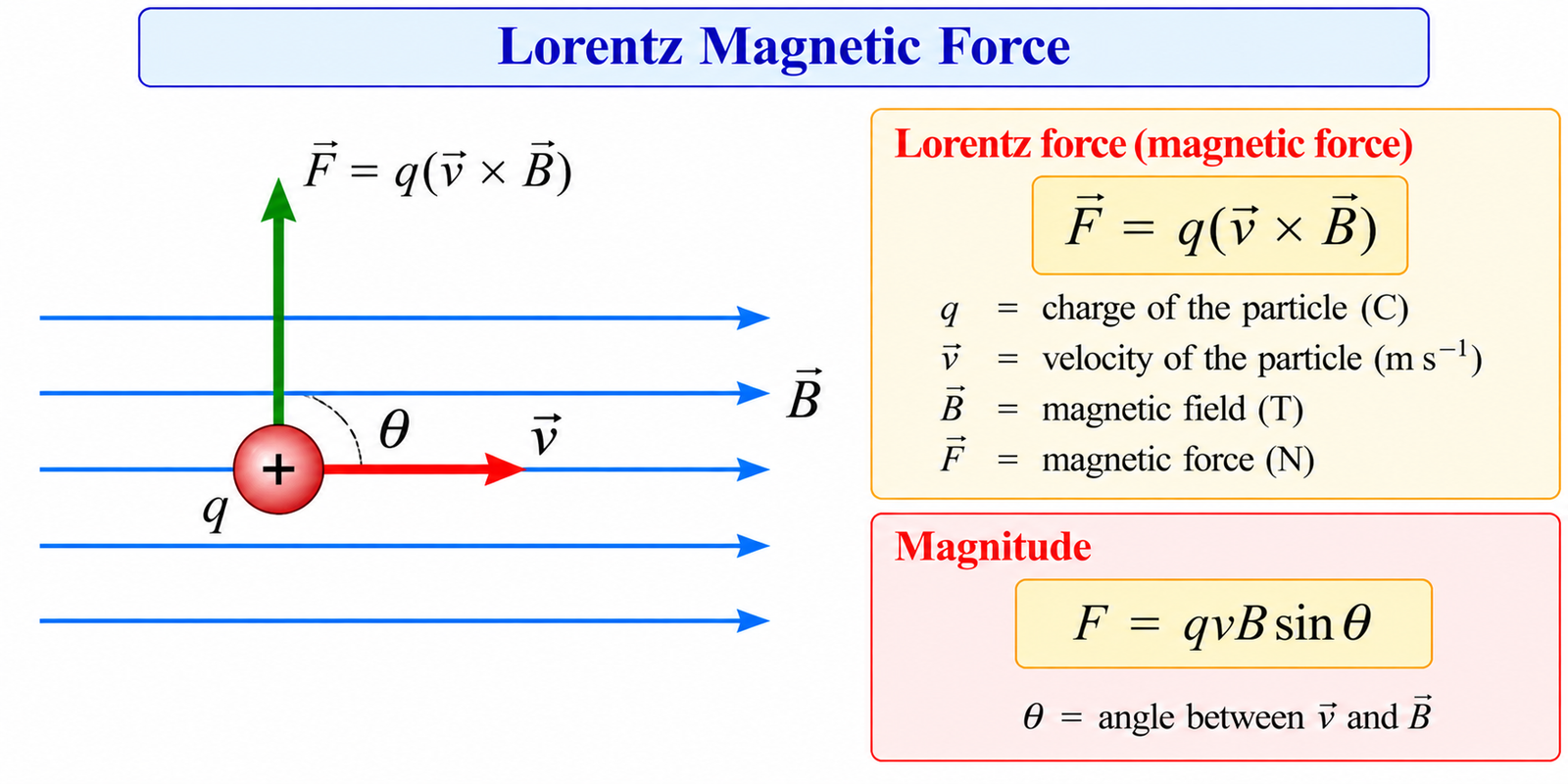
Fm = q(v × B)
गतिमान आवेश भी चुंबकीय क्षेत्र उत्पन्न करता है।
वैद्युत बल है:
Fe = qE
वैद्युत तथा चुंबकीय बलों को जोड़ने पर:
F = qE + q(v × B)
या:
F = q[E + (v × B)]
वैद्युत बल तथा चुंबकीय बल के संयुक्त प्रभाव को लॉरेंट्ज बल (Lorentz Force) कहते हैं।
Keep preparing
Available in the app
- Complete NotesConfirmed for this chapter
- Important QuestionsConfirmed for this chapter
- Previous Year QuestionsConfirmed for this chapter
- Revision NotesConfirmed for this chapter