Chapter 4
Moving Charges and Magnetism
Preview Moving Charges and Magnetism for Physics in JAC 12th (SCI.).
A quick look
Study material preview
Notes
Moving Charges and Magnetism
1. Magnetism
The branch of Physics that deals with magnets, their properties, behaviour, nature and applications is called magnetism.
Electromagnetism
Magnetism produced due to the flow of charges is called electromagnetism.
2. Magnetic Field
The region around a magnet in which another magnet experiences magnetic force is called a magnetic field.
Magnetic Force
The force between two magnets is called magnetic force.
Electric Force
The force between two charges is called electric force.
Fe = qE
There exists an electric field but not necessarily a magnetic field.
The electric field is indicated by E.
Magnetic Force
The force between two magnets or two current-carrying wires is called magnetic force.
Fm = q(v × B)
The magnetic field is indicated by B.
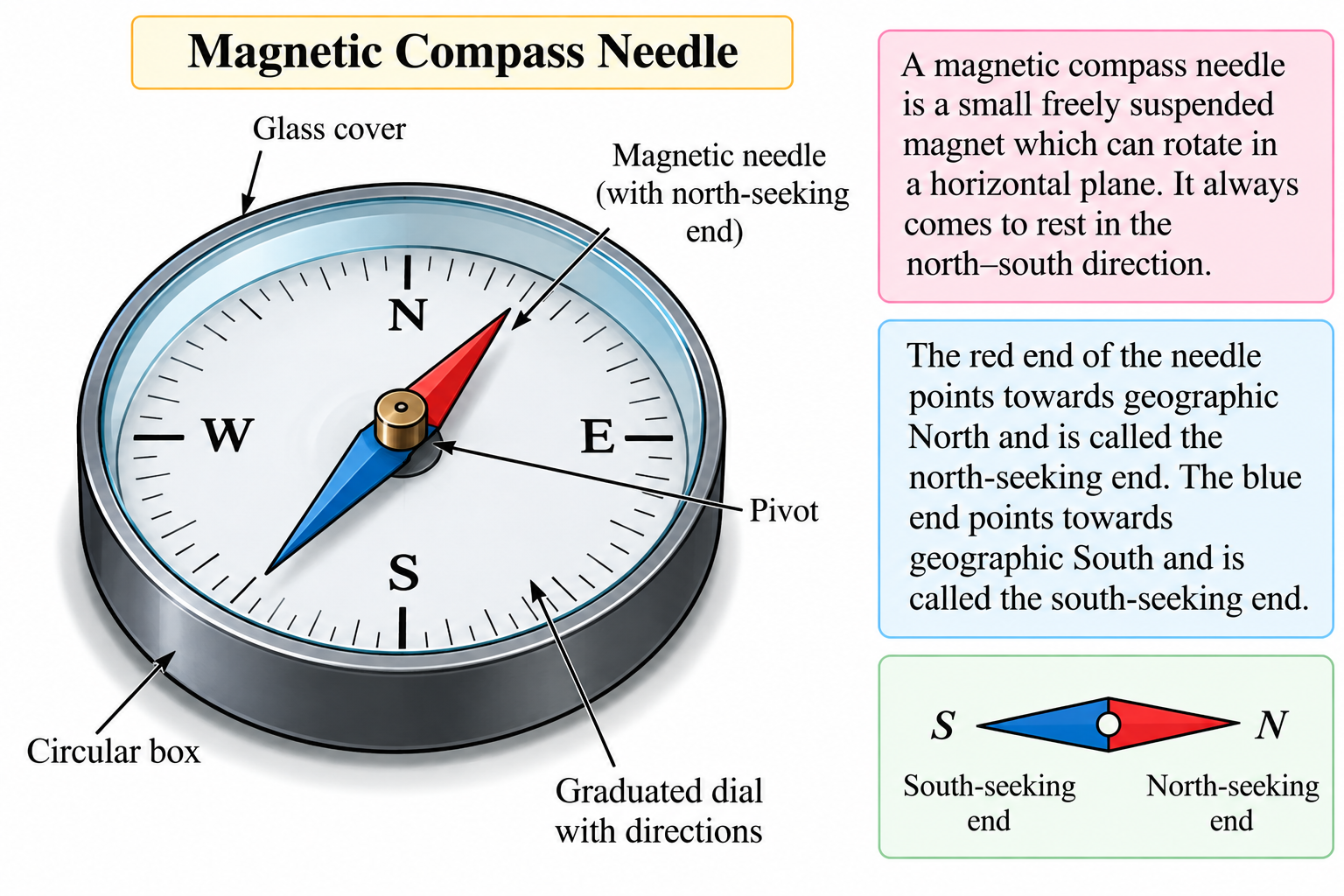
3. Magnetic Compass Needle
A magnetic compass needle is an instrument that detects the presence of a magnetic field around a magnet or a current-carrying wire.
4. Oersted Experiment
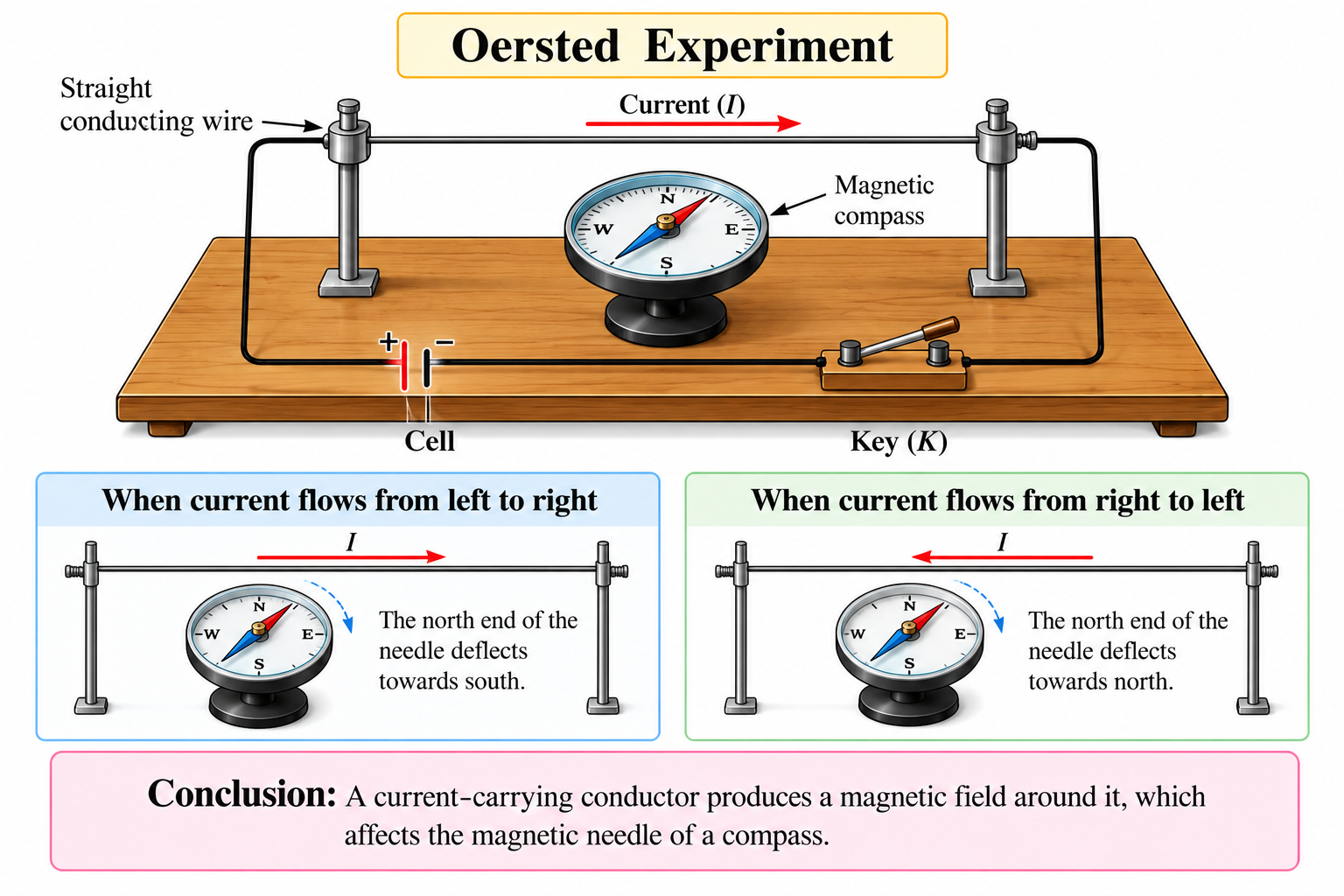
In 1820, a scientist named Hans Christian Oersted performed an experiment to show that a moving charge produces a magnetic field. This experiment is known as the Oersted experiment.
For performing the experiment, he took a conducting wire, a battery, a key and a compass needle.
Observation
- When the key is open, the compass needle remains in its normal position.
- When the needle is brought near the current-carrying wire, deflection is observed.
- When the needle is brought nearer to the wire, the deflection becomes greater.
Conclusion
Oersted concluded that there is a special property around a current-carrying conductor which affects the compass needle.
Hence, a moving charge or current-carrying conductor produces a magnetic field.
5. Magnetic Field – Important Properties
- Magnetic field is a vector quantity.
- It has three-dimensional nature and properties.
- It obeys the superposition principle.
- It is produced due to moving charges.
- Its SI unit is tesla (T).
- Another unit is weber per metre square (Wb m−2).
- Its CGS unit is gauss (G).
1 T = 104 G
or:
1 G = 10−4 T
6. Superposition Principle
According to the superposition principle, the net magnetic field is equal to the vector sum of the individual magnetic fields.
Keep preparing
Available in the app
- Complete NotesConfirmed for this chapter
- Important QuestionsConfirmed for this chapter
- Previous Year QuestionsConfirmed for this chapter
- Revision NotesConfirmed for this chapter