Chapter 6
Electromagnetic Induction
Preview Electromagnetic Induction for Physics in JAC 12th (SCI.).
A quick look
Study material preview
Notes
वैद्युतचुंबकीय प्रेरण (Electromagnetic Induction)
1. वैद्युतचुंबकीय प्रेरण (Electromagnetic Induction)
जब किसी कुंडली (Coil) और चुंबक के बीच सापेक्ष गति (Relative Motion) होती है, तो कुंडली में विद्युत धारा प्रेरित होती है। इस धारा को प्रेरित धारा (Induced Current) कहते हैं।
विद्युत धारा उत्पन्न होने की इस घटना को वैद्युतचुंबकीय प्रेरण (Electromagnetic Induction) कहते हैं।
2. फैराडे के प्रयोग (Faraday's Experiments)
प्रथम प्रयोग (First Experiment)
इस प्रयोग में एक गैल्वेनोमीटर (Galvanometer) से जुड़ी कुंडली तथा एक दंड चुंबक (Bar Magnet) का उपयोग किया जाता है।
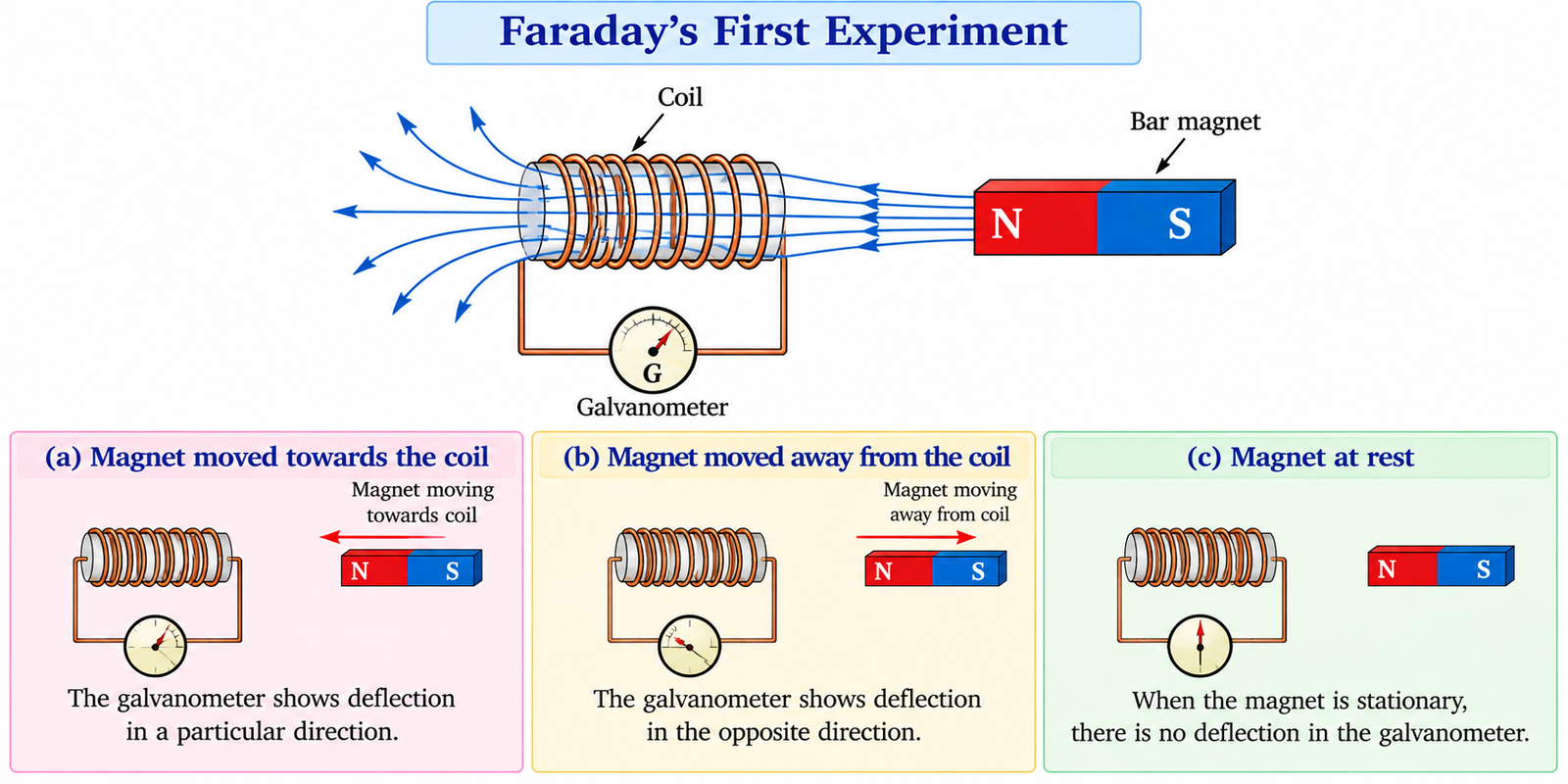
चरण 1: दंड चुंबक को कुंडली के पास लाया जाता है। इससे कुंडली से संबद्ध चुंबकीय फ्लक्स (Magnetic Flux) में परिवर्तन होता है। इसके कारण गैल्वेनोमीटर एक निश्चित दिशा में विक्षेप दिखाता है।
चरण 2: अब चुंबक को कुंडली से दूर ले जाया जाता है। इससे कुंडली से संबद्ध चुंबकीय फ्लक्स में परिवर्तन होता है और गैल्वेनोमीटर पहले के विक्षेप की विपरीत दिशा में विक्षेप दिखाता है।
चरण 3: जब दंड चुंबक स्थिर रहता है, तो गैल्वेनोमीटर में कोई विक्षेप नहीं होता क्योंकि कुंडली से संबद्ध चुंबकीय फ्लक्स में कोई परिवर्तन नहीं होता है।
निष्कर्ष (Conclusion)
कुंडली में विद्युत धारा तभी प्रेरित होती है, जब उससे संबद्ध चुंबकीय फ्लक्स में परिवर्तन होता है।
द्वितीय प्रयोग (Second Experiment)
इस प्रयोग में एक गैल्वेनोमीटर से जुड़ी कुंडली तथा दूसरी परिनालिका (Solenoid) के आकार की कुंडली का उपयोग किया जाता है, जो स्विच के माध्यम से विद्युत धारा के स्रोत से जुड़ी होती है।
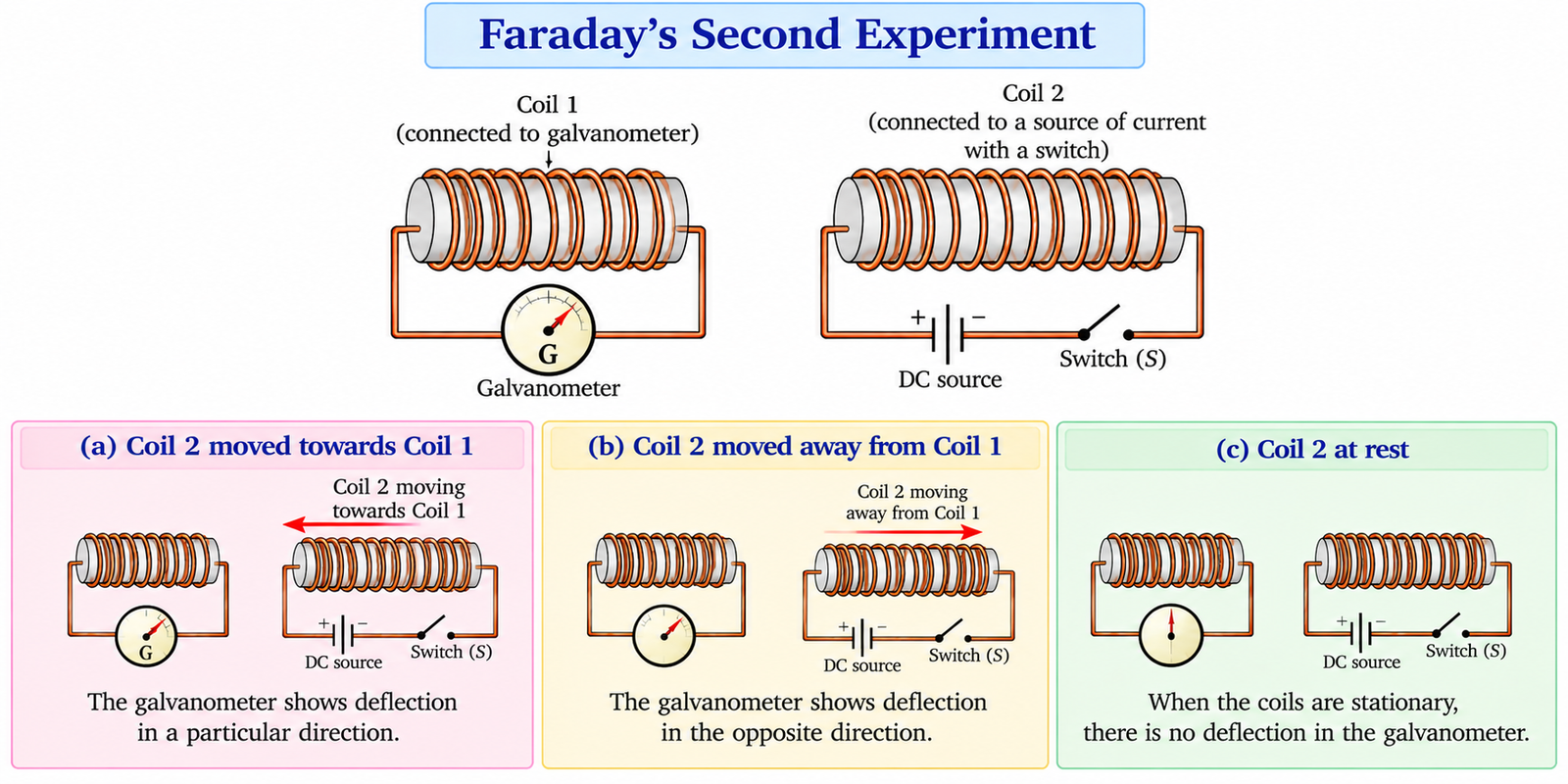
चरण 1: एक कुंडली को दूसरी कुंडली के पास लाया जाता है। इससे कुंडली से संबद्ध चुंबकीय फ्लक्स में परिवर्तन होता है और गैल्वेनोमीटर एक निश्चित दिशा में विक्षेप दिखाता है।
चरण 2: अब कुंडली को दूसरी कुंडली से दूर ले जाया जाता है। इससे चुंबकीय फ्लक्स में परिवर्तन होता है और गैल्वेनोमीटर पहले के विक्षेप की विपरीत दिशा में विक्षेप दिखाता है।
चरण 3: जब कुंडली स्थिर रहती है, तो गैल्वेनोमीटर में कोई विक्षेप नहीं होता क्योंकि कुंडली से संबद्ध चुंबकीय फ्लक्स में कोई परिवर्तन नहीं होता है।
निष्कर्ष (Conclusion)
कुंडली में विद्युत धारा तभी प्रेरित होती है, जब चुंबकीय फ्लक्स में परिवर्तन होता है।
तृतीय प्रयोग (Third Experiment)
इस प्रयोग में एक गैल्वेनोमीटर से जुड़ी कुंडली तथा दूसरी परिनालिका के आकार की कुंडली का उपयोग किया जाता है, जो स्विच के माध्यम से विद्युत धारा के स्रोत से जुड़ी होती है।
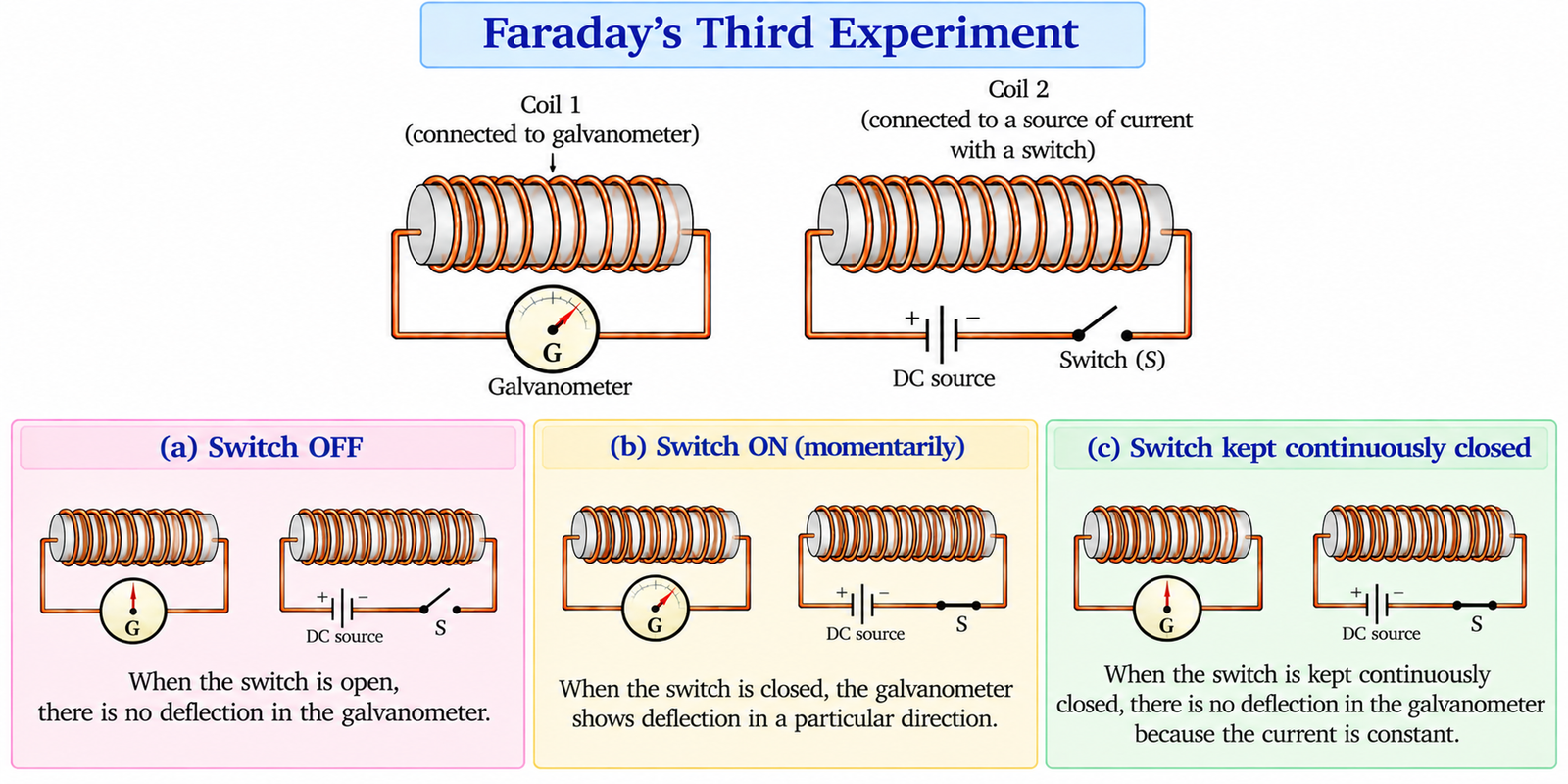
चरण 1: इस स्थिति में दोनों कुंडलियों के बीच कोई सापेक्ष गति नहीं होती है। इसलिए गैल्वेनोमीटर वाली कुंडली में कोई धारा प्रेरित नहीं होती है।
चरण 2: इस स्थिति में दूसरी कुंडली के परिपथ का स्विच ON किया जाता है। इस समय गैल्वेनोमीटर में विक्षेप देखा जाता है।
जब स्विच लगातार बंद रहता है, तो गैल्वेनोमीटर में कोई विक्षेप नहीं होता क्योंकि कुंडली में प्रवाहित धारा का मान स्थिर रहता है। इसके कारण दूसरी कुंडली के क्षेत्रफल से गुजरने वाली चुंबकीय क्षेत्र रेखाएँ स्थिर रहती हैं और इसलिए चुंबकीय फ्लक्स भी स्थिर रहता है।
3. फैराडे का प्रेरण नियम (Faraday's Law of Induction)
प्रथम नियम (First Law): जब किसी कुंडली और चुंबक के बीच सापेक्ष गति होती है, तो कुंडली में विद्युत वाहक बल (EMF), ε, प्रेरित होता है।
द्वितीय नियम (Second Law): कुंडली में प्रेरित विद्युत वाहक बल (Induced EMF), चुंबकीय फ्लक्स के परिवर्तन की दर (Rate of Change of Magnetic Flux) के समानुपाती होता है।
ε ∝ dφ/dt
गणितीय रूप से (Mathematically)
माना समय t = 0 पर चुंबकीय फ्लक्स है:
φ₁
माना समय t = t पर चुंबकीय फ्लक्स है:
φ₂
फ्लक्स में परिवर्तन:
Δφ = φ₂ − φ₁
अतः फ्लक्स के परिवर्तन की दर:
dφ/dt
फैराडे के प्रेरण नियम के अनुसार:
ε ∝ dφ/dt
4. लेंज का नियम (Lenz's Law)
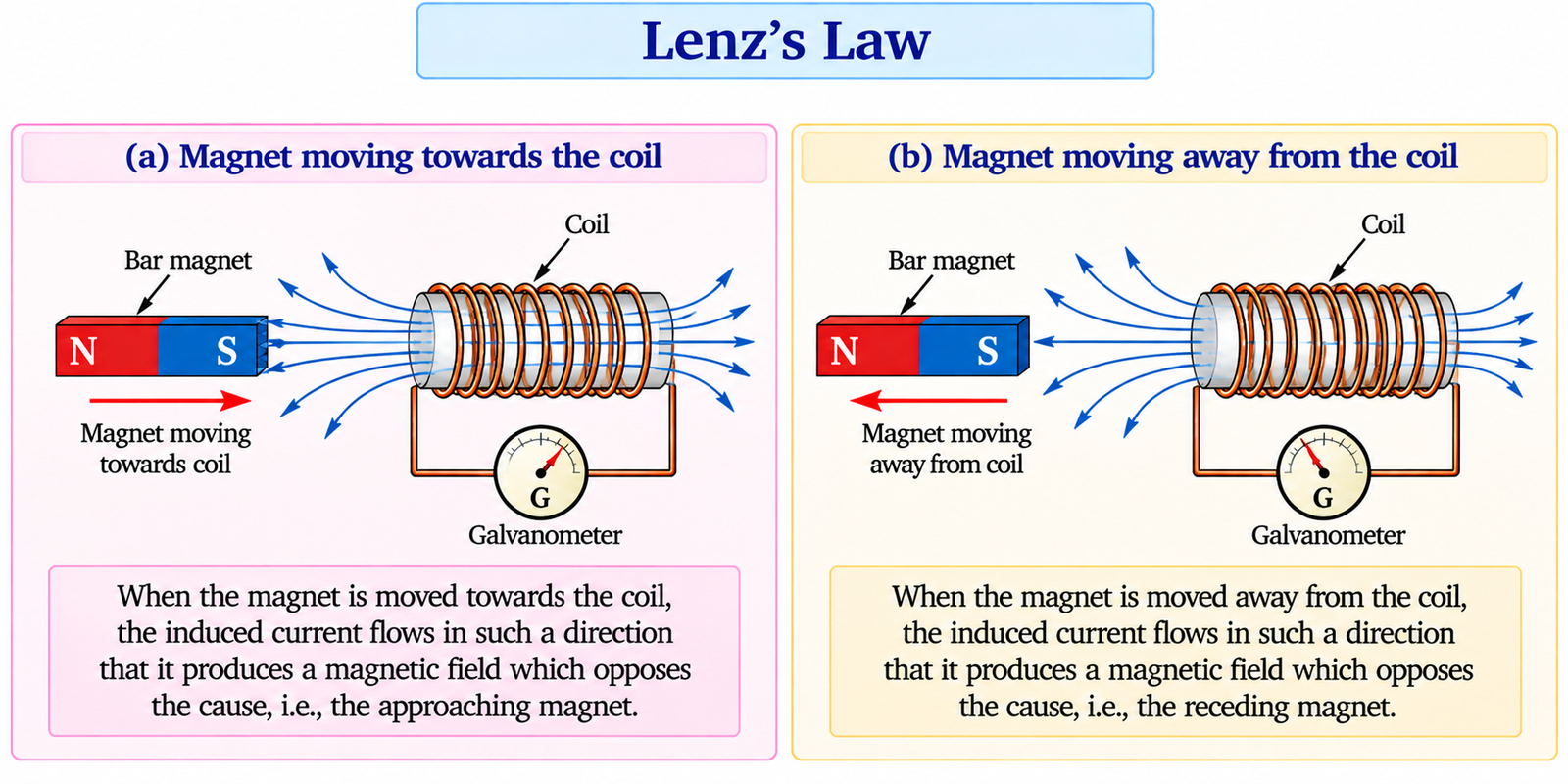
किसी बंद लूप या परिपथ (Closed Loop or Circuit) में प्रेरित धारा की दिशा ऐसी होती है कि वह उस कारण का विरोध करती है, जिसके कारण वह उत्पन्न हुई है।
लेंज का नियम प्रेरित धारा (Induced Current) की दिशा बताता है।
गणितीय रूप से
फैराडे के नियम से:
ε = −dφ/dt
इसे प्रेरित धारा के रूप में भी लिखा जा सकता है:
I = ε/R
अतः:
I = −(1/R)(dφ/dt)
ऋणात्मक चिह्न यह दर्शाता है कि प्रेरित धारा उस कारण का विरोध करती है, जिसके कारण वह उत्पन्न हुई है।
5. लेंज का नियम ऊर्जा संरक्षण के नियम का समर्थन करता है
ऊर्जा संरक्षण के नियम (Law of Conservation of Energy) के अनुसार, ऊर्जा न तो उत्पन्न की जा सकती है और न ही नष्ट की जा सकती है; इसे केवल एक रूप से दूसरे रूप में परिवर्तित किया जा सकता है।
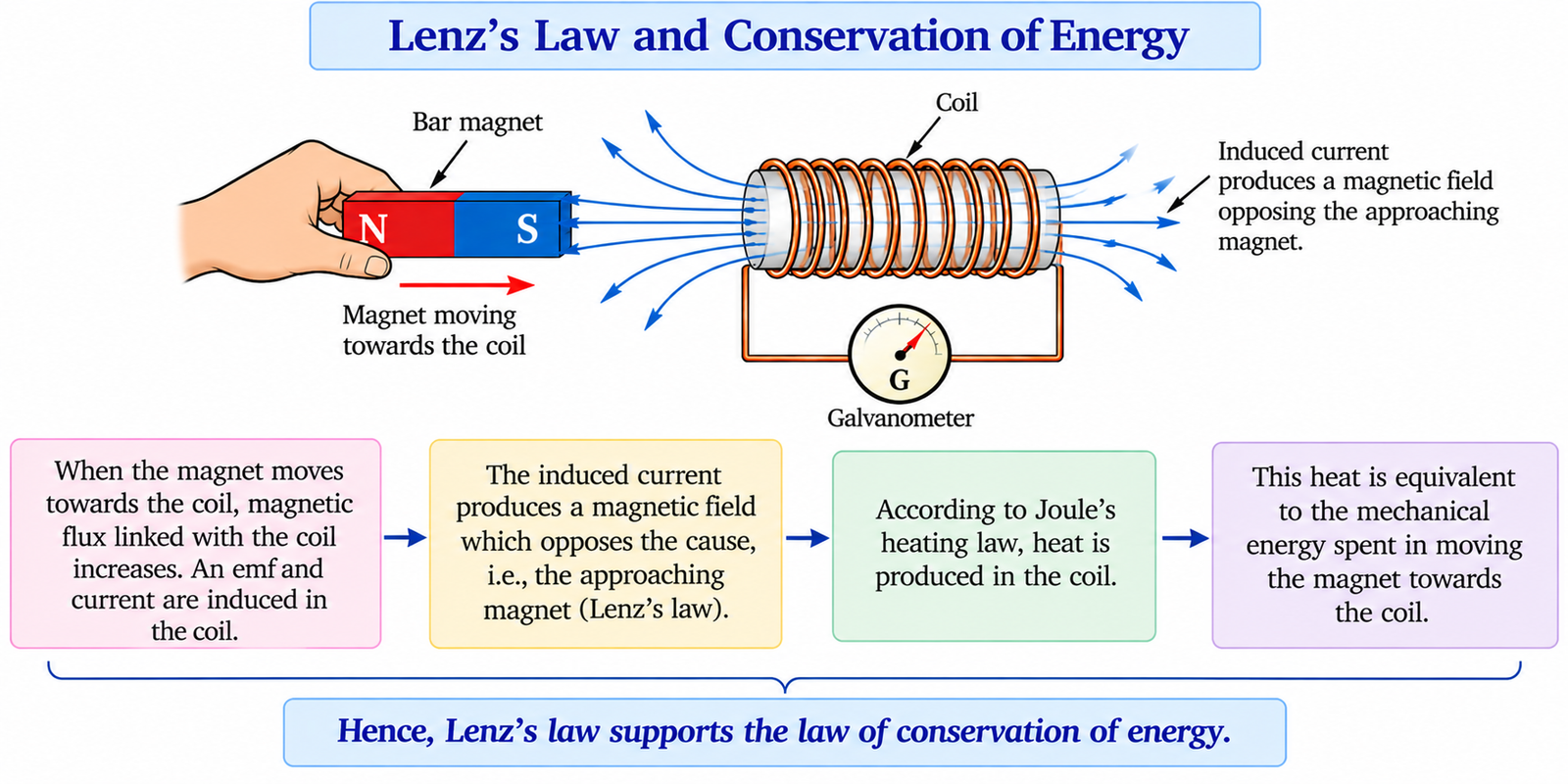
जब चुंबक को कुंडली की ओर ले जाया जाता है, तो कुंडली से संबद्ध चुंबकीय फ्लक्स में परिवर्तन होता है। इसके कारण कुंडली में EMF प्रेरित होता है तथा विद्युत धारा उत्पन्न होती है।
जूल के ऊष्मा नियम (Joule's Heating Law) के अनुसार कुंडली में ऊष्मा उत्पन्न होती है।
यह ऊष्मा परिवर्तित यांत्रिक ऊर्जा (Mechanical Energy) के बराबर होती है।
अतः लेंज का नियम ऊर्जा संरक्षण के नियम का समर्थन करता है।
6. भँवर धारा (Eddy Current)
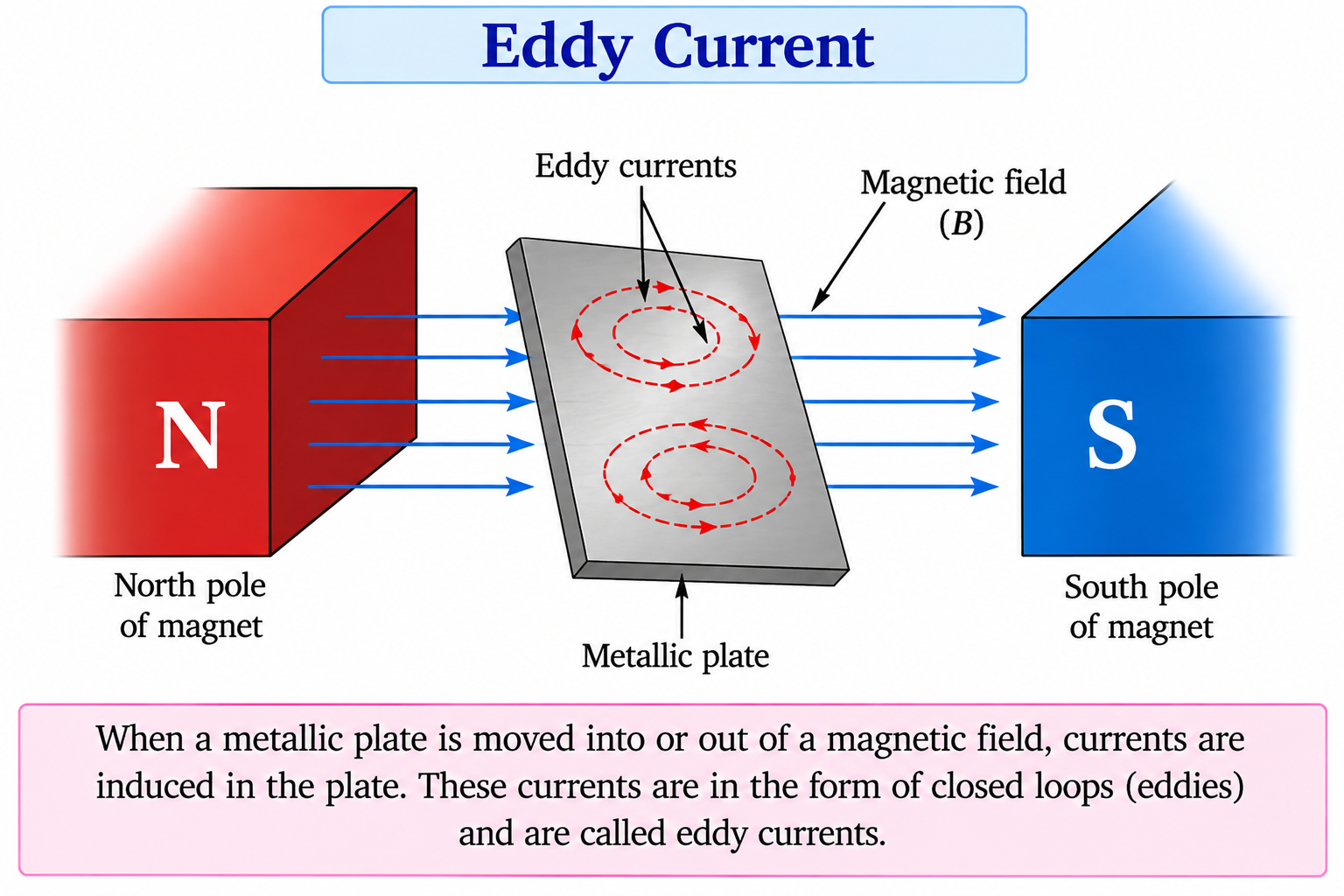
जब किसी धातु की प्लेट (Metallic Plate) को प्रबल चुंबकीय क्षेत्र में प्रवेश कराया जाता है और फिर उससे बाहर निकाला जाता है, तो प्लेट में भँवर के आकार की विद्युत धाराएँ उत्पन्न होती हैं।
ये धाराएँ भँवर (Eddies) के आकार की होती हैं, इसलिए इन्हें भँवर धाराएँ (Eddy Currents) कहा जाता है।
7. प्रेरण (Induction)
परिवर्ती विद्युत धारा (Variable Current) के कारण उसी कुंडली या किसी दूसरी कुंडली में EMF उत्पन्न होने की घटना को प्रेरण (Induction) कहते हैं।
प्रेरण के प्रकार (Types of Induction)
- स्व-प्रेरण (Self Induction)
- अन्योन्य प्रेरण (Mutual Induction)
8. स्व-प्रेरण (Self Induction)
परिवर्ती विद्युत धारा के कारण उसी कुंडली में EMF उत्पन्न होने की घटना को स्व-प्रेरण (Self Induction) कहते हैं।
यह उसी कुंडली में होता है।
9. स्व-प्रेरकत्व (Self Inductance)
मान लीजिए कि एक कुंडली को परिवर्ती विद्युत धारा स्रोत (Variable Source of Current) से जोड़ा गया है। इसके कारण कुंडली के चारों ओर चुंबकीय क्षेत्र उत्पन्न होता है। फलस्वरूप कुंडली से संबद्ध चुंबकीय फ्लक्स में परिवर्तन होता है, जिसके कारण कुंडली में EMF प्रेरित होता है।
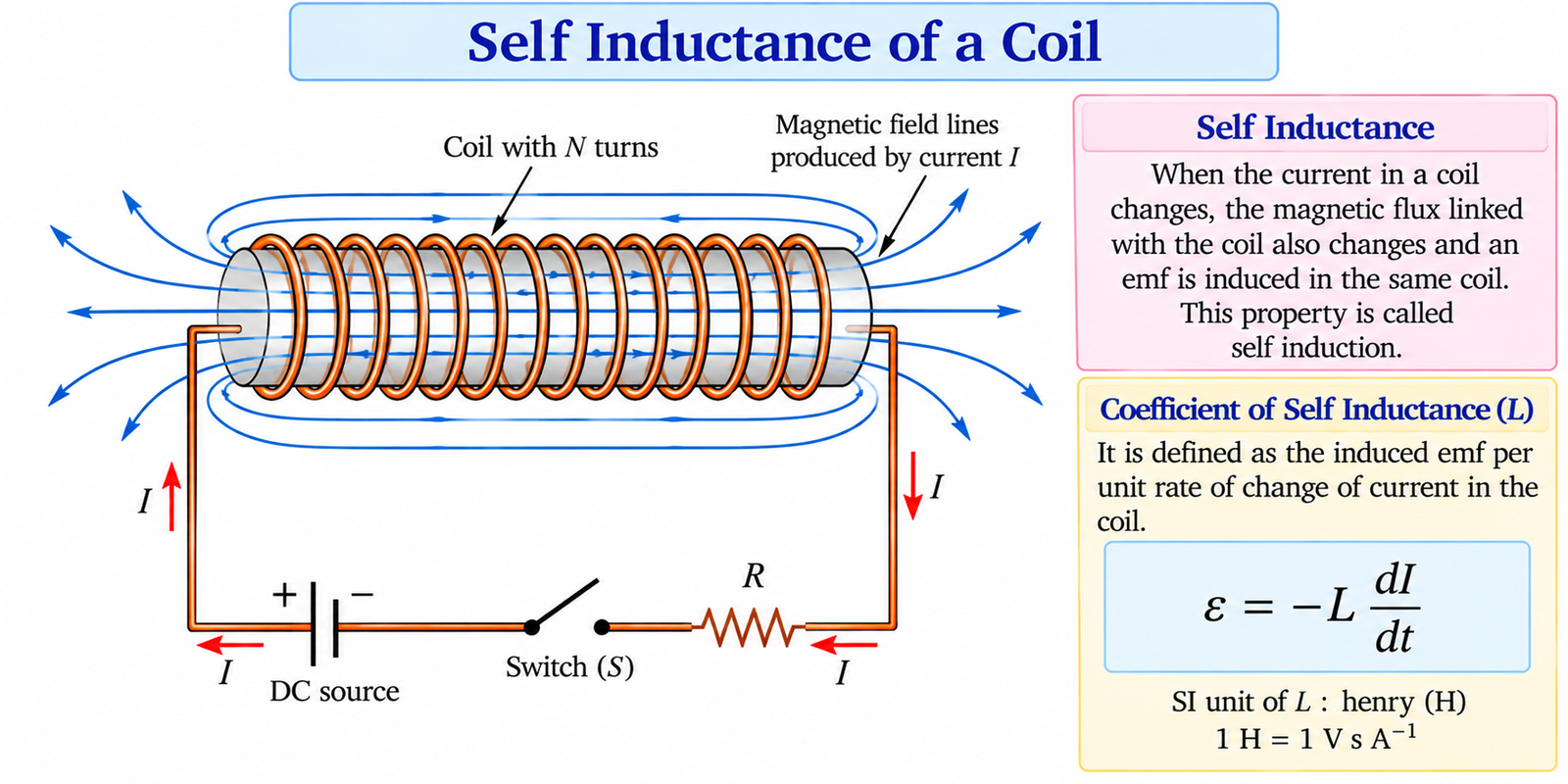
प्रयोगात्मक रूप से:
φ ∝ I
या:
φ = LI
जहाँ L एक नियतांक है, जिसे कुंडली का स्व-प्रेरकत्व (Self Inductance) कहते हैं।
अतः:
L = φ/I
इसलिए, किसी कुंडली का स्व-प्रेरकत्व संख्यात्मक रूप से उस कुंडली से संबद्ध फ्लक्स के बराबर होता है, जब कुंडली में प्रवाहित धारा 1 A हो।
इसे स्व-प्रेरण गुणांक (Coefficient of Self Induction) भी कहते हैं।
स्व-प्रेरण के कारण उत्पन्न EMF
हम जानते हैं:
ε = dφ/dt
तथा:
φ = LI
अतः:
ε = L(dI/dt)
इसलिए:
L = ε/(dI/dt)
जहाँ dI/dt विद्युत धारा के परिवर्तन की दर है।
यदि:
dI/dt = 1 A/s
तो:
L = ε
अतः स्व-प्रेरकत्व संख्यात्मक रूप से उस प्रेरित EMF के बराबर होता है, जब विद्युत धारा के परिवर्तन की दर एकता हो।
SI मात्रक एवं विमा
स्व-प्रेरकत्व का SI मात्रक = हेनरी (Henry – H)
विमीय सूत्र = [M L² T⁻² A⁻²]
स्व-प्रेरकत्व एक अदिश राशि (Scalar Quantity) है।
10. अन्योन्य प्रेरण (Mutual Induction)
दो पास-पास स्थित कुंडलियों में धारा के परिवर्तन के कारण EMF उत्पन्न होने की घटना को अन्योन्य प्रेरण (Mutual Induction) कहते हैं।
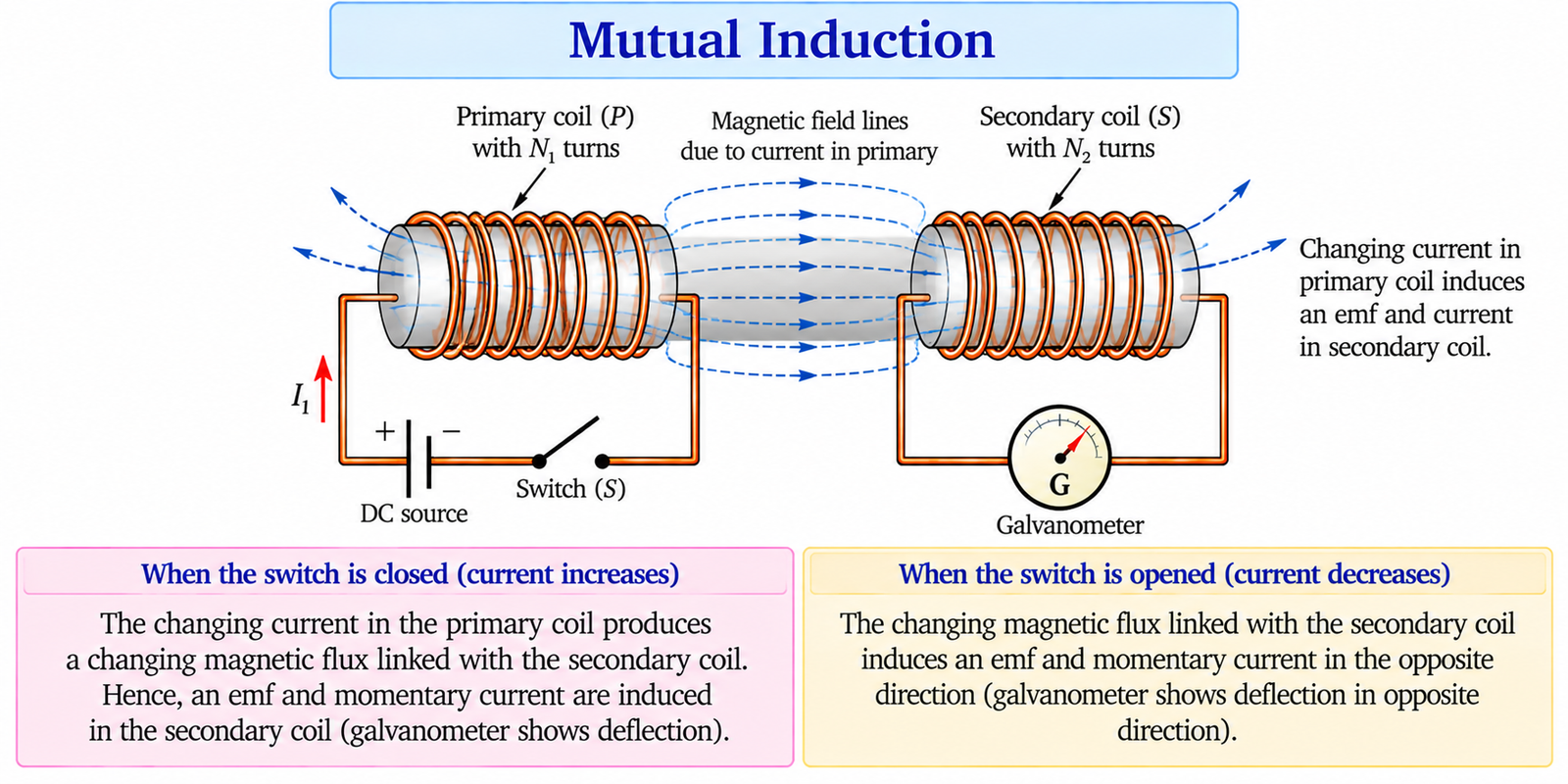
11. अन्योन्य प्रेरकत्व (Mutual Inductance)
मान लीजिए C₁ तथा C₂ दो पास-पास स्थित कुंडलियाँ हैं। C₁ में धारा I प्रवाहित होती है। इसके कारण कुंडली C₂ से संबद्ध चुंबकीय फ्लक्स उत्पन्न होता है।
प्रयोगात्मक रूप से:
φ ∝ I
या:
φ = MI
जहाँ M एक नियतांक है, जिसे कुंडली का अन्योन्य प्रेरकत्व (Mutual Inductance) कहते हैं।
अतः:
M = φ/I
इसलिए, अन्योन्य प्रेरकत्व संख्यात्मक रूप से उस फ्लक्स संबद्धता के बराबर होता है, जब कुंडली में प्रवाहित धारा 1 A हो।
अन्योन्य प्रेरण के कारण उत्पन्न EMF
हम जानते हैं:
ε = dφ/dt
तथा:
φ = MI
अतः:
ε = M(dI/dt)
इसलिए:
M = ε/(dI/dt)
जहाँ dI/dt विद्युत धारा के परिवर्तन की दर है।
यदि:
dI/dt = 1 A/s
तो:
M = ε
अतः अन्योन्य प्रेरकत्व संख्यात्मक रूप से उस प्रेरित EMF के बराबर होता है, जब विद्युत धारा के परिवर्तन की दर एकता हो।
SI मात्रक एवं विमा
अन्योन्य प्रेरकत्व का SI मात्रक = हेनरी (Henry – H)
विमीय सूत्र = [M L² T⁻² A⁻²]
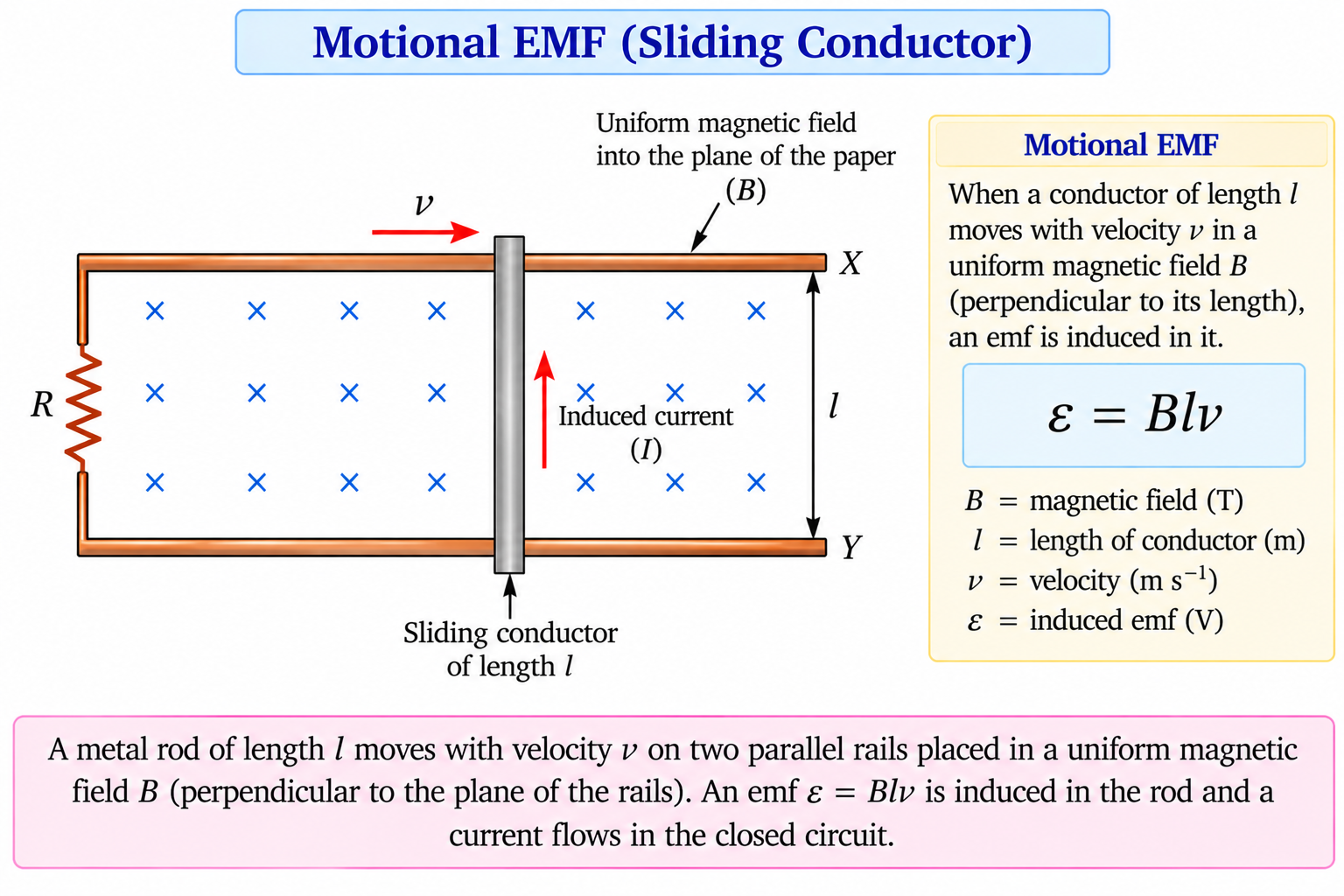
12. गतिक विद्युत वाहक बल (Motional EMF)
जब कोई चालक एकसमान चुंबकीय क्षेत्र (Uniform Magnetic Field) में सरकता है, तो उसमें उत्पन्न प्रेरित विद्युत वाहक बल को गतिक विद्युत वाहक बल (Motional EMF) कहते हैं।
13. गतिक विद्युत वाहक बल की गणना
माना B कागज के तल के अंदर की ओर निर्देशित एकसमान चुंबकीय क्षेत्र है।
माना आयताकार चालक ABCD की लंबाई l है।
मान लीजिए कि चालक v वेग से सरक रहा है।
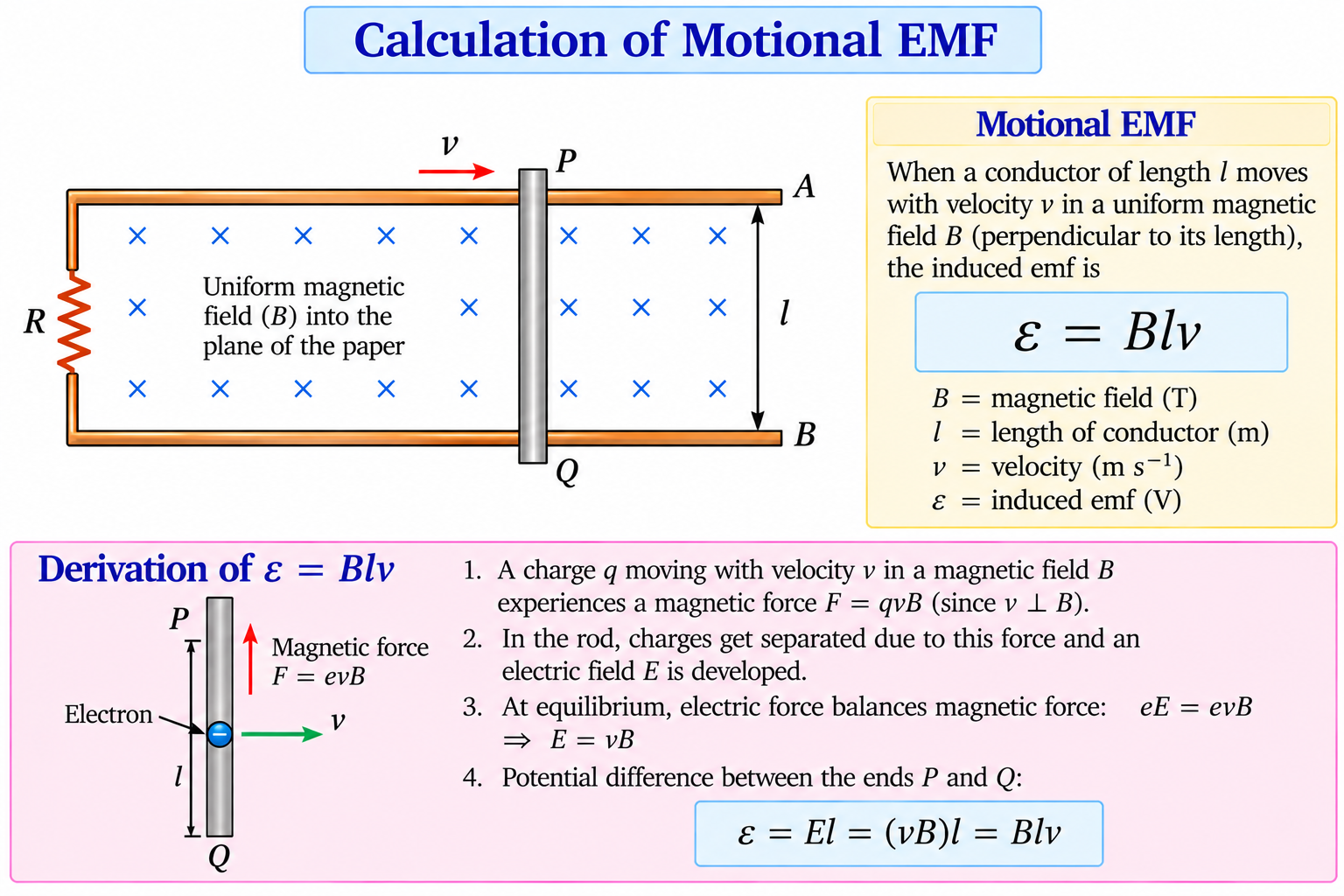
हम जानते हैं:
ε = dφ/dt
फ्लक्स में कुल परिवर्तन:
dφ = B × क्षेत्रफल में परिवर्तन
dφ = B × l × vdt
अतः:
ε = dφ/dt
इसलिए:
ε = Blv
गतिक EMF निम्न कारकों पर निर्भर करता है
- चुंबकीय क्षेत्र B
- चालक की लंबाई l
- चालक के सरकने का वेग v
14. चुंबकीय क्षेत्र में घूमता हुआ चालक (Conductor Rotating in a Magnetic Field)
यदि चालक को चुंबकीय क्षेत्र में θ कोण से घुमाया जाता है, तो EMF:
ε = Blv
माना:
l = r
तथा:
v = rω
अतः:
ε = B(r)(rω)
ε = Br²ω
संपूर्ण घूर्णनशील चालक (Complete Rotating Conductor) के लिए कुल EMF:
ε = Br²ω/2
15. परिनालिका के स्व-प्रेरकत्व का व्यंजक
हम जानते हैं:
L = φ/I
तथा:
φ = BA
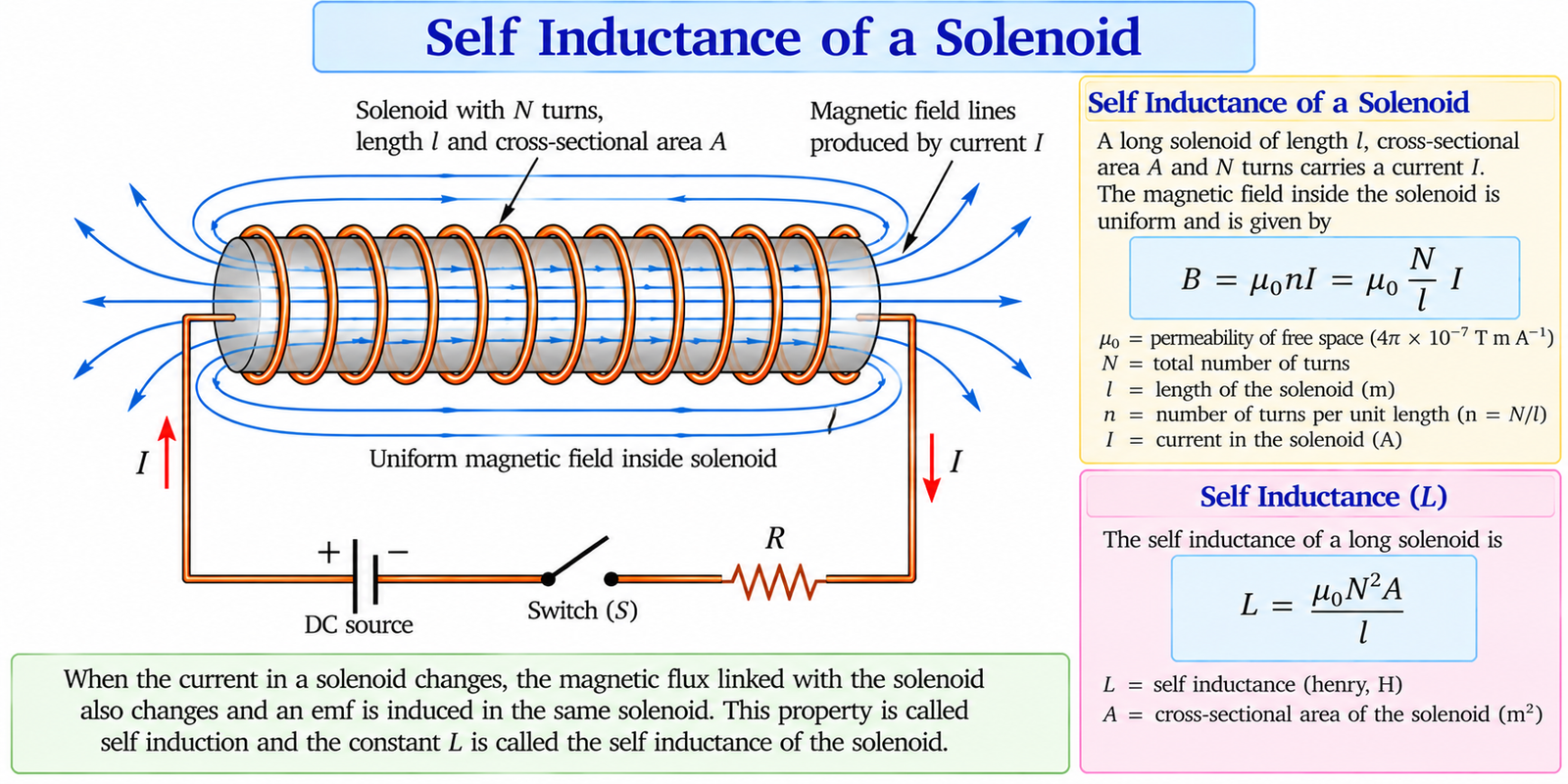
कुल फ्लक्स:
φ = NBA
परिनालिका (Solenoid) के लिए:
B = μ₀nI
अतः:
φ = Nμ₀nIA
इसे:
L = φ/I
में रखने पर:
L = Nμ₀nA
चूँकि:
n = N/l
अतः:
L = N²μ₀A/l
16. प्रेरक में संचित ऊर्जा (Energy Stored in an Inductor)
प्रेरक (Inductor) एक ऐसा उपकरण है, जिसका उपयोग चुंबकीय क्षेत्र में ऊर्जा संचित करने के लिए किया जाता है। इसे प्रेरकत्व (Inductance) भी कहा जाता है।
हम जानते हैं:
V = dW/dq
अतः:
dW = Vdq
लेकिन:
ε = dφ/dt
तथा:
ε = L(dI/dt)
अतः:
dW = L(dI/dt)dq
चूँकि:
dq/dt = I
इसलिए:
dW = LI dI
कुल किया गया कार्य:
W = ∫₀ᴵ LI dI
अतः:
W = LI²/2
इसलिए:
W = ½LI²
यह किया गया कार्य प्रेरक में ऊर्जा के रूप में संचित हो जाता है।
17. दो लंबी समाक्षीय परिनालिकाओं का अन्योन्य प्रेरकत्व
दो लंबी समाक्षीय परिनालिकाएँ (Coaxial Long Solenoids) मानिए, जिनमें से प्रत्येक की लंबाई l है।
Keep preparing
Available in the app
- Complete NotesConfirmed for this chapter
- Important QuestionsConfirmed for this chapter
- Previous Year QuestionsConfirmed for this chapter
- Revision NotesConfirmed for this chapter