Chapter 13
Nuclei
Preview Nuclei for Physics in JAC 12th (SCI.).
A quick look
Study material preview
Notes
1. Nucleus
Nucleus: A positive region with a positive particle is called the nucleus.
Nucleon: The particles which are present in the nucleus of an atom are called nucleons.
The nucleons are:
- Proton
- Neutron
The mass of the nucleus is due to the mass of nucleons.
2. Atomic Number
Atomic Number: The number of protons and electrons is called the atomic number.
Z = P = e
3. Atomic Mass Number
Atomic Mass Number: Number of protons + number of neutrons.
A = P + N
4. Atomic Mass
Atomic Mass: The summation of the masses of protons and neutrons is called atomic mass.
Atomic mass = Atomic mass number
The mass of an atom is measured in a unit called atomic mass unit (a.m.u.).
1 a.m.u. = 1 u
It is defined as one-twelfth of the mass of one atom of carbon-12.
1 a.m.u. = (1/12) × mass of one atom of C-12
Since:
Mass of 6.023 × 10²³ atoms of carbon = 12 g
Therefore:
Mass of one atom of carbon = 12/(6.023 × 1023) g
Hence:
1 a.m.u. = (1/12) × [12/(6.023 × 1023)] g
1 a.m.u. = 1.66 × 10⁻²⁴ g
1 a.m.u. = 1.66 × 10⁻²⁷ kg
Mass of Proton, Electron and Neutron
mp = 1.00727 u = 1.6722 × 10⁻²⁷ kg
me = 0.00055 u = 9.1 × 10⁻³¹ kg
mn = 1.00866 u = 1.6745 × 10⁻²⁷ kg
5. Isotopes
Isotopes: Same atomic number but different mass number.
Examples:
168O, 178O, 188O
3517Cl, 3717Cl
199F
3919K, 4019K, etc.
6. Isobars
Isobars: Same mass number but different atomic number.
Examples:
4018Ar, 4020Ca
31H, 32He
73Li, 74Be, etc.
7. Isotones
Isotones: Same number of neutrons.
Examples:
4018Ar and 4019K
146C and 147N
199F and 2010Ne
2411Na and 2412Mg, etc.
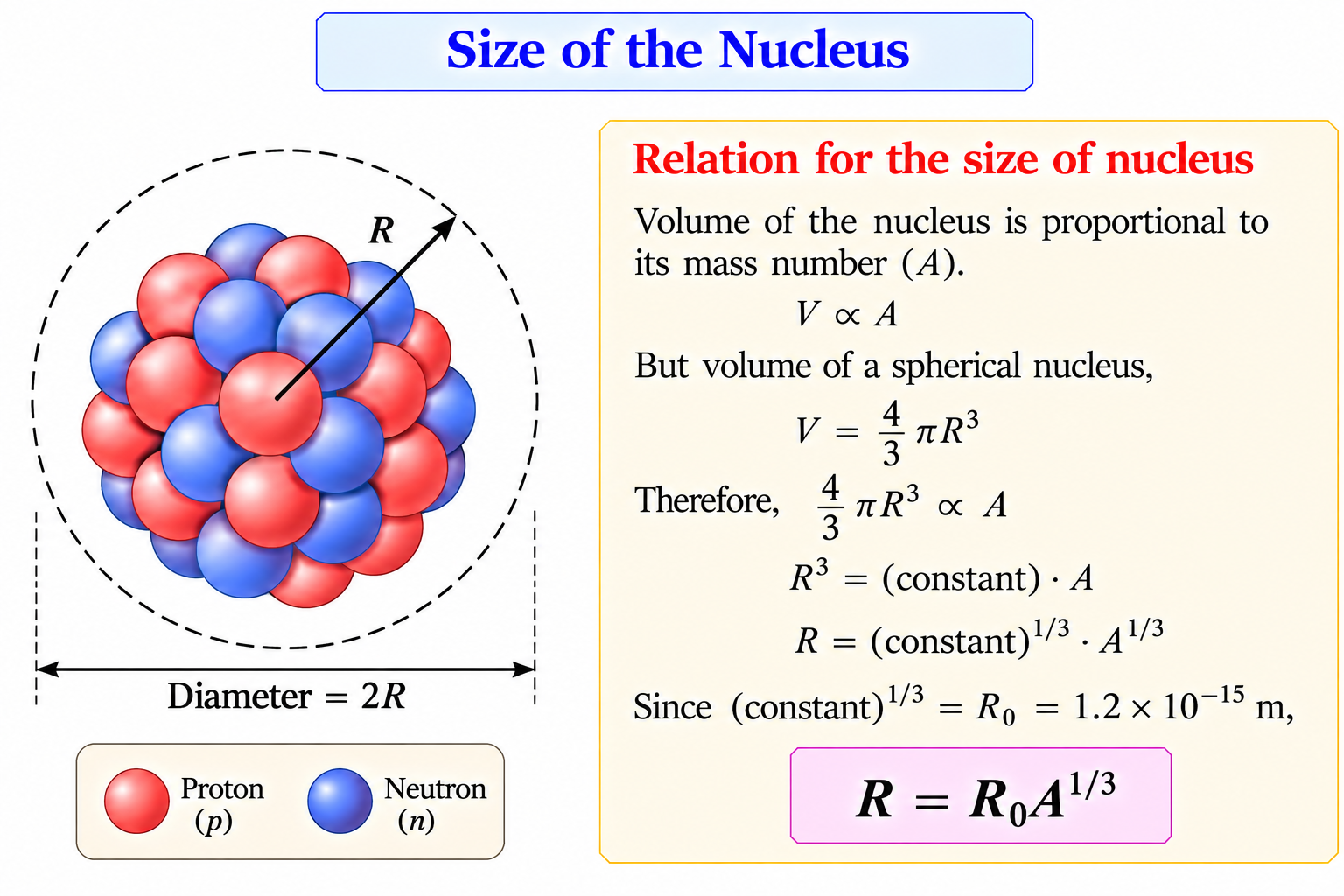
8. Size of the Nucleus
The volume of the nucleus is proportional to the mass number.
V ∝ A
But:
V = (4/3)πR³
Due to the spherical shape of the nucleus:
(4/3)πR³ ∝ A
Therefore:
R³ = Constant × A
Hence:
R = (Constant)1/3A1/3
Since:
(Constant)1/3 = R₀ = 1.2 × 10⁻¹⁵ m
Therefore:
R = R₀A1/3
Hence:
R ∝ A1/3
9. Density of the Nucleus
Mass per unit volume is called density.
Density = Mass/Volume
Mass of nucleus:
Mass = (P + N) × 1 a.m.u.
Volume:
V = (4/3)πR³
Therefore:
ρ = [(P + N)1 a.m.u.]/[(4/3)πR³]
Since:
P + N = A
and
R = R₀A1/3
Therefore:
ρ = A × 1 a.m.u./[(4/3)π(R₀A1/3)³]
ρ = A × 1 a.m.u./[(4/3)πR₀³A]
Keep preparing
Available in the app
- Complete NotesConfirmed for this chapter
- Important QuestionsConfirmed for this chapter
- Previous Year QuestionsConfirmed for this chapter
- Revision NotesConfirmed for this chapter