Chapter 7
Alternating Current
Preview Alternating Current for Physics in JAC 12th (SCI.).
A quick look
Study material preview
Notes
1. Electric Current
The flow of electric charge or electrons through a wire is called electric current.
2. Types of Electric Current
- Direct Current (D.C.)
- Alternating Current (A.C.)
Direct Current (D.C.)
The current whose direction does not change with time through a load is known as direct current (D.C.).
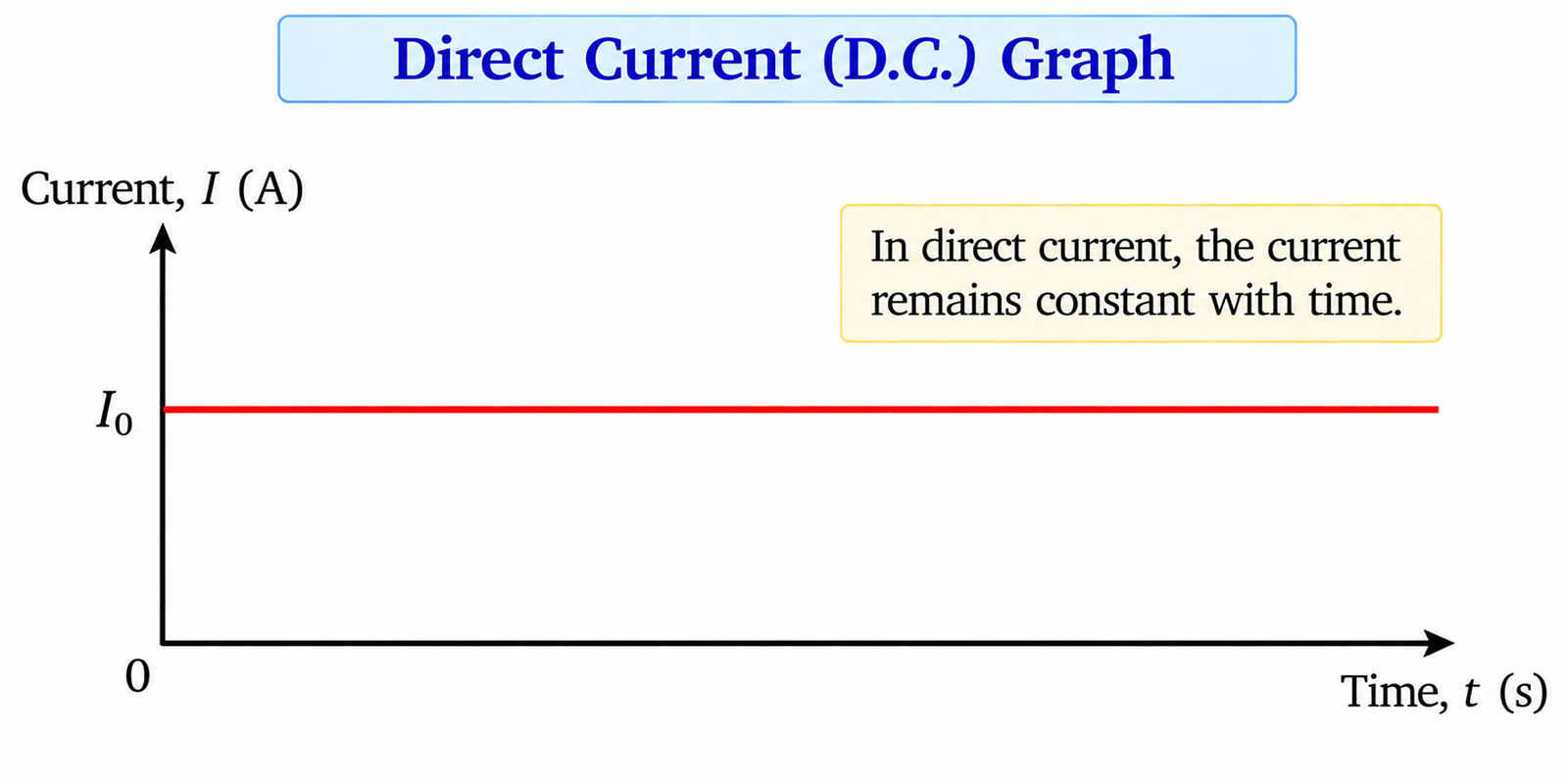
For D.C.:
I = Q/t
Also:
I = ne/t
and:
I = neAvd
Alternating Current (A.C.)
The current whose direction changes periodically through a load is known as alternating current (A.C.).
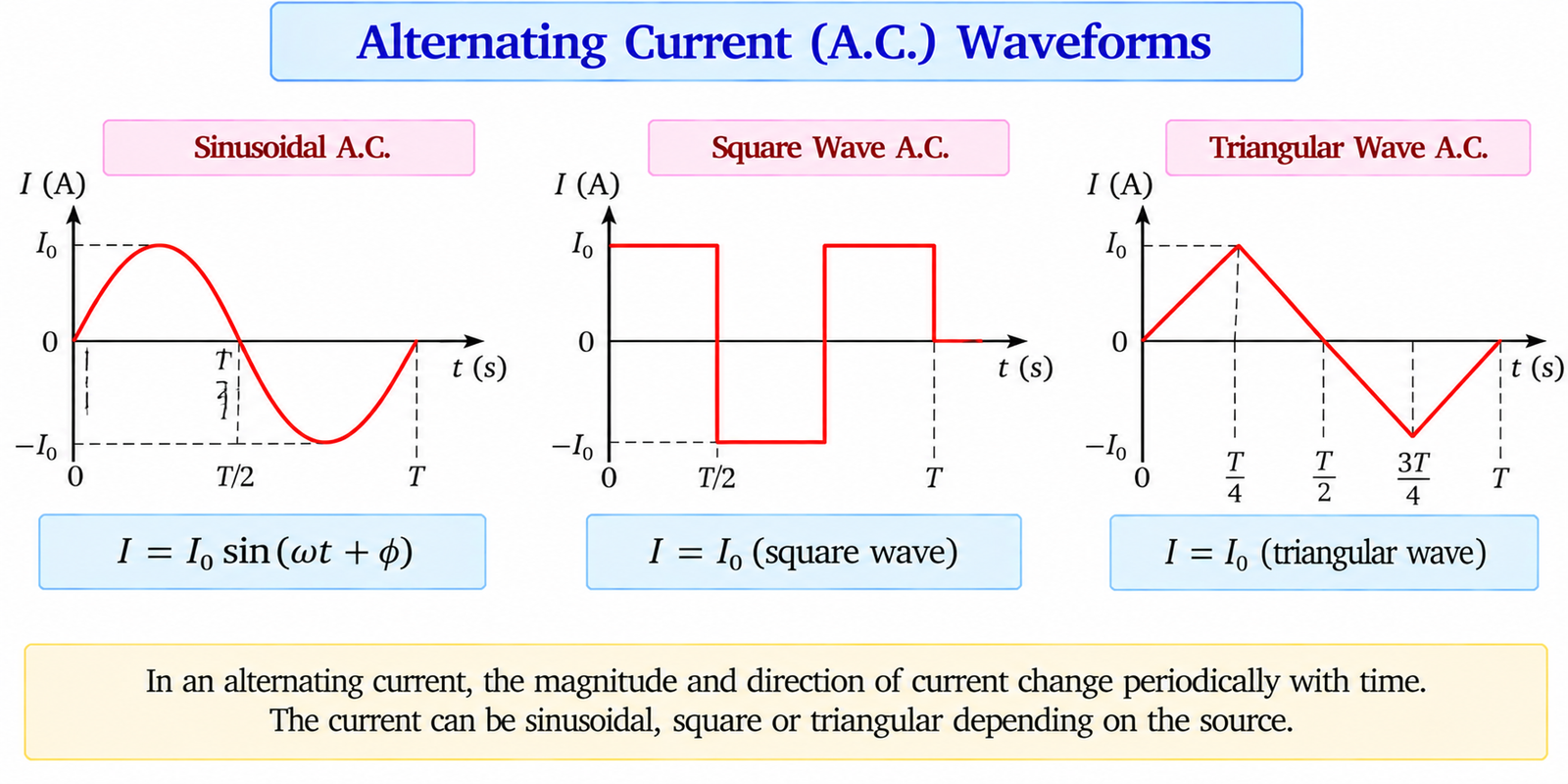
The alternating current can be represented as:
I = I0 sin(ωt + φ)
Similarly, alternating voltage can be represented as:
V = V0 sin(ωt + φ)
or:
V = ε = ε0 sin(ωt + φ)
The current that varies like a sinusoidal wave or function is called alternating current.
Terms Used in Alternating Current
- I: Instantaneous current of A.C.
- I0: Maximum value of A.C.
- ωt + φ: Phase at time t
- φ: Initial phase or phase constant
- ω = 2πf: Angular frequency
- t: Time period
- f = 1/T: Frequency
- A: Area
- B: Magnetic field
For a coil rotating in a uniform magnetic field:
I0 = NABω
3. Time Period
The time taken to complete one cycle is called the time period.
T = 2π/ω
Also:
T = 1/f
Here, 2π is the angular displacement in one cycle.
4. Frequency
The number of cycles completed per second is called frequency.
f = Number of cycles / Time period
f = 1/T
Also:
ω = 2πf
For India:
f = 50 Hz = 50 cps
Therefore:
ω = 2π × 50 = 314 rad/s
For U.S.:
f = 60 Hz
5. Peak or Maximum Value / Amplitude
The maximum value of A.C. is called its peak value or amplitude.
It is denoted by:
I0 for current.
V0 for voltage.
For the rotating coil:
I0 = NABω
The peak value may be in either direction, i.e. positive or negative.
6. Phase
Phase is a physical quantity.
It represents the instantaneous value and direction.
It is a dimensionless quantity.
Its SI unit is radian (rad).
7. Phase Difference
The difference between the phase of current and the phase of voltage is known as phase difference.
Let:
V = V0 sin(ωt + φ1)
and:
I = I0 sin(ωt + φ2)
Therefore:
Phase difference, φ = φ2 − φ1
8. Important Points of A.C.
Keep preparing
Available in the app
- Complete NotesConfirmed for this chapter
- Important QuestionsConfirmed for this chapter
- Previous Year QuestionsConfirmed for this chapter
- Revision NotesConfirmed for this chapter