Chapter 12
Atoms
Preview Atoms for Physics in JAC 12th (SCI.).
A quick look
Study material preview
Notes
1. Democritus
Democritus first used the term atom, which means “uncuttable”.
He said that the atom is the smallest particle among the particles present in the world because it is indivisible.
2. J. J. Thomson
J. J. Thomson – 1897
- Discovery of electron – cathode ray tube/gas discharge experiment.
- He stated that atoms are neutral.
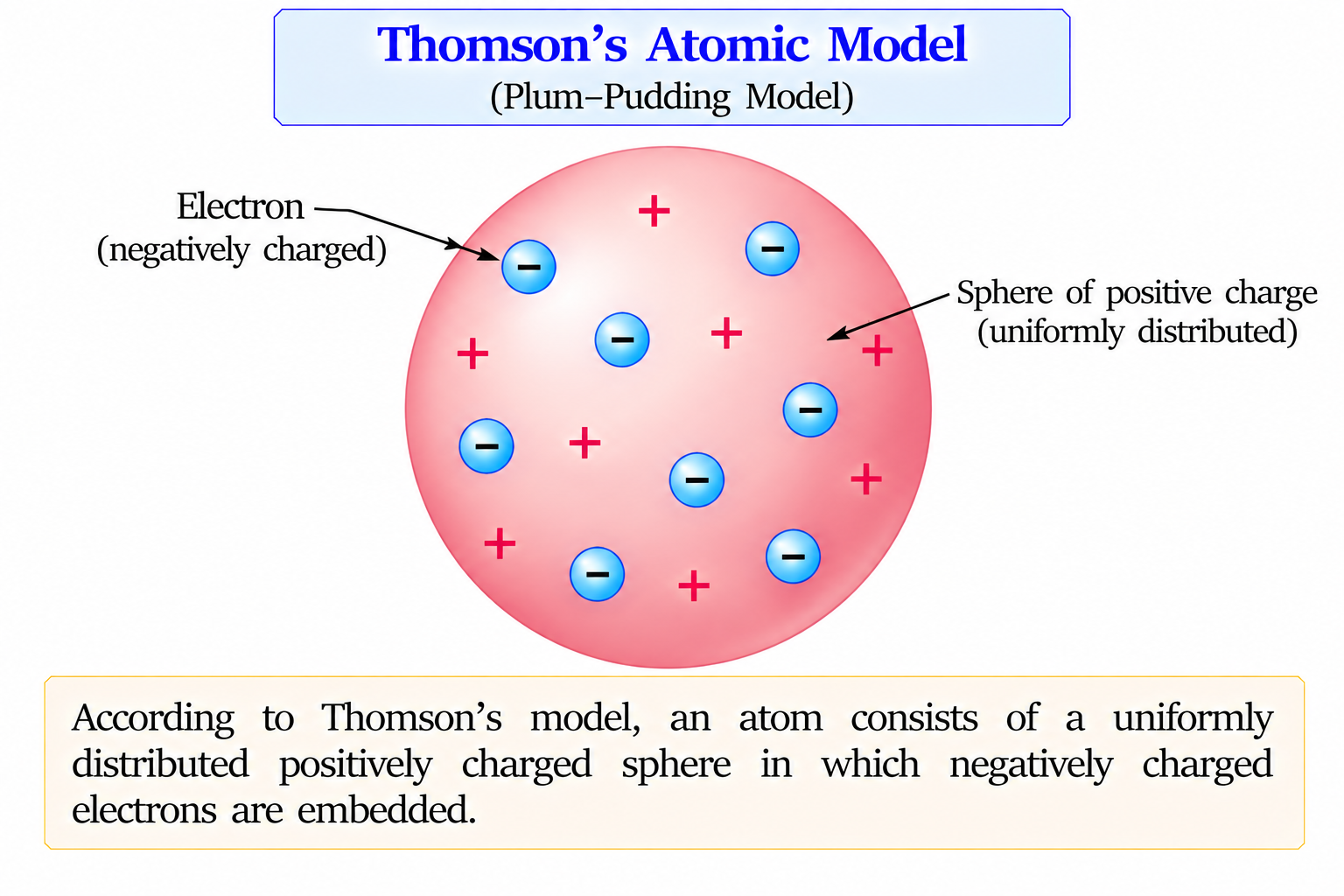
- He explained that an atom consists of negatively charged electrons, which are balanced by positively charged particles.
- The number of positively charged particles is equal to the number of electrons.
- This model is known as the plum-pudding model.
3. Atom
Atom: An atom is the smallest and indivisible particle which consists of a very dense nucleus surrounded by negatively charged electrons.
4. Rutherford's Alpha-Particle Scattering Experiment
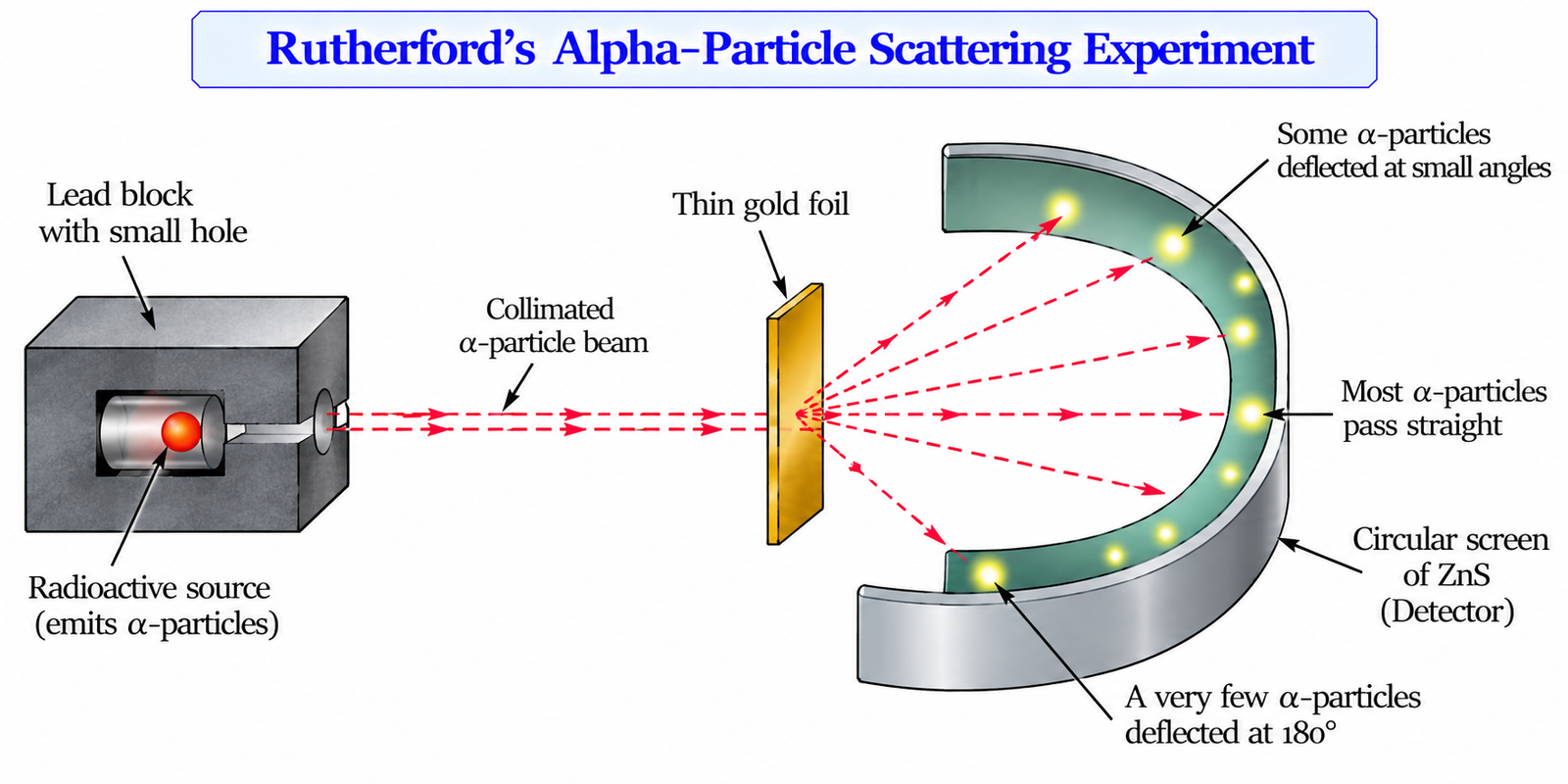
To perform the experiment, Rutherford used:
- A radioactive element that emits α-particles.
- Lead block.
- Thin gold foil.
- Circular screen of ZnS.
The arrangement is shown in the figure.
4.1 Observations
- Most of the α-particles passed straight through the gold foil.
- About 0.14% of the incident α-particles were deflected at small angles.
- A few α-particles were deflected at 180°.
4.2 Conclusions
- Most of the space inside an atom is empty.
- All the positive particles are concentrated in a small region at the centre of the atom, which is called the nucleus.
5. Force on an Alpha Particle
According to Coulomb's force:
F = (1/4πε₀) × (q₁q₂/r²)
For an α-particle:
q₁ = +2e
Charge on nucleus:
q₂ = +Ze
where Z is the atomic number.
For the distance of closest approach:
r = r₀
Therefore:
F = (1/4πε₀) × (2e × Ze/r₀²)
Hence:
F = 2Ze²/(4πε₀r₀²)
6. Distance of Closest Approach
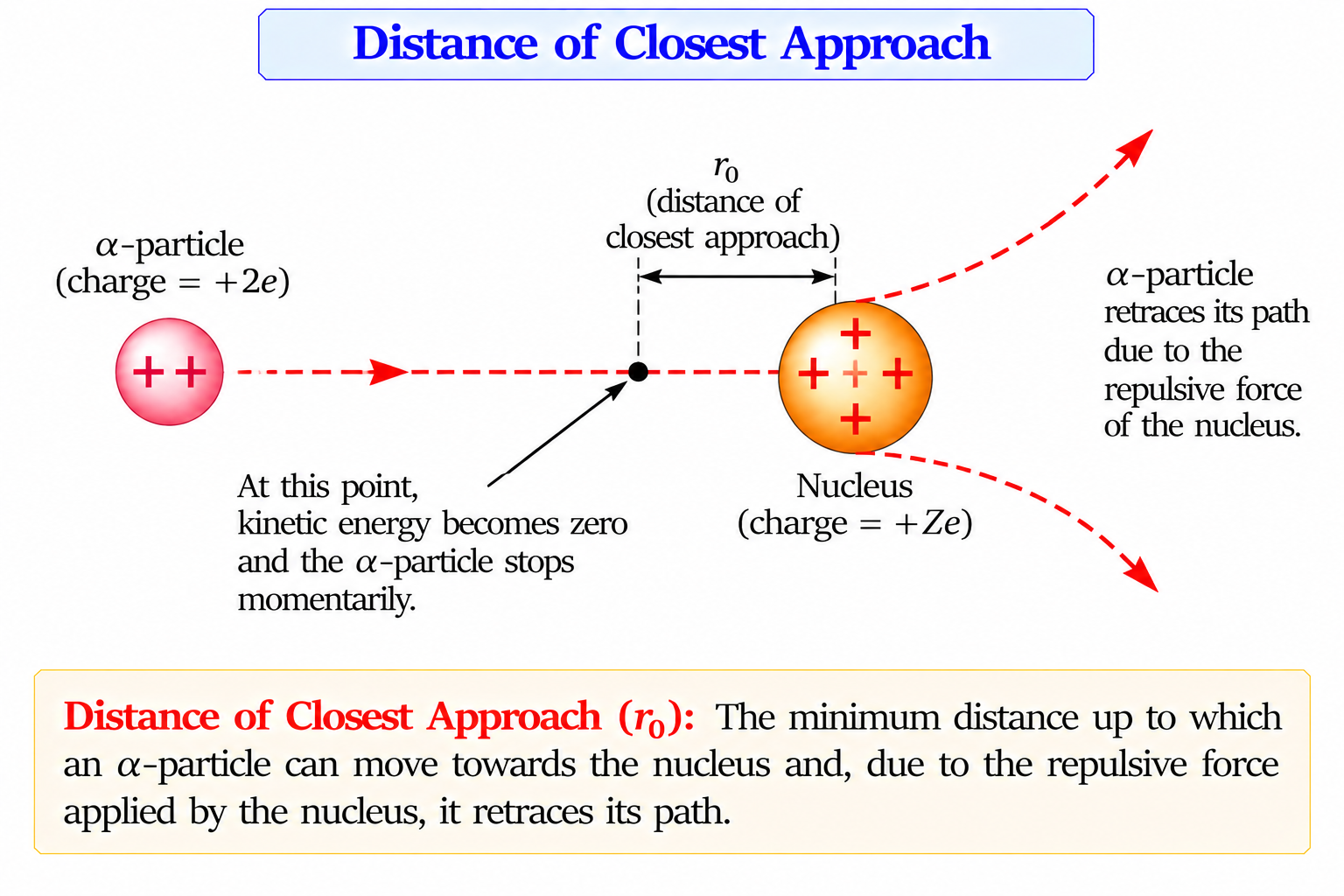
Distance of Closest Approach: The minimum distance up to which an α-particle can move and, due to the repulsive force applied by the nucleus, it retraces its path is known as the distance of closest approach.
It is represented by r₀.
6.1 Calculation of r₀
An α-particle is moving with kinetic energy:
EK = 1/2 mv²
The electric potential energy is given by:
U = U₀
According to the PDF, at the distance of closest approach:
EK = Electric Potential Energy
Therefore:
1/2 mv² = (1/4πε₀)(e²/r₀)
Keep preparing
Available in the app
- Complete NotesConfirmed for this chapter
- Important QuestionsConfirmed for this chapter
- Previous Year QuestionsConfirmed for this chapter
- Revision NotesConfirmed for this chapter