Chapter 8
Electromagnetic Waves
Preview Electromagnetic Waves for Physics in JAC 12th (SCI.).
A quick look
Study material preview
Notes
1. Electromagnetic Waves
The name electromagnetic wave comes from electric and magnetic waves.
- A time-varying electric field produces a magnetic field. This is given by Faraday.
- A time-varying magnetic field produces an electric field. This is given by Maxwell.
Hence, the combination or couple of time-varying electric field and magnetic field produces electromagnetic waves.
A time-varying current produces a magnetic field.
A time-varying electric field produces displacement current.
A time-varying magnetic field produces current.
The total current is:
I = Ic + Id
where:
- Ic = conduction current
- Id = displacement current
The displacement current is:
Id = ε0 dΦE/dt
For alternating current:
I = I0 sinωt
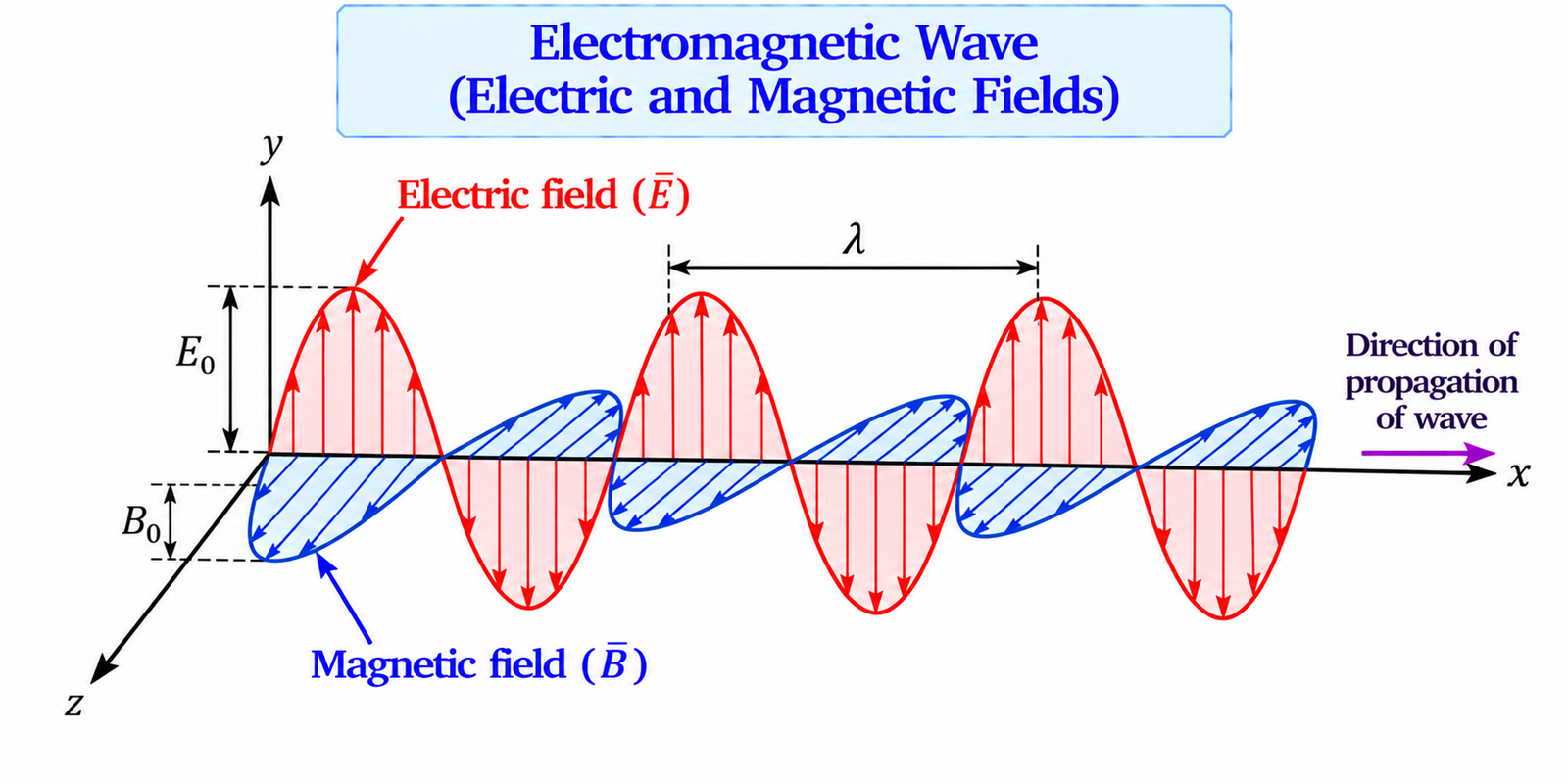
Electromagnetic waves are waves in which the electric field E and magnetic field B are perpendicular to each other. Both are also perpendicular to the direction of propagation of the wave.
2. Inconsistency of Ampere's Circuital Law or Maxwell's Assumption
According to Ampere's Circuital Law:
∮ B · dl = μ0I
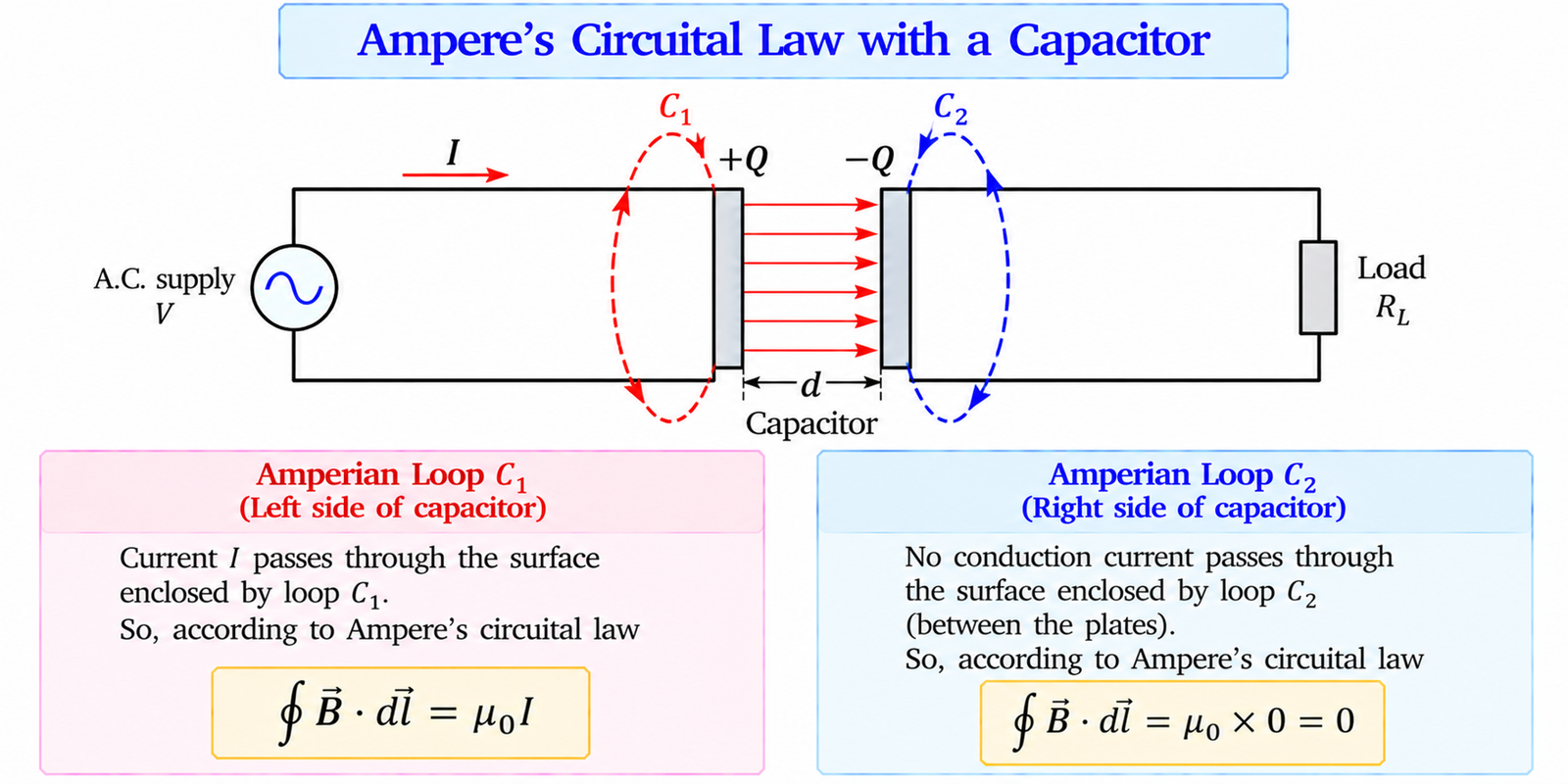
Consider a capacitor and assume two Amperian loops.
- C1: Just to the left side of the capacitor plate.
- C2: Just to the right of the capacitor plate.
For Loop C1
Applying Ampere's Circuital Law:
∮ B · dl = μ0I
For Loop C2
No conduction current passes through the space between the capacitor plates.
Therefore:
∮ B · dl = μ0 × 0
∮ B · dl = 0
Thus, the two results are inconsistent.
This shows the inconsistency of Ampere's Circuital Law for a capacitor.
3. Ampere-Maxwell Law – Improvement of Ampere's Circuital Law
To correct Ampere's Circuital Law, Maxwell considered a capacitor of capacitance C.
Let:
- d = separation between the plates
- I = flowing current
- V = potential difference across the plates
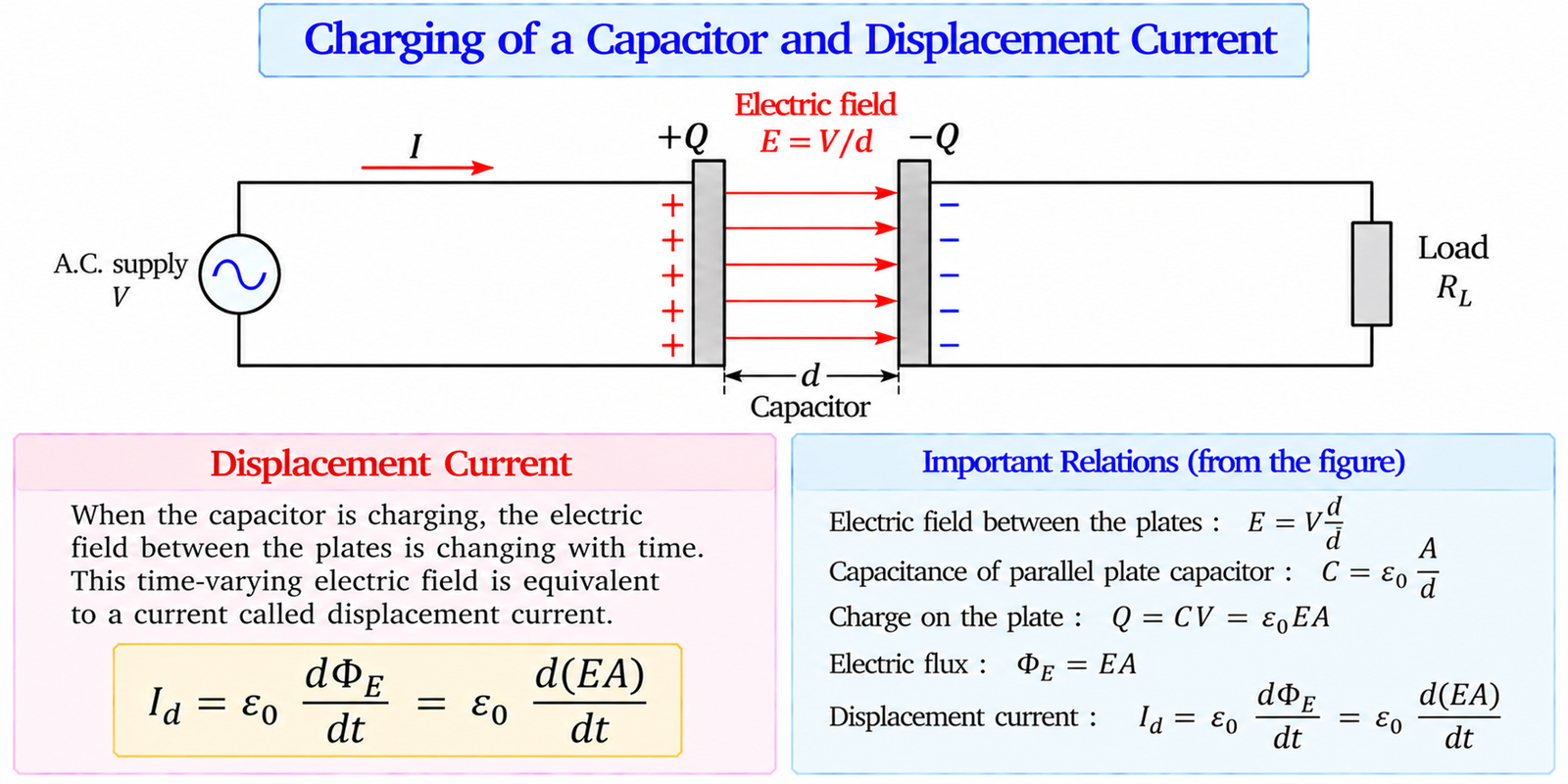
Since positive and negative charges exist on the two plates respectively, an electric field exists between the plates.
The electric field between the plates is:
E = V/d
We know:
C = Q/V
Therefore:
V = Q/C
Hence:
E = (Q/C)/d
For a parallel plate capacitor:
C = Aε0/d
Therefore:
E = Q/(Aε0)
Hence:
Q = EAε0
Since the capacitor gets charged and discharged, the amount of charge stored by the capacitor is variable.
Differentiating with respect to time:
dQ/dt = ε0 d(EA)/dt
Keep preparing
Available in the app
- Complete NotesConfirmed for this chapter
- Important QuestionsConfirmed for this chapter
- Previous Year QuestionsConfirmed for this chapter
- Revision NotesConfirmed for this chapter