Chapter 10
Wave Optics
Preview Wave Optics for Physics in JAC 12th (SCI.).
A quick look
Study material preview
Notes
Wave Optics
1. Huygens' Principle
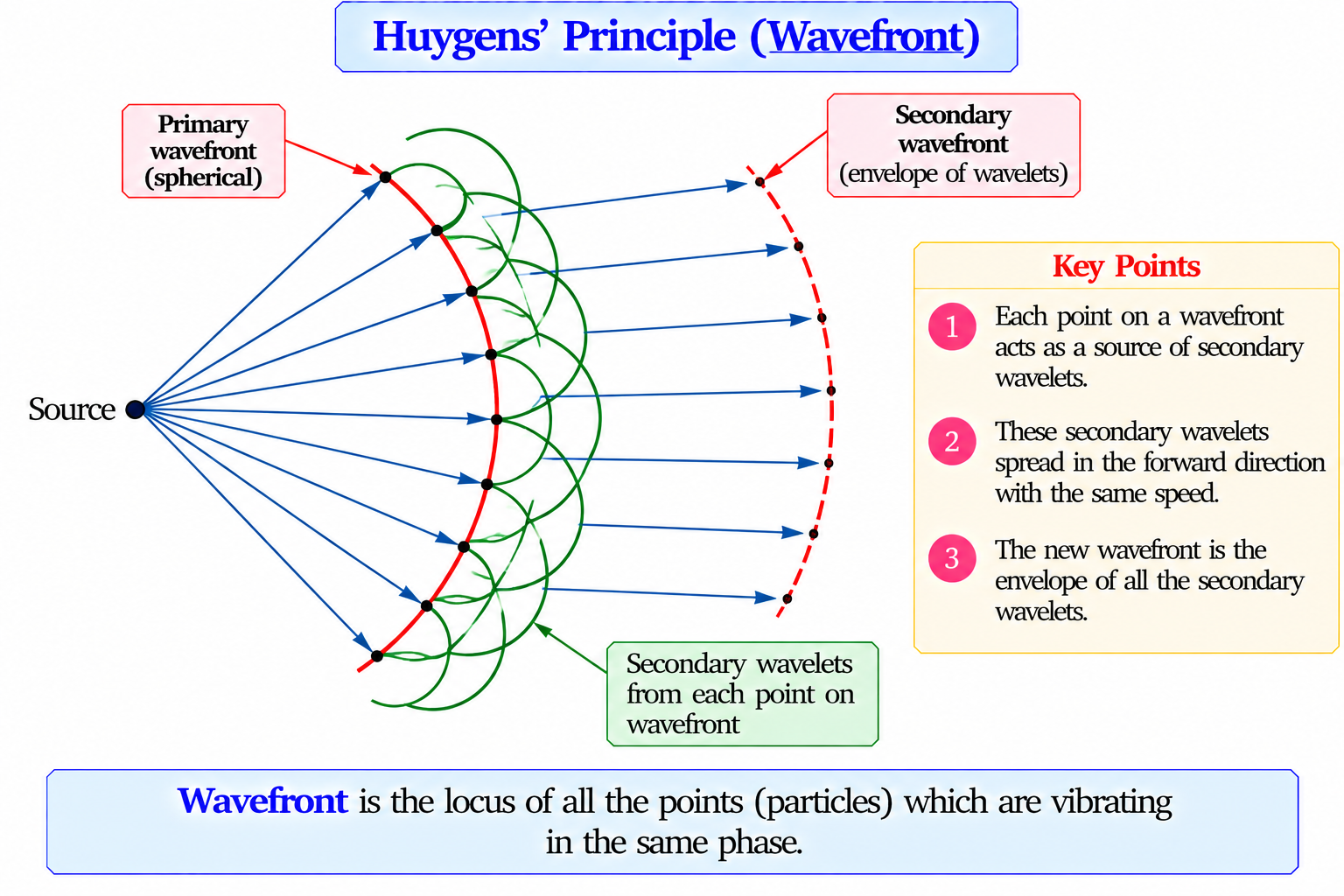
Wavefront: The locus of all the points (particles) which are vibrating in the same phase is called a wavefront.
Types of Wavefront
- Spherical wavefront – Point source
- Cylindrical wavefront – Linear source
- Plane wavefront – Infinite source
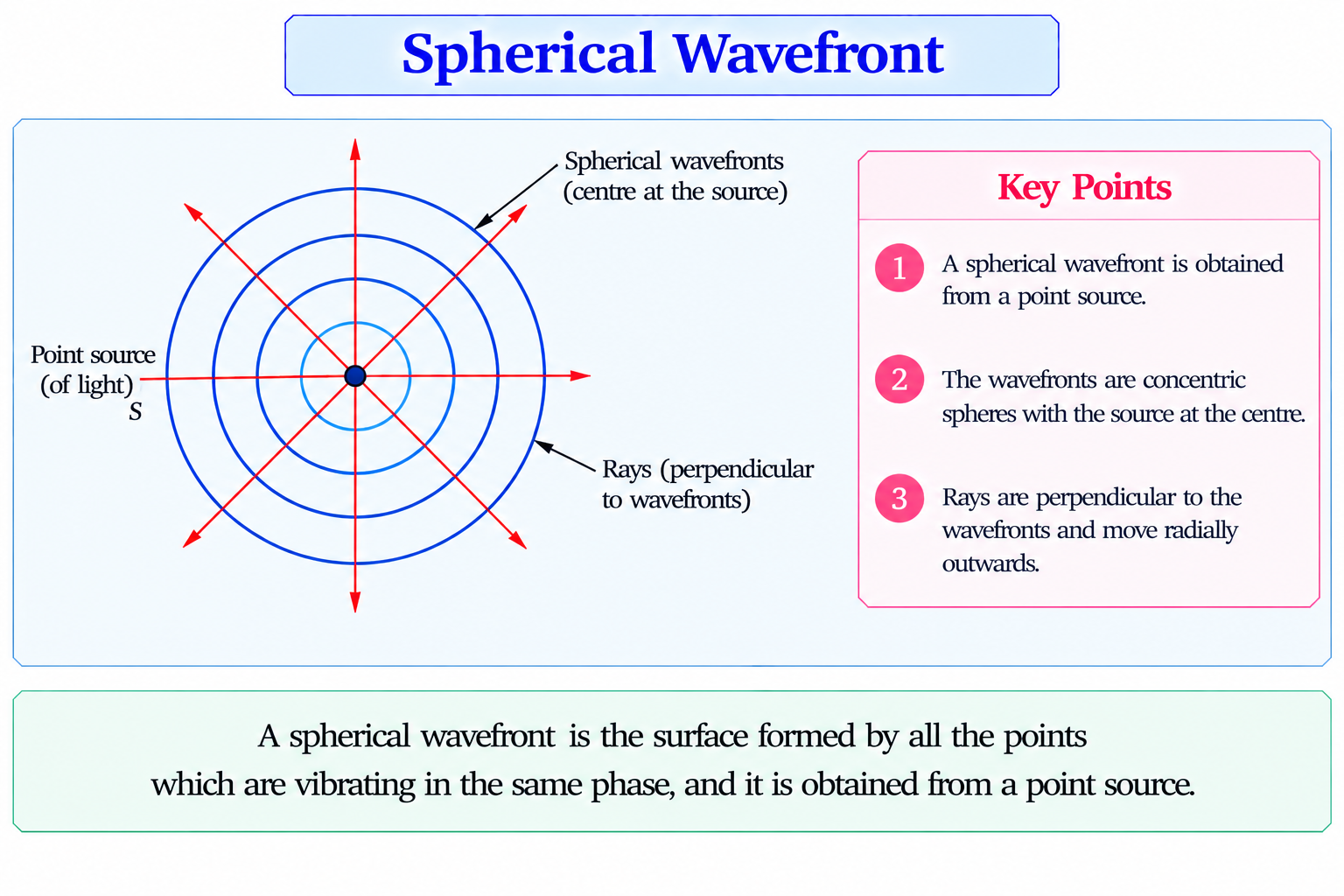
1.1 Spherical Wavefront
The wavefront obtained from a point source is known as a spherical wavefront.
1.2 Cylindrical Wavefront
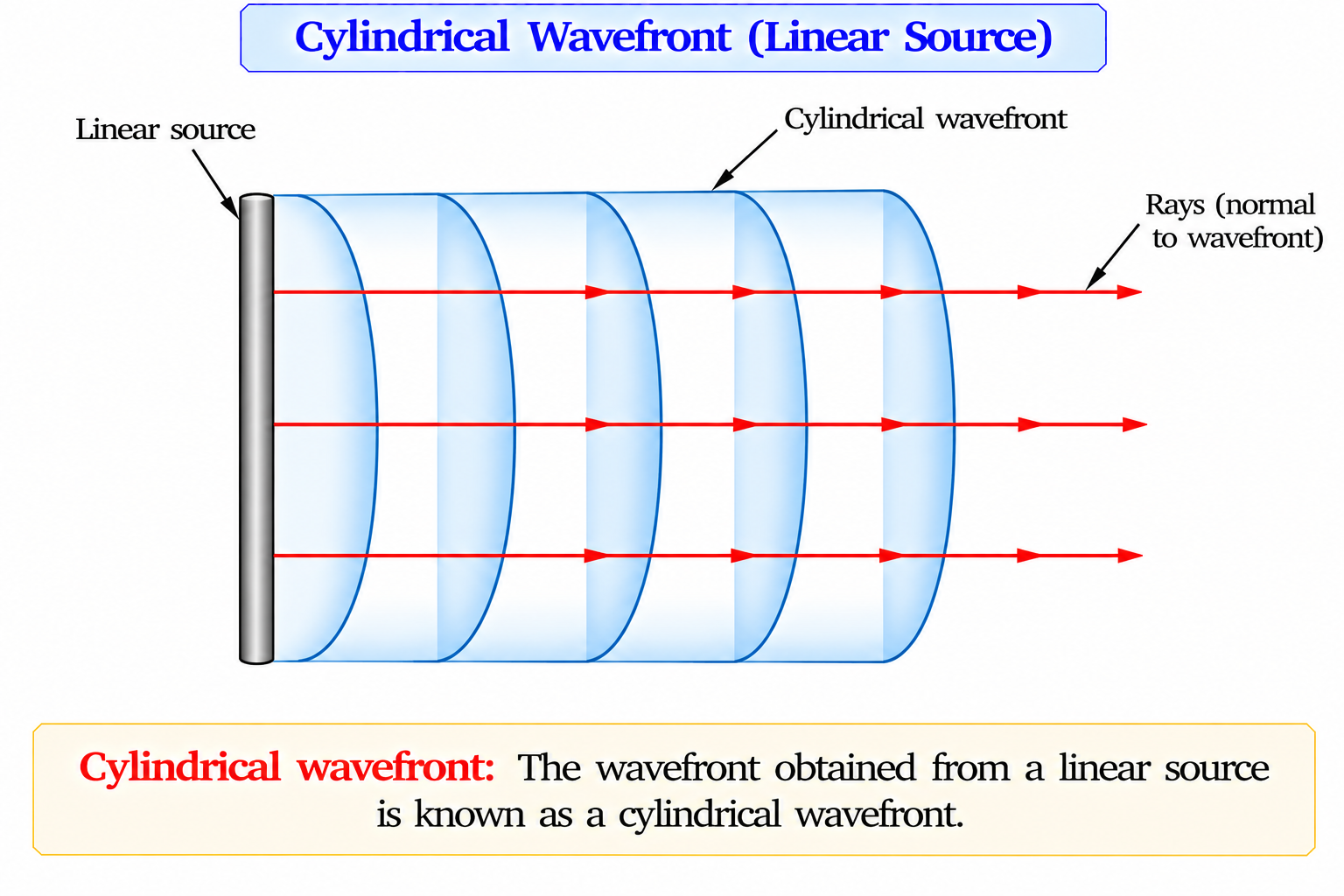
The wavefront obtained from a linear source is called a cylindrical wavefront.
1.3 Plane Wavefront
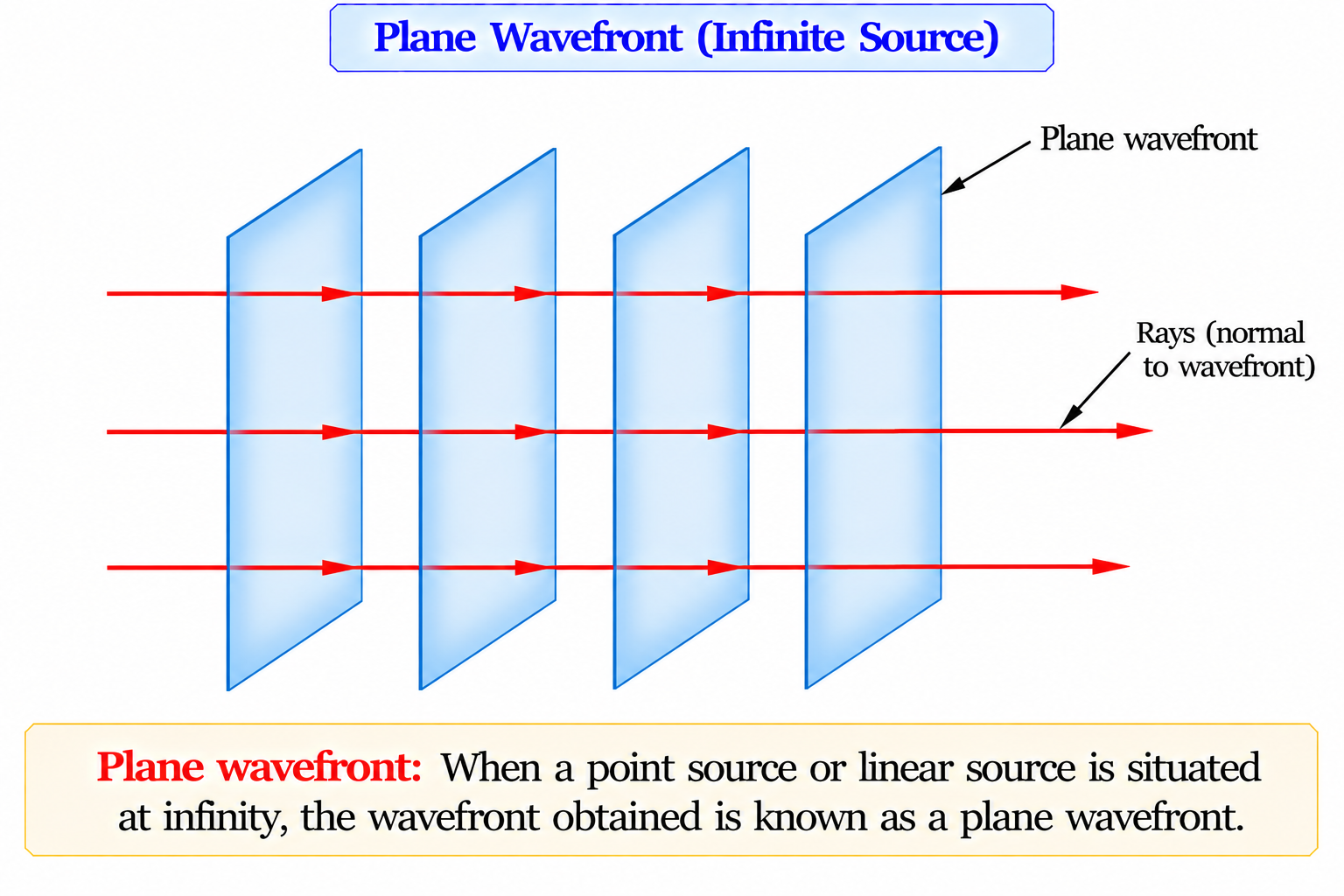
When a point source or linear source is situated at infinity, then the wavefront obtained from these sources is known as a plane wavefront.
2. Principles of Huygens
Huygens' principle is used to determine the position of a new wavefront.
First Principle
Each point on a wavefront is the source of a new disturbance (secondary wavefront).
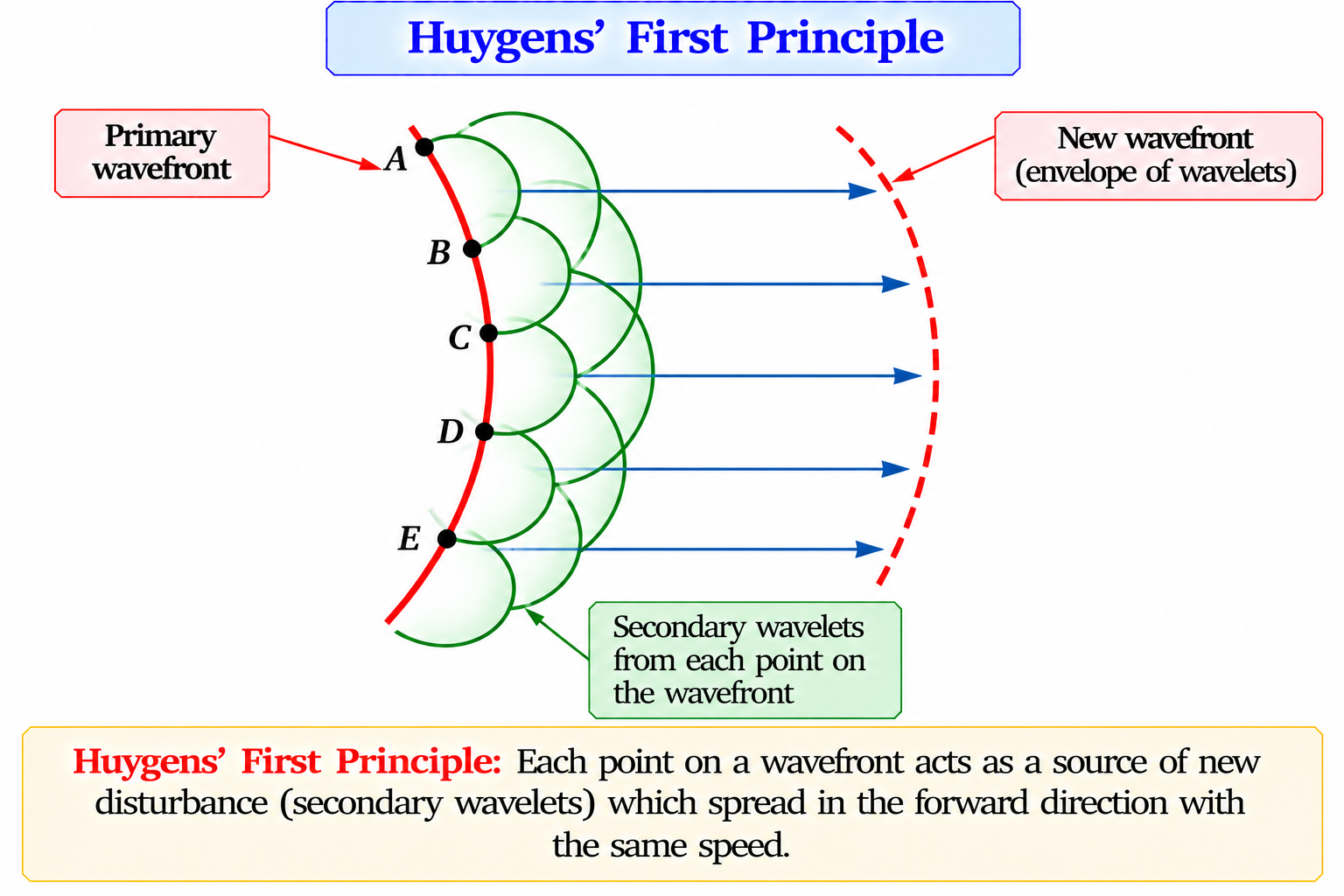
Second Principle
The secondary wavefront can be obtained by the envelope of all the wavelets in the forward direction.
Third Principle
All particles vibrating in the same phase with a plane speed are on a wavefront.
Ray: A line drawn perpendicular to the wavefront is called a ray.
3. Reflection of Light Using Huygens' Principle
Let us suppose AB is an incident wavefront which falls on a plane reflecting surface XY.
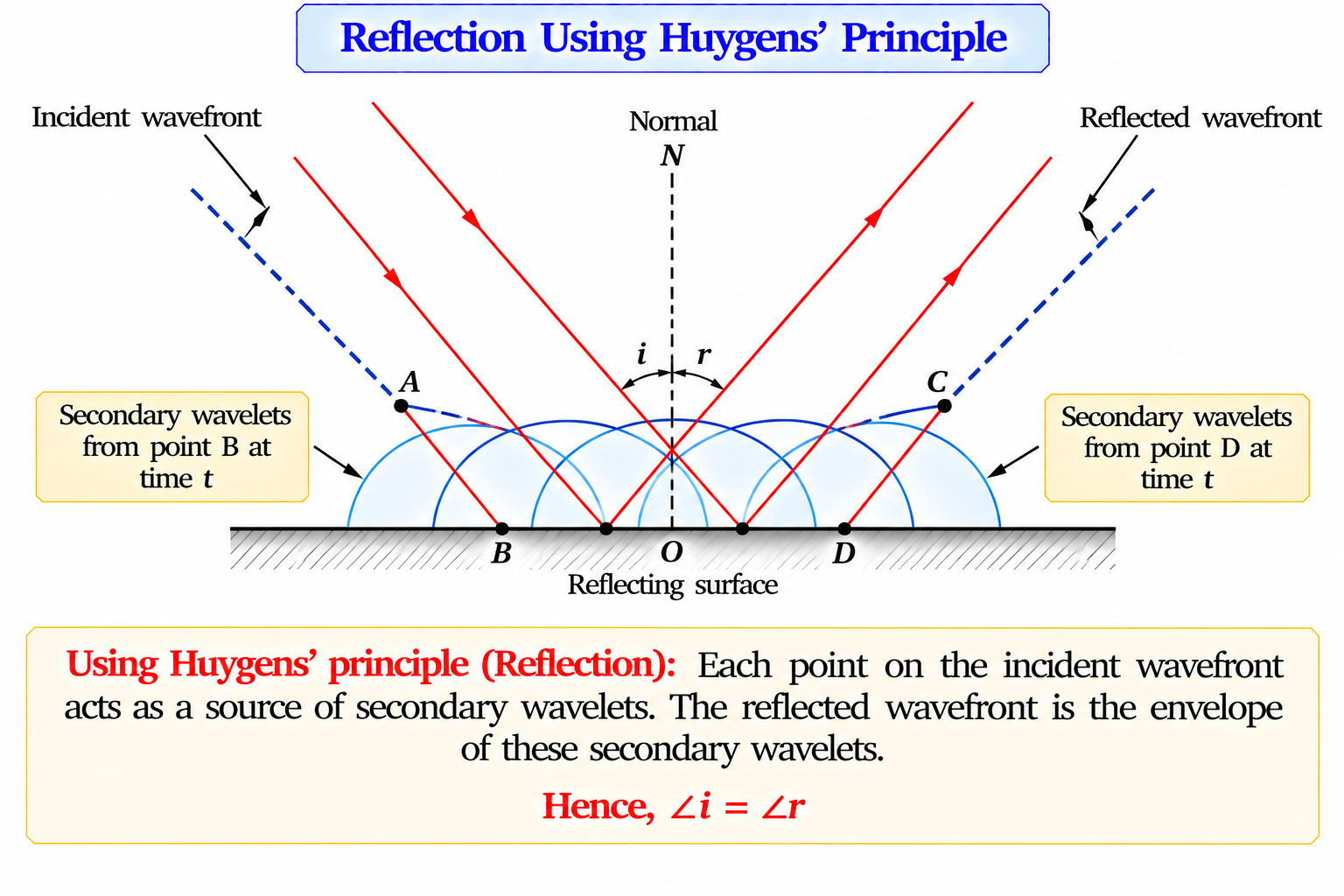
Let t be the time taken by the wavefront in reaching from B to C with speed v.
Let us take a radius equal to BC at point A and draw a circle and then draw a tangent CD.
According to Huygens' principle, each point on wavefront AB behaves as a source of secondary wavefronts.
Since ΔABC and ΔADC are similar (S.A.S.):
In ΔABC:
sin i = BC / AC
BC = AC sin i ...(i)
In ΔADC:
sin r = AD / AC
AD = AC sin r ...(ii)
Since BC = AD, from equations (i) and (ii):
AC sin i = AC sin r
∴ i = r
The incident wavefront, reflected wavefront and the normal at the point of incidence all lie in the same plane.
4. Refraction of Light Using Huygens' Principle
Let us suppose AB is an incident wavefront which falls on the interface XY.
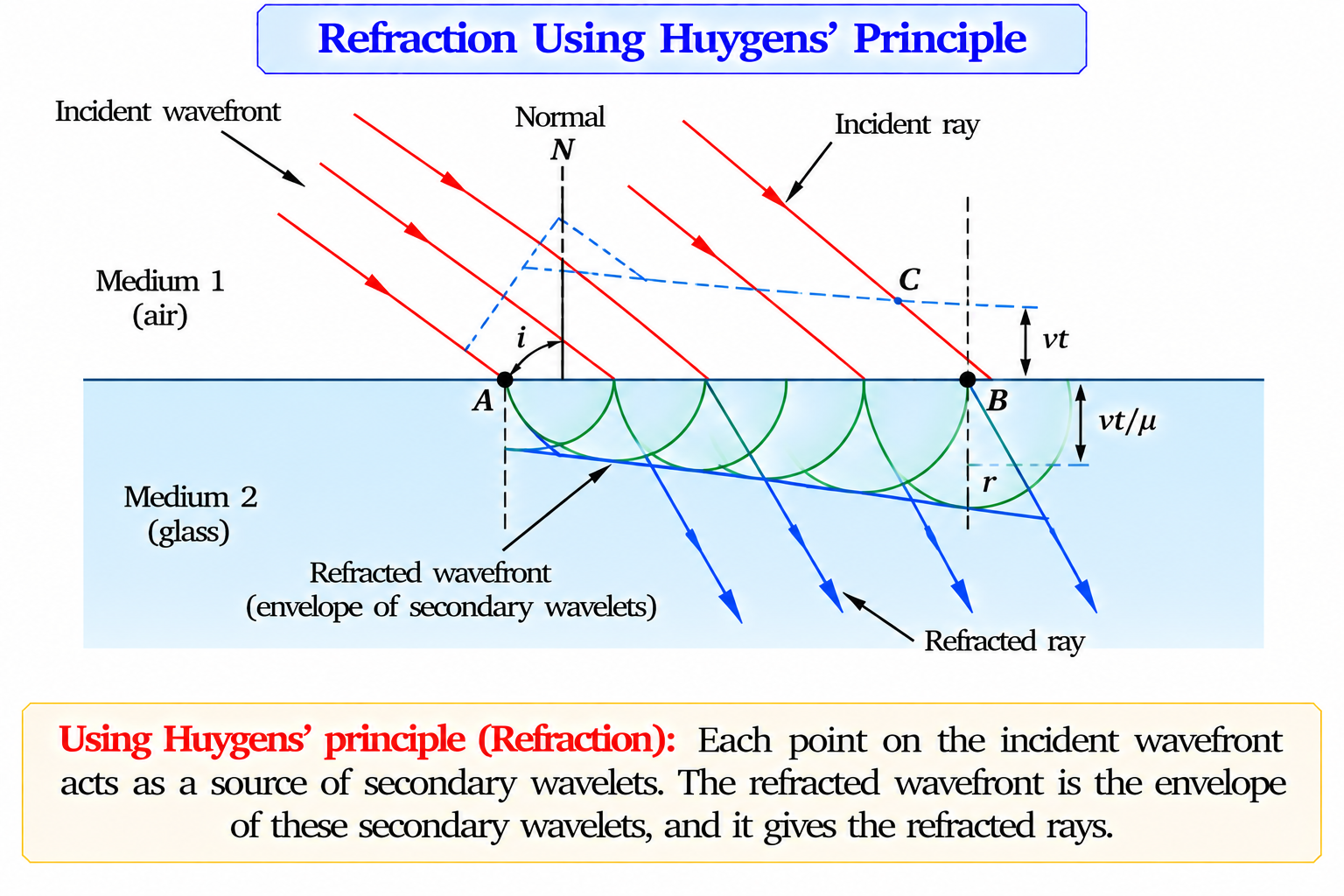
Let us suppose v₁ is the speed of the incident wave and v₂ is the speed of the refracted wave.
Keep preparing
Available in the app
- Complete NotesConfirmed for this chapter
- Important QuestionsConfirmed for this chapter
- Previous Year QuestionsConfirmed for this chapter
- Revision NotesConfirmed for this chapter